
Industrial Property Due Diligence: 12 Critical Checks
Industrial property due diligence is the verification process you complete between signing a purchase agreement and closing: confirming the income is real, the tenant’s use is legal, the building’s specifications support the rent being charged, and no environmental or title problem becomes yours at closing. For a warehouse or logistics asset, the short answer is that diligence must cover five things — the documents, the leases, the building, the environment and the numbers — in that order, inside a deadline your purchase agreement sets.
This checklist is written for U.S. investors buying leased industrial property, not for owner-users fitting out a factory. An investor’s questions are different: Is the rent roll true? Will the clear height, docks and floor load hold this tenant — and the next? What does the environmental report actually protect you from? The sections below walk that sequence, from day-one deadlines to the final decision.
What Industrial Property Due Diligence Means (and How It Differs from Other Commercial Assets)
Due diligence is the buyer’s investigation period: a defined window in which you examine everything the seller claims and can usually walk away — with your earnest money — if the findings do not match what you were sold. The universal framework behind those checks — title, zoning, leases, financials, physical condition, environmental review — is set out in our commercial real estate due diligence checklist template; this article covers only what changes when the asset is a warehouse, distribution building or light-industrial property.
Three things change. First, the income is concentrated: an industrial building often has one tenant, or a handful, where a retail centre has many — so if that lease is weaker than presented, the entire investment case moves. Second, the building itself is an income feature: clear height, dock doors, truck-court depth and floor load decide which tenants can occupy the space and what rent it commands, which is why the same characteristics drive value when you test pricing against commercial property comparables. Third, the environmental stakes are higher, because industrial sites carry longer histories of manufacturing, fuel and solvents.
Setting Deadlines and Deal Protections in the Purchase Agreement
Your diligence rights exist only because the purchase agreement creates them. Before you sign, confirm four protections are written in.
First, a diligence period long enough to run the work: environmental reports, surveys and estoppels depend on third parties, so the period must cover ordering a Phase I, receiving it, and still having time to act. Second, a document-delivery obligation with a clock — leases, statements, contracts and reports due within a set number of days — because a period spent waiting for documents is wasted. Third, extension and termination rights: extend, typically for a fee or added deposit, if a report is delayed; terminate within the period if findings are unacceptable. Fourth, access rights for you and your consultants to inspect the roof, slab, systems and the tenant’s operation on reasonable notice.
Keep an exception log from day one — every issue found, who owns it, whether it is resolved, repriced or accepted — and work backwards from the expiry date, because the findings that matter most arrive last. A diligence period is not a reading period; it is a decision deadline with paperwork attached.
The First-Week Document Request List for an Industrial Deal
Everything you verify later depends on documents you request now. Send the list in the first week, in writing, and log what arrives:
- Leases and amendments — every executed lease, amendment, guaranty, commencement-date letter and side letter, plus correspondence about defaults, options or disputes.
- Rent roll and collections — the current rent roll plus evidence of actual collections (bank deposits or a collections ledger), not just scheduled rent.
- Operating history — trailing-12-month (T-12) operating statements and year-to-date figures, with the detail behind recoveries and the most recent CAM reconciliation per tenant.
- Title and survey materials — the seller’s title policy, any prior survey, and easements of record.
- Physical records — roof reports and warranties, prior property condition reports, sprinkler and fire-system inspection records, certificates of occupancy, and recent capital-improvement invoices.
- Environmental records — any prior Phase I or Phase II reports, regulatory correspondence, and spill or remediation records.
- Service and compliance files — service contracts that survive closing, insurance loss history, and zoning correspondence.
A missing document is itself a finding: if the seller cannot produce the executed lease behind a rent-roll line, that line is unverified income, and should be priced as such.
Title, Survey and Access: Easements, Rail and Truck Routes
Title review works as it does for any commercial asset, but the survey deserves extra attention: industrial value runs on access — a warehouse is worth what trucks can reach, and the survey proves the reaching is legal.
Order a current survey built to the ALTA/NSPS Land Title Survey standards — the 2026 standards took effect February 23, 2026, so confirm your surveyor works to the current version. On the survey and title commitment together, verify:
- Vehicular access and truck routing — docks and truck courts connect to a public road by a legal route, not by habit across a neighbour’s parcel; check access easements, shared drives and any truck-traffic restrictions.
- Easements that cut both ways — utility, drainage and rail easements can limit where you can expand, pave or build. Read them; do not just schedule them.
- Rail service, if claimed — if the price reflects a rail-served building, confirm the spur exists, who maintains it, and whether the service agreement transfers.
- Encroachments and setbacks — outside storage, trailer parking and tenant improvements often creep beyond lot lines or into setbacks; the survey surfaces that while it is still the seller’s problem.
- Flood and drainage — confirm the flood designation and how stormwater is handled on site.
Zoning Verification: Is the Tenant’s Use Actually Legal?
For most commercial assets, zoning diligence confirms the building can be used as intended. For industrial property the sharper question is narrower: is what this tenant actually does a permitted use, right now, under current zoning?
Get a zoning verification letter from the municipality and test three things. First, the use itself: warehousing, light manufacturing, distribution, truck terminal and outdoor storage are frequently different use categories with different permissions, and a tenant’s real operation may sit in a different category than the lease’s stated use. Second, nonconformity: a use legal when it started may be legal-nonconforming today, restricting expansion, rebuilding after a casualty, or a change of tenant — and lenders and insurers treat nonconformity very differently. Third, operational conditions: outside storage, trailer parking, hazardous-materials storage and operating hours are commonly conditioned or prohibited even where the headline use is allowed, and a tenant in breach transfers that compliance problem to you with the building.
Also check the tenant’s permits and any open code or fire violations. If the tenant’s use is not legal, the lease behind your income may not be enforceable as written — a finding for the reprice-or-walk-away conversation, not for a file.
Environmental Review: Phase I, Phase II and Liability Protection
Start environmental review first, because it has the longest lead time and the most fixed steps. A Phase I report has a shelf life, and a Phase II — if one is needed — can take weeks. Build both into your diligence period.
Phase I Environmental Site Assessment is an investigation, not a lab test: records review, interviews with owners and occupants, and a site inspection, looking for what the standard calls Recognized Environmental Conditions — past or present releases, or conditions indicating a release, of hazardous substances or petroleum. It rarely involves sampling.
The legal point matters as much as the findings. Under the federal Brownfields Act of 2002, a buyer who conducts “All Appropriate Inquiries” before acquiring a property can claim protections against liability under CERCLA (the Superfund law) for contamination that pre-dates the purchase. A Phase I done to the current ASTM standard, E1527-21, is how a buyer satisfies that requirement — provided it is done before closing, by a qualified environmental professional, and with a reliance letter naming the buyer. A Phase I that is out of date, or that someone else ordered and you never got reliance on, may not protect you.
Phase II is triggered when the Phase I identifies a Recognized Environmental Condition. It adds sampling — soil, groundwater or vapour — to confirm whether contamination exists and how far it extends. If a Phase II is recommended and the seller will not allow it, or the diligence period expires before it is done, the liability question remains open; price that risk explicitly, or walk away. For an industrial asset, “we skipped it” can become the most expensive sentence in the deal.

Inspecting the Building Shell: Roof, Structure and Floor Load
Commission a property condition assessment from an engineer who knows industrial buildings, and walk the property during operating hours — a quiet warehouse hides what a working one reveals: dock congestion, inadequate lighting, drainage issues and how the tenant actually uses the space.
Roof. The roof is usually the largest near-term capital item in an industrial purchase. Get the roof’s age, the remaining warranty (and whether it transfers), and a core-cut or infrared survey if the age or condition suggests it. A roof with five years left is a negotiation, not a surprise — but only if you priced it before closing.
Structure and envelope. Look for signs of settlement, wall-panel distress, and column or truss damage from forklift or truck impacts. Check the envelope for leaks and insulation: an uninsulated warehouse with a tenant who needs temperature control is a different building from the one in the brochure.
Floor load and slab. Confirm the slab’s load capacity in pounds per square foot (psf) and its condition — cracking, joint deterioration and patching tell you how hard the floor has worked. Floor load is a specification, not a cosmetic issue: it is covered in more detail in the next section because it directly limits the tenant’s racking and storage.
The Specifications That Set Industrial Value: Clear Height, Docks, Truck Courts and Power
Two warehouses with identical square footage can command very different rents — and the difference is specifications. Verify each by measurement or documents, never by the marketing brochure:
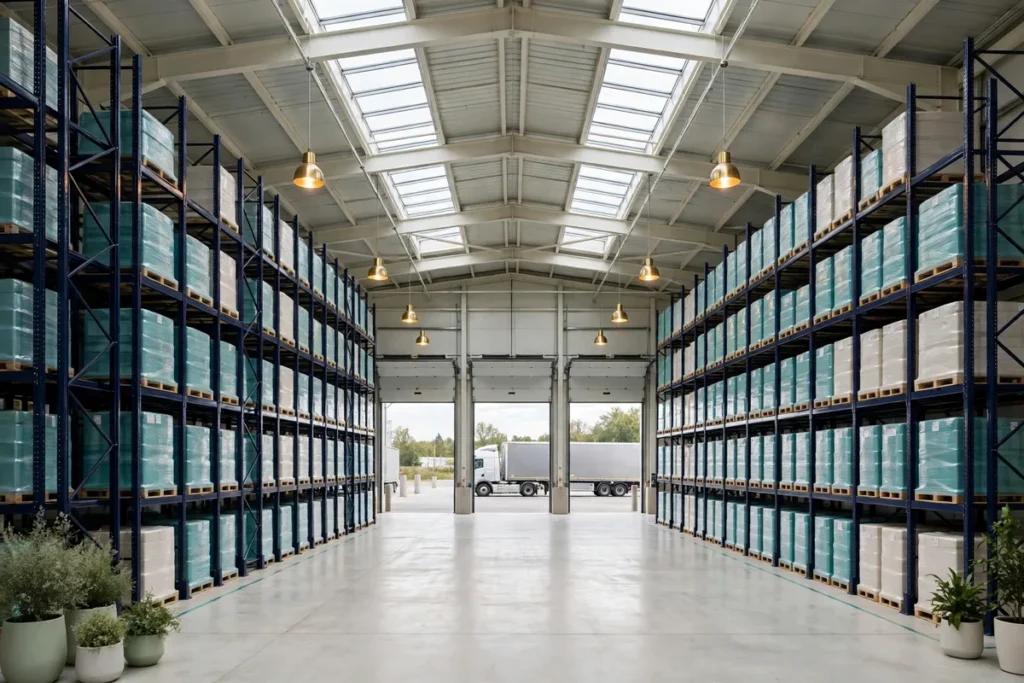
- Clear height — the usable height from floor to the lowest obstruction (truss, sprinkler or light), measured at the lowest point, not the advertised peak. A few feet decide whether modern racking fits.
- Column spacing — wider spacing means more flexible racking and fewer blocked bays; note it alongside clear height, because the two together set the usable cube.
- Loading — dock doors and drive-in doors, their dimensions and count, and then stand in the truck court: its depth determines whether a trailer can manoeuvre and park, or whether dock access is a daily compromise.
- Floor load — the slab’s rated capacity in psf, and whether it supports the tenant’s racking and stored goods.
- Power capacity — the electrical service in amps and voltage, and whether the tenant’s operation (charging, refrigeration, manufacturing) can run on it or needs an upgrade.
- Rail service — where claimed, the spur, its condition and the service arrangement, as covered in the title section.
Record these on a one-page fact sheet for the building — it becomes your pricing tool and your letting tool, because the next tenant will ask exactly the same questions.
Fire Protection and Life Safety: ESFR and Sprinkler Adequacy
A warehouse sprinkler system is designed for a particular occupancy and storage arrangement. Change the tenant or the stored goods, and the system that was adequate may no longer be.
Establish four things. First, what system is installed — ESFR (Early Suppression, Fast Response) or a conventional sprinkler system — and what it was designed to protect. Second, whether the design matches the current storage: commodity type, rack height and storage arrangement. Third, the inspection record: whether the system has been tested and maintained, and whether any deficiencies are open. Fourth, the insurer’s view: a system that does not match the occupancy can raise premiums or, in extreme cases, affect cover.
Upgrading a sprinkler system is a major capital cost, so price any correction into the deal before closing, not after you discover the tenant’s goods exceed the system’s design.
Reading Industrial Leases as Income Documents
An industrial lease is not a legal formality attached to a building; it is the income document you are actually buying. Read every lease against the rent roll, and read every clause that can change the rent, the term or the tenant’s obligations.
The risks here differ from retail, where multiple tenants dilute a single failure — here, one tenant’s default can be the whole income. For comparison, see how those risks are weighted in our retail property due diligence checklist. For industrial leases, verify these items in each lease:
- Term and WALT — the remaining term, and the weighted average lease term across the building, so you know when income is at risk of expiry or renegotiation.
- Escalations — verify rent as escalated to today, not the headline rent at signing; confirm the escalation mechanism (fixed steps, CPI-linked or market review) and when the next increase falls.
- Expense structure — whether the lease is gross, net or triple-net (NNN), what is recoverable, and what caps or exclusions apply to recoveries.
- Options and rights — renewal options, expansion rights, rights of first refusal, and termination or break options that can shorten the term you are paying for.
- Use and compliance clauses — the permitted use, restrictions on hazardous materials, and obligations to comply with environmental law.
- Transfer and credit — assignment and change-of-control provisions, and the tenant’s credit: the tenant is the income, so check financial statements and payment history where available.
- Estoppels and SNDAs — estoppel certificates confirming the lease terms and that no defaults exist, and subordination, non-disturbance and attornment agreements (SNDAs) where a lender is involved.
Verifying the Rent Roll, Recoveries and Operating Cash Flow
Now rebuild the numbers from source documents. The rent roll is a claim; the leases and the collections are the evidence. Match all three, tenant by tenant: rent roll against leases against actual collections. Where they disagree, believe the collections, then the leases, and the rent roll last.
Work in order. First, verify base rent and escalations from the executed leases, including any free-rent periods or abatements still running. Second, audit recoveries: are CAM, tax and insurance recoveries actually billed, actually collected, and actually permitted by the lease — or are disallowed expenses inflating the recovery ratio? Third, rebuild operating expenses from the T-12s and service contracts, separating owner costs that a buyer will not bear from tenant-recoverable costs. Fourth, calculate verified net operating income (NOI = Effective Gross Income — Operating Expenses) and test it against the seller’s figure; the gap is often the deal. See our guide to commercial property operating cash flow for the full calculation.
A worked example shows why this matters. A warehouse priced at $7,200,000 on a seller’s NOI of $480,000 implies a 6.67% cap rate. If your audit finds $28,000 of recoveries the leases do not allow, verified NOI falls to $452,000 — and at the same cap rate the value is $6,780,000, a $420,000 difference. Add a $185,000 roof replacement the seller’s figures ignored, and you have $605,000 of findings. That is the diligence discount, documented line by line.

Market, Location and Logistics Checks (Labour, Transport, Competing Supply)
The building does not operate in isolation. Four market checks complete the picture before you price the deal.
Transport access. Distance to motorways, ports, rail and air freight, and the quality of the last-mile road network, determine whether logistics tenants will stay and what they will pay.
Labour. Warehouse operations are labour-intensive. Check the local labour pool, wage levels and competing employers — a building in a tight labour market faces higher tenant costs and higher vacancy risk.
Competing supply. New industrial construction in the submarket can cap rents and extend re-letting times. Check what is under construction, what is planned, and what comparable space is available now.
The tenant’s position. Is this tenant’s business growing, stable or shrinking? Does it have other locations it could consolidate into? A tenant with alternatives has negotiating leverage at renewal that the rent roll does not show.
Turning Findings into a Decision: Reprice, Cure, Extend or Walk Away
At the end of the diligence period, sort your exception log into four outcomes — and record the decision, with reasons, for every item.
Proceed as agreed. The findings are immaterial, or were already reflected in the price.
Reprice. Reduce the price by the cost of the findings — verified NOI shortfalls, roof or sprinkler capital, or environmental risk — documented line by line, as in the worked example above.
Cure or condition. Require the seller to fix the problem, or to fund an escrow for it, before closing. Put the cure in writing with a deadline; verbal cures expire.
Extend or walk away. If a Phase II, a zoning ruling or an estoppel is still outstanding, extend the period; if the findings are unresolvable — unverified income, illegal use, environmental liability — walk away inside the period and protect your deposit. A known problem at full price is the most expensive.
People Also Ask
The purchase-agreement deadlines; a first-week document request (leases, rent roll, T-12s, title and survey materials, environmental records); title and access checks; zoning confirmation for the tenant’s actual use; a Phase I environmental assessment; roof, structure and floor-load inspection; specification verification (clear height, docks, truck courts, power); fire-protection adequacy; a lease audit; and a rent-roll check against leases and collections — ending in a documented decision.
A Phase I is a research-and-inspection process — records review, interviews and a site visit — that identifies Recognized Environmental Conditions; it rarely involves sampling. Done to ASTM E1527-21, it satisfies the EPA’s All Appropriate Inquiries requirement behind CERCLA buyer protections. A Phase II follows when a Phase I finds such a condition, adding soil, groundwater or vapour sampling to confirm contamination and its extent.
As long as your purchase agreement allows — the period is contractual, not fixed by law. It must cover leases and financials, a Phase I (and acting on it), survey and zoning confirmation, the inspection, and estoppels. Delivery deadlines, extension rights and an in-period termination right are the buyer’s protections.
Clear height, column spacing, loading (dock doors, drive-in doors, truck-court depth), floor load in psf, and power capacity — plus rail service and sprinkler infrastructure where present. These decide which tenants can occupy the building and what rent it commands, and they drive comparisons of industrial value — verify each by measurement or documents.
Key Takeaways
- Industrial due diligence verifies five things, in order: documents, leases, the building, the environment and the numbers — inside a deadline your purchase agreement sets.
- Because industrial income is concentrated in one or a few tenants, rebuild the rent roll from leases and collections, and price any shortfall.
- A Phase I done to ASTM E1527-21 before closing, with a reliance letter, is what supports CERCLA buyer protections under All Appropriate Inquiries; a Phase II follows when a Recognized Environmental Condition is found.
- Specifications are income: clear height, column spacing, loading, floor load and power decide which tenants a warehouse can serve and what rent it commands — verify them, never brochure them.
- Every finding ends in one of four decisions — proceed, reprice, cure or walk away — recorded in an exception log before the diligence period expires.
- The checks in this article are asset-agnostic in structure: the master template linked in the first section covers the universal framework, and CalcLandlord’s calculators can help you test the numbers once your verified NOI is in hand.
Disclaimer: This article is for educational and informational purposes only and does not constitute legal, tax, accounting or financial advice. Laws and regulations vary by state and locality, and individual circumstances differ; consult a qualified professional — such as an attorney, environmental consultant or accountant — before acting on any matter discussed here.
