

How to Calculate Operating Cash Flow for a Commercial Property
Understanding how much cash a commercial property actually generates is essential before purchasing an investment, refinancing a building, or evaluating its long-term profitability. A property may appear profitable on an income statement while producing less cash than expected because of unpaid rent, operating expenses, and payment timing.
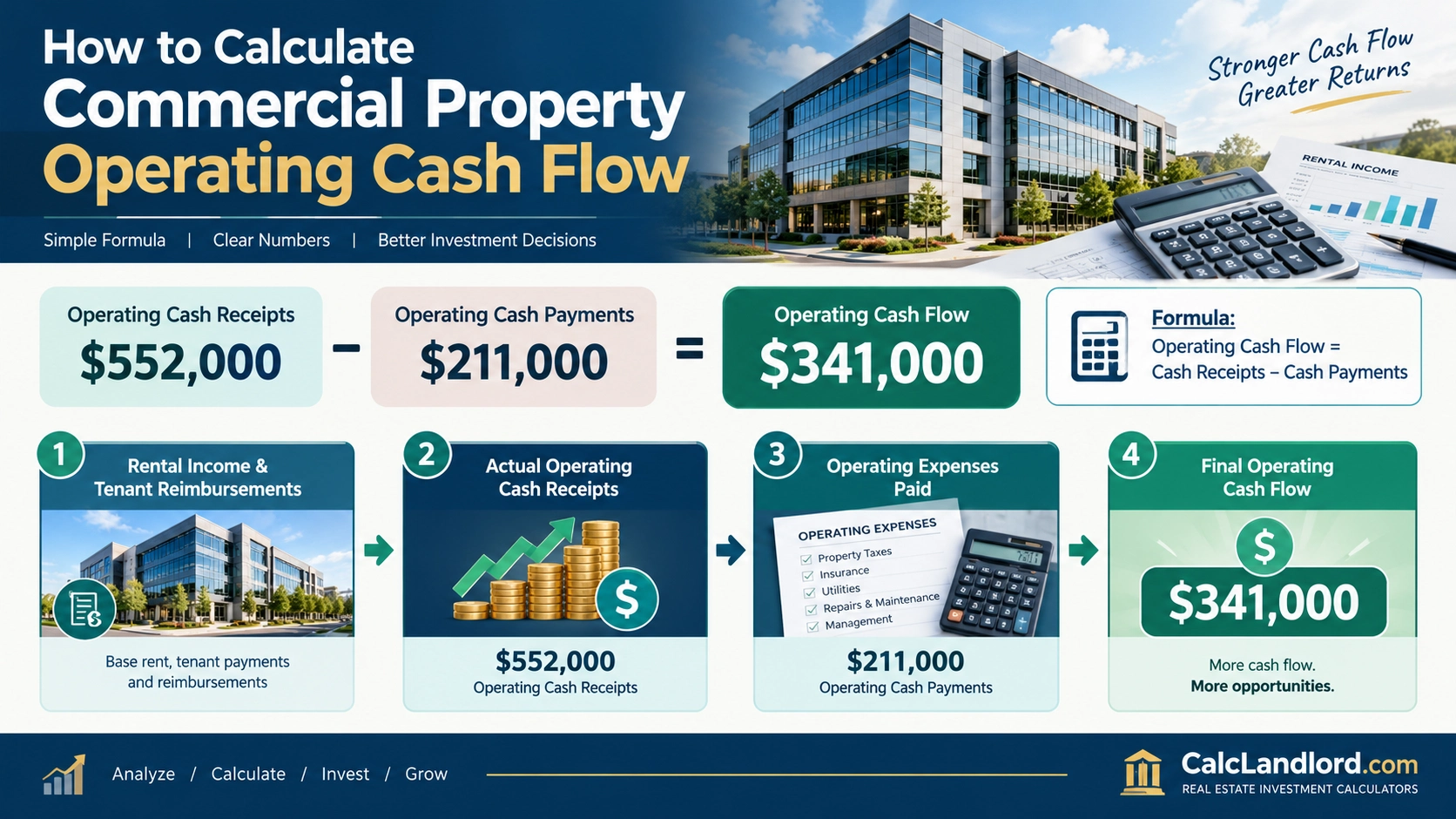
To calculate operating cash flow for a commercial property, subtract actual operating cash payments from actual operating cash receipts during the same reporting period.
\[ \text{Operating Cash Flow} = \text{Operating Cash Receipts} – \text{Operating Cash Payments} \]
For example, suppose a commercial building collects $552,000 in rent, tenant reimbursements, and other operating income and pays $211,000 in operating expenses. Its property-level operating cash flow is $341,000 before debt service, capital expenditures, and owner income taxes.
However, operating cash flow is not always the same as net operating income (NOI). NOI measures property operating performance under the accounting or underwriting basis used, while operating cash flow focuses on actual money collected and paid.
This guide explains how to calculate both figures, reconcile their differences, evaluate commercial lease structures, and determine how much cash remains after financing and capital improvements. It also includes a practical example and a spreadsheet layout that landlords and commercial real estate investors can use.
1. What Is Operating Cash Flow in Commercial Real Estate?
Operating cash flow (OCF) measures the actual cash generated by a commercial property through its normal rental operations during a specific period.
It helps landlords and commercial real estate investors understand how much money the property produces after collecting tenant payments and paying recurring operating expenses.
For example, a shopping center may generate income from several sources:
- Monthly base rent from retail tenants.
- Common Area Maintenance (CAM) reimbursements.
- Parking fees.
- Storage rental income.
- Percentage rent from qualifying retail leases.
- Other property-related operating receipts.
Its operating cash payments may include property taxes, insurance, utilities, maintenance, landscaping, cleaning, security, and property management fees.
The basic calculation is:
\[ OCF = \text{Operating Cash Inflows} – \text{Operating Cash Outflows} \]
What does operating cash flow tell a landlord?
Operating cash flow helps answer three important questions:
- Are tenants actually paying the rent and other charges they owe?
- Is the property generating enough cash to cover its regular operating requirements?
- Is the property’s reported income translating into real cash generation?
Consider a commercial property reporting $300,000 in NOI. That figure may look attractive, but suppose tenants have paid only $280,000 of the operating income recorded during the same period.
The difference deserves investigation. It could reflect outstanding tenant receivables, collection problems, or timing differences.
The distinction becomes especially important when purchasing an existing commercial property. A seller’s projected income should not automatically be treated as money the new owner will collect.
Important: This article uses a property-level, pre-financing and pre-capital-expenditure definition of operating cash flow. It is an investment analysis measure, not a substitute for a complete entity-level financial statement prepared under U.S. accounting requirements. Different commercial real estate reports and underwriting models may use different definitions, so always identify the metric being presented. LoopNet+1
2. What Is the Commercial Property Operating Cash Flow Formula?
The most straightforward commercial property operating cash flow formula subtracts actual operating cash payments from actual operating cash receipts.
\[ \boxed{OCF = OCR – OCP} \]
Where:
- OCF: Operating cash flow.
- OCR: Operating cash receipts.
- OCP: Operating cash payments.
For property-level analysis, receipts generally include collected rent and operating reimbursements, while payments include cash actually paid for regular property operations.
Direct method formula
\[ OCF = \text{Cash Collected} – \text{Cash Operating Expenses Paid} \]
This method uses actual transactions during the reporting period.
Indirect method formula
When starting with accrual-based NOI, adjust for changes in operating working capital:
\[ \begin{aligned} OCF ={}& NOI\\ &-\text{Increase in Receivables}\\ &-\text{Increase in Prepaid Expenses}\\ &+\text{Increase in Operating Payables}\\ &\pm\text{Other Relevant Adjustments} \end{aligned} \]
This is a simplified property-level reconciliation. The correct adjustments depend on the accounting records, relevant balance-sheet accounts, and reporting period.
Example: Basic operating cash flow calculation
Suppose a commercial office building has the following annual transactions:
| Operating item | Annual amount |
|---|---|
| Rent collected | $420,000 |
| Tenant reimbursements collected | $90,000 |
| Parking income collected | $18,000 |
| Total operating cash receipts | $528,000 |
| Property taxes paid | ($65,000) |
| Insurance paid | ($22,000) |
| Utilities paid | ($28,000) |
| Repairs and maintenance paid | ($31,000) |
| Property management paid | ($20,000) |
| Total operating cash payments | ($166,000) |
Therefore:
\[ OCF = \$528,000-\$166,000 \]
\[ \boxed{OCF=\$362,000} \]
The property generates $362,000 in annual operating cash flow before financing and capital expenditures.
What should you exclude from this formula?
For this property-level calculation, show the following items separately:
| Item | Treatment |
|---|---|
| Mortgage principal | Exclude from OCF |
| Mortgage interest | Exclude from this pre-financing measure |
| Major capital improvements | Show below OCF |
| Owner’s personal income taxes | Show separately |
| Depreciation | Noncash expense; exclude from direct cash payments |
| Tenant security deposits | Do not treat as rental income |
Debt service and capital requirements still matter. They simply belong in the next stages of the cash-flow analysis. jpmorgan.com+1
3. Operating Cash Flow vs. NOI vs. Cash Flow After Debt Service
Operating cash flow, net operating income, and cash flow after debt service describe different aspects of a commercial property’s financial performance.
Although investors sometimes use the terms loosely, confusing them can lead to inaccurate investment decisions.
| Metric | What it measures | Main purpose |
|---|---|---|
| Net Operating Income (NOI) | Property income less operating expenses | Property valuation and performance |
| Property Operating Cash Flow | Actual operating cash received less operating cash paid | Actual cash generation |
| Cash Flow After Debt Service | Cash remaining after scheduled loan payments | Financing assessment |
| Cash Available to Equity | Cash remaining after specified financing, capital, leasing, and reserve deductions | Investor cash analysis |
Understanding the difference with an example
Assume a commercial retail property has:
| Financial metric | Amount |
|---|---|
| Effective gross income | $564,000 |
| Accrual-based operating expenses | ($216,000) |
| Net operating income | $348,000 |
| Actual property operating cash flow | $341,000 |
| Annual mortgage payments | ($180,000) |
| Cash flow after debt service | $161,000 |
The property has $348,000 in NOI but generates $341,000 in actual operating cash.
After mortgage payments, the remaining cash is $161,000.
These figures answer different investment questions.
Why NOI matters
NOI helps investors compare properties without allowing different financing structures to distort the property’s operating performance.
It is also commonly used to estimate commercial property value through capitalization rates.
\[ \text{Property Value}=\frac{NOI}{\text{Capitalization Rate}} \]
For instance, if a property produces $348,000 in NOI and comparable-property underwriting supports an illustrative 7% cap rate:
\[ \text{Estimated Value}= \frac{\$348,000}{0.07} =\$4,971,429 \]
This is an illustrative valuation calculation, not an appraisal or guaranteed market value. jpmorgan.com+1
Why operating cash flow matters
Operating cash flow tells you whether reported property income is becoming actual cash.
A building with strong NOI but consistently late-paying tenants may experience cash shortages despite apparently healthy operating performance.
Why cash flow after debt service matters
Mortgage obligations can significantly reduce the money available to the owner.
Two commercial properties with similar NOI may produce different investor cash flows because they have different loan balances, interest rates, amortization schedules, and capital requirements.
The best approach is to calculate and label all three measures separately.
4. What Documents Do You Need to Calculate Operating Cash Flow?
Accurate commercial property cash flow analysis begins with reliable financial records.
Do not depend entirely on a seller’s advertised income, a broker’s summary, or a projected investment spreadsheet.
Review the underlying documents to confirm whether the property is actually generating the cash described in its financial statements.
Essential commercial property documents
| Document | What to verify |
|---|---|
| Trailing 12-month operating statement | Historical income and expenses |
| Current rent roll | Tenant rent, occupancy, and lease information |
| Executed lease agreements | Contractual rent and expense responsibilities |
| Accounts receivable aging report | Outstanding tenant payments |
| Bank statements | Actual deposits and cash payments |
| Vendor invoices | Amounts owed and operating expenses |
| Property tax bills | Current property tax obligations |
| Insurance policies and invoices | Premiums and renewal costs |
| Mortgage statement | Principal, interest, and payment obligations |
| Capital improvement records | Major repairs and planned replacements |
| Tenant improvement commitments | Future leasing obligations |
| Property management agreement | Fees and management responsibilities |
Why should investors review the rent roll?
A rent roll shows the contractual rental income associated with the property’s tenants.
However, contractual rent is not proof that tenants have paid.
For example, a commercial office building may have 95% occupancy, but several tenants might regularly pay 30 days late.
Its occupancy figure may appear healthy while its actual cash collections tell a different story.
The OCC’s commercial real estate lending guidance emphasizes reviewing actual collections and the accuracy of rent rolls when evaluating income-producing property. OCC.gov+1
Check the reporting period
Use consistent reporting periods throughout your calculation.
For example, do not compare:
- Annual rental income.
- Monthly operating expenses.
- Quarterly mortgage payments.
Convert everything to the same period before calculating operating cash flow.
For acquisition analysis, a trailing 12-month statement combined with the current rent roll provides a useful starting point. Then compare historical performance with contractual lease obligations and future expenses.
5. How to Calculate Potential Rental Income
Potential rental income is the total contractual rental income a property could generate under the occupancy and rent assumptions used in your analysis.
It provides the starting point for estimating a commercial building’s revenue.
For a property with uniform rentable area and annual rent per square foot, use:
\[ \text{Potential Annual Rental Income} = \text{Rentable Square Feet} \times \text{Annual Rent per Square Foot} \]
Example: Calculate potential commercial rental income
Suppose you are evaluating a commercial office building with:
- Rentable area: 20,000 square feet.
- Annual rent: $24 per square foot.
Calculation:
\[ 20,000\times \$24=\$480,000 \]
Calculated result
$480,000
Potential annual rental income
The building could generate $480,000 in annual base rent under these assumptions.
What if the property has multiple tenants?
Commercial buildings commonly have different tenants paying different rental rates.
For example:
| Tenant | Rentable space | Annual rent per sq. ft. | Annual rent |
|---|---|---|---|
| Tenant A | 8,000 sq. ft. | $25 | $200,000 |
| Tenant B | 7,000 sq. ft. | $22 | $154,000 |
| Tenant C | 5,000 sq. ft. | $25.20 | $126,000 |
| Total | 20,000 sq. ft. | — | $480,000 |
Add the contractual rental income from every occupied and leasable space.
What should landlords check?
Review the following before accepting the potential rent figure:
- Lease commencement and expiration dates.
- Contractual rent increases.
- Rent-free periods and concessions.
- Vacant units or spaces.
- Tenant renewal options.
- Below-market or above-market leases.
- Rent collection history.
A property with strong potential rental income may still generate less actual income because of vacancy, collection problems, and lease concessions.
For that reason, potential rental income is only the starting point, not the final cash-flow result.
6. How to Calculate Effective Gross Income
Effective gross income (EGI) estimates the revenue remaining after accounting for vacancy, credit losses, concessions, and other property-related income.
It gives investors a more realistic picture of a commercial property’s income-producing potential than contractual rent alone.
The formula is:
\[ \begin{aligned} EGI={}&\text{Potential Rental Income}\\ &-\text{Vacancy Loss}\\ &-\text{Credit Loss}\\ &-\text{Concessions}\\ &+\text{Tenant Reimbursements}\\ &+\text{Other Operating Income} \end{aligned} \]
Worked example: Effective gross income
Suppose a commercial office building has:
| Income item | Annual amount |
|---|---|
| Potential base rental income | $480,000 |
| Vacancy and credit losses | ($30,000) |
| Rental concessions | ($6,000) |
| Tenant expense reimbursements | $108,000 |
| Parking and other operating income | $12,000 |
| Effective gross income | $564,000 |
Therefore:
\[ EGI=\$480,000-\$30,000-\$6,000 +\$108,000+\$12,000 \]
\[ \boxed{EGI=\$564,000} \]
The building generates $564,000 in effective gross income under these assumptions.
How do vacancy and credit losses differ?
Vacancy loss occurs when rental space is not occupied and therefore does not generate the expected rent.
Credit loss occurs when occupied tenants fail to pay amounts owed.
These are different problems and should be tracked separately whenever the available records allow it.
For example:
- An empty retail unit creates vacancy loss.
- An occupied unit with an unpaid rent balance creates collection or credit loss.
How do tenant reimbursements affect EGI?
Commercial tenants may reimburse landlords for property operating expenses under their lease agreements.
These payments can include:
- Common Area Maintenance (CAM) charges.
- Property tax reimbursements.
- Insurance reimbursements.
- Other recoverable operating expenses.
However, only include amounts that are properly supported by the lease and the calculation method.
Avoid counting a tenant-paid expense reimbursement as landlord cash income when the tenant pays the supplier directly and the landlord never receives that money.
Also distinguish accrued reimbursements from amounts actually collected when calculating operating cash flow.
7. How to Calculate Net Operating Income (NOI)
Net operating income measures the income a property produces after deducting its normal operating expenses.
It is one of the most widely used metrics in commercial property investment analysis because it helps investors evaluate property performance independently of their financing arrangements.
The basic formula is:
\[ \boxed{NOI=EGI-\text{Operating Expenses}} \]
Which expenses should be included in NOI?
Typical commercial property operating expenses include:
| Operating expense | Annual example |
|---|---|
| Property taxes | $72,000 |
| Property insurance | $24,000 |
| Landlord-paid utilities | $30,000 |
| Routine repairs and maintenance | $36,000 |
| Property management | $24,000 |
| Cleaning, landscaping, and security | $24,000 |
| Administration and professional fees | $6,000 |
| Total operating expenses | $216,000 |
These numbers are hypothetical and assume the landlord pays these costs.
Calculate NOI using the example
From the previous calculation:
- Effective gross income: $564,000.
- Total operating expenses: $216,000.
Therefore:
\[ NOI=\$564,000-\$216,000 \]
\[ \boxed{NOI=\$348,000} \]
The property generates $348,000 in annual NOI.
Which expenses should normally remain outside conventional NOI?
| Expense | Conventional NOI treatment |
|---|---|
| Mortgage principal | Excluded |
| Mortgage interest | Excluded |
| Owner income taxes | Excluded |
| Depreciation | Excluded |
| Major capital improvements | Excluded |
| Routine property repairs | Included |
| Property management | Included |
| Property insurance | Included |
One important consideration is replacement reserves.
Some lenders and investors deduct replacement reserves when calculating adjusted underwriting income or a more conservative cash-flow measure. Others report those reserves separately below NOI.
Always explain which approach your model uses. J.P. Morgan’s commercial real estate guidance also distinguishes conventional NOI from financing and major capital expenditure requirements. jpmorgan.com+1
8. How to Reconcile NOI With Actual Operating Cash Flow
NOI and operating cash flow can differ because accounting records do not always match the timing of actual cash collections and payments.
A tenant may owe rent that has been recorded as income but has not yet been collected. Similarly, a property owner may record an expense before actually paying the vendor.
This is why investors should reconcile accrual-based NOI with actual operating cash movements.
The NOI-to-OCF reconciliation formula
For a simplified property with no other relevant adjustments:
\[ \begin{aligned} OCF={}&NOI\\ &-\text{Increase in Accounts Receivable}\\ &-\text{Increase in Prepaid Expenses}\\ &+\text{Increase in Accounts Payable} \end{aligned} \]
This formula assumes increases are measured from opening to closing balances and that the accounts relate to property operations.
Worked example: Reconcile NOI to operating cash flow
Our commercial building has already generated $348,000 in NOI.
Now assume:
- Tenant receivables increased by $12,000.
- Prepaid operating expenses increased by $3,000.
- Operating accounts payable increased by $8,000.
The adjustments are:
| Reconciliation item | Amount |
|---|---|
| Accrual-based NOI | $348,000 |
| Increase in tenant receivables | ($12,000) |
| Increase in prepaid expenses | ($3,000) |
| Increase in operating payables | $8,000 |
| Actual operating cash flow | $341,000 |
The calculation is:
\[ OCF=\$348,000-\$12,000-\$3,000+\$8,000 \]
\[ \boxed{OCF=\$341,000} \]
Why do these adjustments matter?
Increase in receivables: The property recorded rental income, but some tenants have not paid. Therefore, the increase in outstanding receivables reduces actual cash flow.
Increase in prepaid expenses: The owner paid cash before recognizing the corresponding expense. This uses more cash during the period than the expense reported in NOI.
Increase in accounts payable: The property incurred expenses but has not paid all vendor invoices. The unpaid amount temporarily leaves more cash in the property.
These timing differences can explain why a property reports $348,000 in NOI but generates only $341,000 in operating cash.
The example assumes no additional noncash adjustments, deferred rent, security deposit movements, or other relevant operating balances. Include those separately when they apply.
Important: If your NOI statement already uses a cash basis, do not automatically apply this reconciliation again. First establish whether the starting figures are accrual-based, cash-based, or underwriting estimates. LoopNet+1
9. How to Verify Operating Cash Flow Using the Direct Method
The direct method calculates operating cash flow using the actual receipts and payments recorded during the reporting period.
It is particularly useful when reviewing bank statements, rent collection records, and vendor payments.
Its formula is:
\[ OCF=\text{Total Operating Cash Received} -\text{Total Operating Cash Paid} \]
The direct method provides an independent way to check the NOI reconciliation.
Step 1: Calculate actual operating cash receipts
Our commercial property has:
| Cash receipts | Amount |
|---|---|
| Effective gross income | $564,000 |
| Less increase in tenant receivables | ($12,000) |
| Total operating cash received | $552,000 |
Therefore:
\[ \$564,000-\$12,000=\$552,000 \]
Step 2: Calculate actual operating cash payments
| Cash payments | Amount |
|---|---|
| Accrued operating expenses | $216,000 |
| Additional cash used for prepaid expenses | $3,000 |
| Less increase in unpaid operating bills | ($8,000) |
| Total operating cash paid | $211,000 |
Therefore:
\[ \$216,000+\$3,000-\$8,000=\$211,000 \]
Step 3: Calculate operating cash flow
\[ OCF=\$552,000-\$211,000 \]
\[ \boxed{OCF=\$341,000} \]
Both methods reconcile
The indirect method and direct method produce the same $341,000 operating cash flow.
This is an important check when analyzing a commercial acquisition.
If the two methods do not reconcile, review the reporting period, tenant collections, outstanding vendor invoices, prepaid expenses, and omitted operating accounts.
The direct and indirect approaches are useful because they expose the difference between reported property income and actual cash transactions. LoopNet+1
10. How Much Cash Remains After Debt Service and Capital Costs?
Positive operating cash flow does not automatically mean the property owner can distribute the entire amount to investors.
Commercial buildings often have significant financial obligations below the operating cash flow line.
These may include:
- Mortgage principal and interest.
- Roof replacements.
- HVAC replacement.
- Parking lot improvements.
- Tenant improvements.
- Leasing commissions.
- Additional reserve funding.
To understand the actual investor cash position, continue the calculation below operating cash flow.
Complete commercial property cash-flow example
Using the previously calculated $341,000 OCF:
| Cash-flow item | Annual amount |
|---|---|
| Property operating cash flow | $341,000 |
| Mortgage principal and interest | ($180,000) |
| Cash flow after debt service | $161,000 |
| Capital expenditures | ($45,000) |
| Tenant improvements | ($20,000) |
| Leasing commissions | ($10,000) |
| Cash remaining before additional reserves | $86,000 |
| Additional cash retained for reserves | ($15,000) |
| Cash available to equity before owner income taxes | $71,000 |
The final calculation is:
\[ \begin{aligned} \text{Cash Available to Equity}={}&\$341,000\\ &-\$180,000\\ &-\$45,000\\ &-\$20,000\\ &-\$10,000\\ &-\$15,000 \end{aligned} \]
\[ \boxed{\$71,000} \]
The property produces $341,000 in operating cash flow, but only $71,000 remains after the listed financing, capital, leasing, and additional reserve deductions.
How does DSCR affect the investment?
Debt-service coverage ratio (DSCR) measures how well property income covers scheduled debt obligations.
A commonly used commercial lending formula is:
\[ DSCR=\frac{NOI}{\text{Annual Debt Service}} \]
Using our example:
\[ DSCR=\frac{\$348,000}{\$180,000} \]
\[ \boxed{DSCR=1.93x} \]
This means the property’s NOI is approximately 1.93 times its annual debt service under the example’s assumptions.
Lenders may use adjusted NOI and their own required expense definitions when evaluating DSCR. The OCC explains that appropriate coverage requirements depend on loan structure and the expected volatility of property cash flows. OCC.gov+1
Avoid double-counting capital reserves
A reserve contribution and an actual capital expenditure are separate cash-flow events.
For example, you might contribute $15,000 to a replacement reserve during one year and use that accumulated money to pay for a roof replacement in another year.
Do not deduct the same economic requirement twice in the same cash-flow analysis.
Maintain a separate reserve schedule that shows:
- Opening reserve balance.
- New reserve contributions.
- Actual reserve withdrawals.
- Closing reserve balance.
This produces a more reliable picture of the money available to the property owner.
11. How Do Commercial Lease Structures Affect Operating Cash Flow?
Commercial lease agreements determine how rental income and operating expenses are divided between landlords and tenants.
Two buildings with similar rental income may produce different operating cash flow because their leases allocate property costs differently.
Gross lease
Under a gross lease, the landlord generally receives rent and remains responsible for a larger share of operating expenses.
For example, the landlord might pay property taxes, building insurance, common-area maintenance, and utilities.
Cash-flow consideration: Increases in operating expenses can reduce the landlord’s cash flow, particularly when the lease does not allow adequate expense recovery.
Triple-net lease (NNN)
Under a triple-net lease, tenants generally pay agreed shares of property taxes, insurance, and maintenance costs in addition to base rent.
The exact allocation depends on the executed lease.
Cash-flow consideration: Expense recovery may reduce the landlord’s direct operating burden, but it does not eliminate every landlord responsibility.
For example, structural obligations, management responsibilities, or costs that are not recoverable under the lease may remain with the owner.
Double-net lease
A double-net lease generally passes two categories of property expenses, commonly property taxes and insurance, to tenants.
The landlord may remain responsible for other maintenance obligations.
How should CAM reimbursements be calculated?
Common Area Maintenance charges help recover eligible shared property operating expenses.
Examples include:
- Shared-area cleaning.
- Landscaping.
- Common-area electricity.
- Parking lot maintenance.
- Security services.
Suppose a shopping center incurs $60,000 in eligible annual CAM expenses and recovers $54,000 from tenants.
The unrecovered amount is:
\[ \$60,000-\$54,000=\$6,000 \]
The landlord must account for the $6,000 shortfall when evaluating the actual property expense burden.
However, a complete cash-flow model should also consider billing dates, collection timing, lease exclusions, caps, and reconciliation adjustments.
Compare lease structures
| Factor | Gross Lease | Triple-Net Lease |
|---|---|---|
| Base rent | Usually includes more operating costs | Generally separate from specified expenses |
| Property tax responsibility | Generally landlord | Generally tenant |
| Insurance responsibility | Generally landlord | Generally tenant |
| Maintenance responsibility | Generally landlord | Often tenant, subject to lease |
| Landlord expense exposure | Usually higher | Often lower |
| Cash-flow predictability | Depends on expense growth | Depends on tenant credit and lease terms |
Do not rely solely on the name of a lease. Read the actual agreement to establish who pays each expense and whether reimbursements are collectible. LoopNet+1
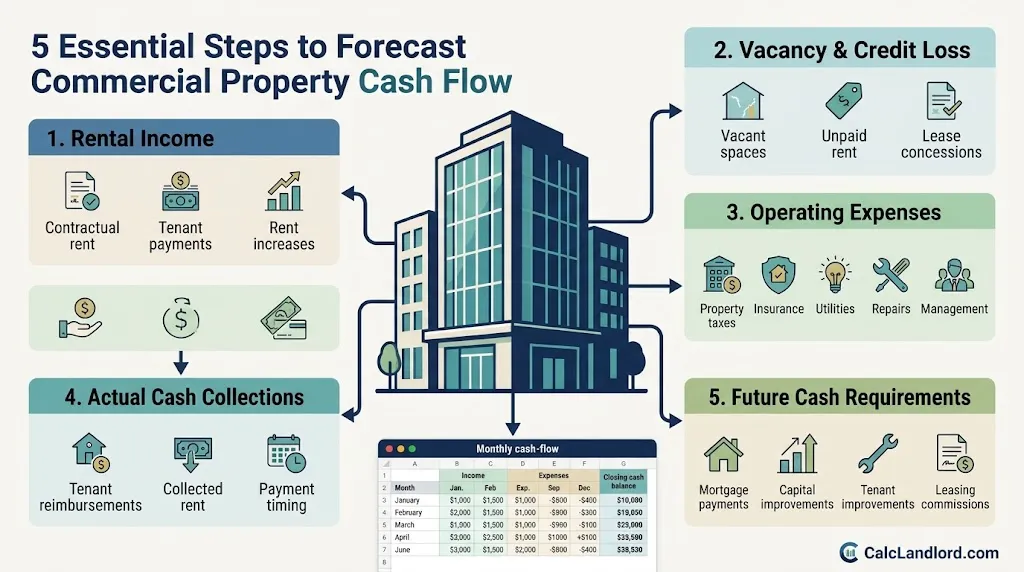
12. How to Forecast Commercial Property Operating Cash Flow
Historical cash flow tells investors what happened. Forecasting helps them estimate what might happen in future periods.
A commercial property with high historical income may experience lower future cash flow because of tenant departures, rent concessions, increasing operating costs, or large capital projects.
A useful forecast should therefore consider both income and the timing of expenses.
Start with the trailing 12-month statement
Use the last 12 months of available operating records as a starting point.
Compare the historical figures with:
- Current occupancy.
- Existing lease agreements.
- Tenant payment history.
- Upcoming lease expirations.
- Contractual rent escalations.
- Operating expense trends.
- Planned maintenance.
- Upcoming insurance and property-tax renewals.
The OCC’s commercial lending guidance highlights the importance of understanding actual property collections, lease characteristics, and the distinction between reported NOI and actual cash-flow analysis. OCC.gov+2
Build a monthly commercial cash-flow forecast
A practical forecast should include:
| Forecast category | What to estimate |
|---|---|
| Base rent | Rent due under each lease |
| Vacancy loss | Expected vacant-space periods |
| Credit loss | Expected unpaid rent |
| Rent concessions | Free-rent periods and incentives |
| Tenant reimbursements | Expected recoverable charges |
| Other income | Parking and service income |
| Operating expenses | Taxes, insurance, utilities, maintenance |
| Cash collections | Expected timing of tenant payments |
| Financing | Scheduled loan payments |
| Capital expenditures | Planned building improvements |
Example: Vacancy sensitivity analysis
Assume a property has $480,000 in potential annual base rent.
Test three different vacancy assumptions while holding all other assumptions constant:
| Scenario | Vacancy assumption | Vacancy loss | Base rent after vacancy |
|---|---|---|---|
| Lower vacancy | 5% | $24,000 | $456,000 |
| Moderate vacancy | 10% | $48,000 | $432,000 |
| Higher vacancy | 15% | $72,000 | $408,000 |
These are hypothetical stress-test assumptions, not recommended market vacancy rates.
The exercise shows why vacancy assumptions have a direct impact on expected property income.
Consider tenant rollover risk
Suppose a major office tenant occupies 40% of a commercial building and its lease expires next year.
Even when the property currently has strong NOI, the potential tenant departure may create:
- Several months without rental income.
- Marketing and brokerage expenses.
- Tenant improvement costs.
- Leasing commissions.
- Additional vacancy-related operating costs.
A conservative investor includes these possibilities in the forecast rather than assuming the tenant will automatically renew.
13. How to Build a Commercial Property Cash Flow Spreadsheet
A spreadsheet makes it easier to organize commercial rental income, operating expenses, collections, and capital costs.
You can use Microsoft Excel or Google Sheets to create a monthly cash-flow model.
The simplest version should use one column for each month and another for annual totals.
Recommended commercial property spreadsheet structure
| Row | Spreadsheet line |
|---|---|
| 2 | Base rent collected |
| 3 | Tenant reimbursements collected |
| 4 | Other operating cash collected |
| 5 | Total operating cash receipts |
| 6 | Property taxes paid |
| 7 | Insurance paid |
| 8 | Utilities paid |
| 9 | Repairs and maintenance paid |
| 10 | Management fees paid |
| 11 | Other operating expenses paid |
| 12 | Total operating cash payments |
| 13 | Property operating cash flow |
| 14 | Mortgage payments |
| 15 | Capital expenditures |
| 16 | Tenant improvements and leasing commissions |
| 17 | Net additional reserve funding |
| 18 | Cash available to equity before owner income taxes |
Excel formulas for commercial property cash flow
Assume January is in column B.
Total operating cash receipts:
=SUM(B2:B4)Total operating cash payments:
=SUM(B6:B11)Operating cash flow:
=B5-B12Cash available to equity:
=B13-SUM(B14:B17)Copy these formulas across the remaining monthly columns.
For the annual total, sum the monthly cash-flow results rather than dividing an annual amount by 12 and treating it as an actual monthly forecast.
Add a separate NOI reconciliation schedule
The direct-method spreadsheet above starts with actual cash receipts and payments.
Do not subtract changes in accounts receivable or adjust accounts payable again in that same calculation.
Instead, create a separate reconciliation tab that starts with accrual-based NOI and adjusts for:
- Changes in tenant receivables.
- Changes in operating payables.
- Changes in prepaid expenses.
- Other applicable operating working capital accounts.
This allows you to compare accrual-based income with the actual cash produced by the building.
Add a reserve and capital improvement schedule
For commercial properties, also track planned and completed capital projects separately.
Examples include:
- Roof replacement.
- HVAC systems.
- Building renovations.
- Parking lot resurfacing.
- Elevator improvements.
A detailed spreadsheet can help commercial landlords identify future liquidity requirements before they become unexpected financial problems.
14. What Mistakes Can Distort a Commercial Property Cash Flow Calculation?
A commercial property can appear more profitable than it really is when the owner uses incorrect assumptions or mixes different financial measures.
Avoid these common mistakes when evaluating an investment.
1. Treating contractual rent as collected cash
A lease may require a tenant to pay $10,000 per month, but this does not mean $10,000 was received every month.
Review actual bank deposits, payment histories, and outstanding tenant balances.
2. Confusing NOI with operating cash flow
NOI and OCF may differ because of accounting treatment and payment timing.
Identify whether the income statement uses a cash or accrual basis before making any adjustments.
3. Including mortgage payments in conventional NOI
Debt service depends on the property’s financing structure.
Keep financing below conventional NOI so that the operating performance of different commercial buildings can be compared more consistently.
4. Ignoring capital expenditure requirements
A property may produce positive operating cash flow while requiring a major roof, elevator, or HVAC replacement.
Review the property’s condition and capital improvement schedule before making an acquisition decision.
5. Double-counting CAM reimbursements
If you record both tenant reimbursements and property expenses, make sure they reflect the actual lease and payment arrangements.
If a tenant pays a supplier directly, do not create fictional landlord cash receipts and expenses.
6. Mixing actual results with projected income
A seller’s estimated rent growth or stabilized occupancy is not the same as historical collections.
Keep actual, budgeted, and projected figures clearly separated.
7. Confusing routine repairs with capital improvements
Regular maintenance normally belongs in operating expenses.
Major improvements generally belong below NOI and should be reflected separately in the full investment cash-flow model.
8. Ignoring tenant improvement and leasing commission costs
A commercial landlord may have to spend considerable money to replace an outgoing tenant.
Account for potential leasing expenses when evaluating properties with upcoming lease expirations.
9. Using annual averages as monthly forecasts
Dividing yearly cash flow by 12 gives an average monthly figure.
It does not show when property taxes, insurance premiums, large maintenance invoices, or tenant reimbursements will actually affect cash balances.
10. Assuming positive operating cash flow guarantees a profitable investment
Positive OCF alone does not establish whether a property is a good investment.
Purchase price, financing, capital requirements, property condition, tenant concentration, and future leasing risks all matter.
15. People Also Ask About Commercial Property Operating Cash Flow
The property-level operating cash flow formula is actual operating cash receipts minus actual operating cash payments.
\[ OCF=\text{Cash Receipts}-\text{Cash Payments} \]
The formula used here excludes debt service, major capital expenditures, and owner income taxes, which are evaluated separately.
No. NOI measures property income after operating expenses under the accounting or underwriting basis used. Operating cash flow measures actual cash received and paid.
The two figures may differ because of unpaid rent, unpaid vendor bills, prepaid expenses, and other timing adjustments.
Not under the pre-financing property-level definition used in this article.
Mortgage principal and interest are deducted afterward to calculate cash flow after debt service.
Yes. Property taxes are generally included in commercial property operating expenses when the landlord is responsible for paying them.
If a tenant pays property taxes directly under the lease, account for that arrangement consistently rather than recording a landlord expense that never occurred.
Depreciation is a noncash accounting expense.
It does not represent an operating cash payment during the period, so it is excluded from the direct-method cash receipt and payment calculation.
Yes.
For example, a commercial property may generate $200,000 in NOI but have substantial debt payments, capital improvements, and leasing obligations.
Those additional requirements may reduce the cash remaining for investors or even create a negative cash position.
Key Takeaways
Calculating commercial property operating cash flow requires more than subtracting expenses from rental income. You must distinguish reported income from cash collected and separate property operations from financing and capital requirements.
Remember these important points:
- Calculate potential rental income from actual lease information.
- Adjust for vacancy, credit losses, and concessions.
- Deduct operating expenses to calculate NOI.
- Reconcile NOI with actual cash collections and payments.
- Verify the result using the direct method.
- Subtract debt service and capital costs separately to evaluate investor cash availability.
- Review commercial lease terms before assuming that expenses will be recovered from tenants.
Your next step: Use the CalcLandlord Cash Flow Calculator to evaluate rental income and operating expenses, then build a detailed spreadsheet when your commercial property has multiple tenants or complex lease arrangements.
Understanding the complete cash-flow picture helps you compare investments, identify financial risks, and make better commercial real estate decisions.
