
What Is a Leasing Agent? Duties, Skills, Salary, and Career Guide
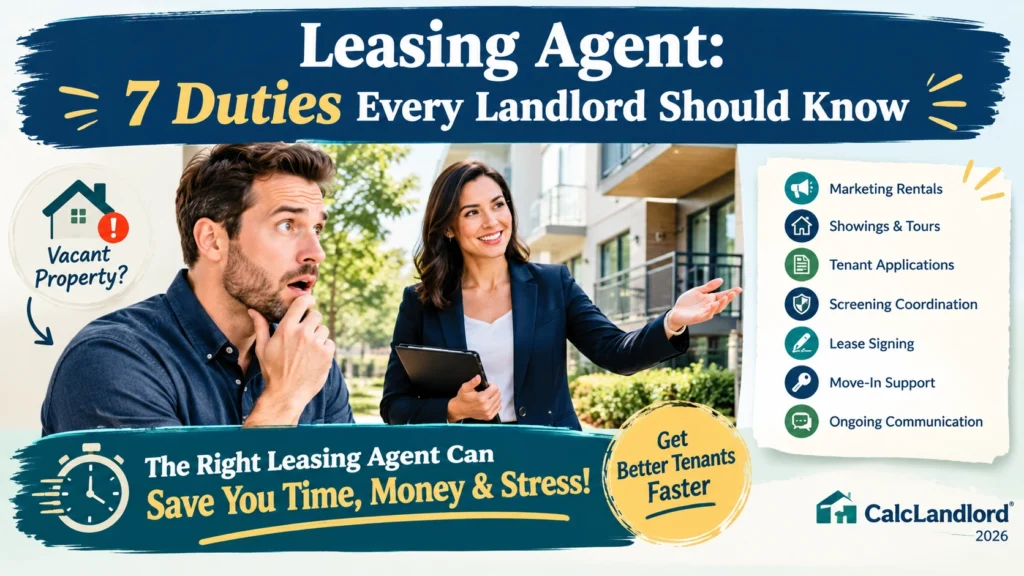
A vacant rental can cost a landlord money every day it sits empty—but finding the right tenant takes more than posting an ad. A leasing agent helps move the process from the first inquiry to property tours, applications, and a signed lease. Yet what do leasing agents handle, how are they paid, and when does a landlord need one? This guide breaks down the role, key responsibilities, skills, salary factors, and licensing considerations in the United States. Whether you’re hiring support for a rental or exploring a real estate career, you’ll learn what to check before taking the step.
A vacant rental property can cost a landlord money every day it remains unoccupied. Finding a suitable tenant involves more than posting a rental listing: someone must respond to inquiries, arrange property tours, review applications, explain lease terms, and coordinate the move-in process. This is where a leasing agent can make a difference.
A leasing agent is a real estate professional who helps landlords and property management companies market rental properties, work with prospective tenants, and complete lease transactions. Their responsibilities may include advertising vacant units, conducting tours, processing applications, and helping convert qualified prospects into signed leases.
Leasing agents work with apartments, single-family rentals, multifamily communities, offices, retail properties, and other rental spaces. Their exact duties, compensation, and licensing requirements depend on the employer, property type, location, and nature of the work.
This guide explains what leasing agents do, how the profession differs from property management and real estate sales, how to enter the field, what salary to expect, and which performance measures landlords should monitor. It also covers practical steps for hiring or managing a leasing agent while keeping tenant screening and fair-housing responsibilities in mind.
1. What Is a Leasing Agent?
A leasing agent helps a property owner or management company attract prospective tenants and complete the rental process. The role combines sales, marketing, customer service, administrative work, and knowledge of rental-property operations.
For example, imagine a landlord has a vacant two-bedroom apartment. The leasing agent prepares or coordinates the listing, answers inquiries, shows the apartment, explains the rental criteria, helps applicants complete their paperwork, and coordinates lease signing with the authorized property representative.
The central objective is to fill vacancies with qualified tenants through an accurate, consistent, and well-managed leasing process.
A leasing agent may work for:
- An apartment community or multifamily property owner.
- A residential property management company.
- A landlord with several rental properties.
- A commercial real estate brokerage or leasing firm.
- A company responsible for leasing office, retail, or industrial space.
The job title does not always describe the full scope of the work. One employer may use leasing consultant, another may use leasing agent, and a commercial company may use leasing associate. Actual duties and licensing rules matter more than the title itself.
For landlords, the key question is whether an agent’s responsibilities are clearly defined. Establish who handles advertising, showings, application processing, lease execution, move-in coordination, and communication with existing residents before work begins.
2. What Does a Leasing Agent Do on a Daily Basis?
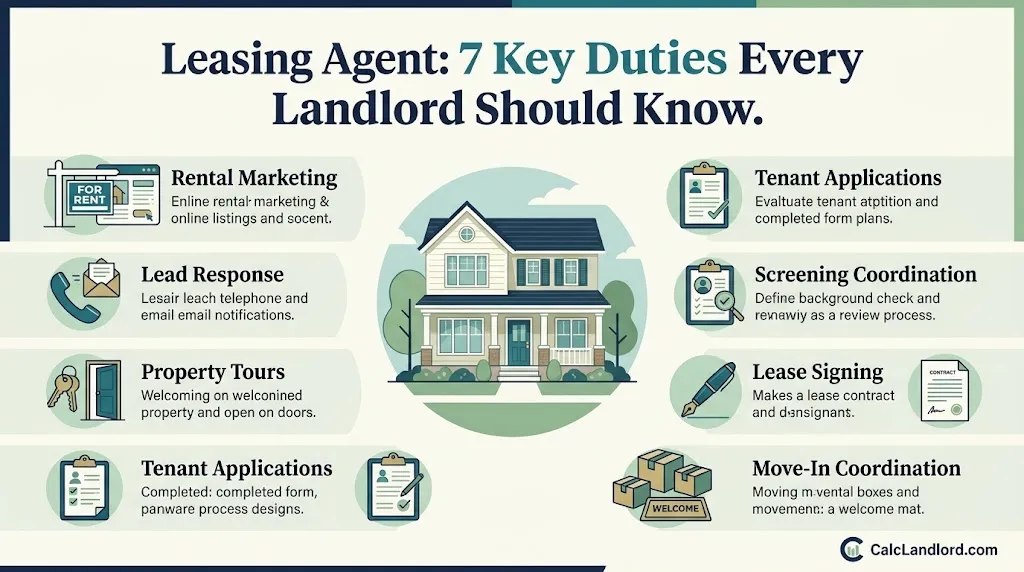
A leasing agent’s day generally revolves around moving prospective tenants from their first inquiry toward a completed rental agreement. The exact schedule depends on the property’s size, vacancy level, and leasing activity.
Typical daily activities include:
Responding to rental inquiries. Agents answer calls, emails, listing-platform messages, and website inquiries. They explain available units, rent, lease lengths, amenities, and the next steps.
Managing listings. They check that advertised units, pricing, availability dates, photographs, and property descriptions are accurate.
Scheduling and conducting tours. They arrange appointments, prepare units for viewing, and explain relevant features without making promises the landlord cannot honor.
Assisting with applications. They explain application requirements and route completed applications through the owner’s approved screening procedures.
Coordinating lease signing. Depending on their authority, they prepare documents, explain standard procedures, organize signatures, and coordinate required payments.
Following up. They contact interested prospects who have toured the property, answer outstanding questions, and communicate application status.
Maintaining records. They update the leasing database, track prospects, document communications, and report leasing activity to the property manager or owner.
A practical day might look like this:
| Time | Example activity |
|---|---|
| 9:00 a.m. | Review new leads and confirm unit availability |
| 10:00 a.m. | Answer inquiries and schedule tours |
| 11:00 a.m. | Conduct property showings |
| 12:30 p.m. | Update prospect records and return calls |
| 2:00 p.m. | Explain application requirements and process files |
| 3:30 p.m. | Follow up with toured prospects |
| 4:30 p.m. | Coordinate pending leases and report results |
This is an illustrative schedule, not a required industry standard.
An effective leasing agent does not measure success by the number of tours alone. The agent should also maintain accurate information, communicate consistently, follow approved procedures, and help qualified prospects complete the process without unnecessary delays.
3. What Should a Leasing Agent Job Description Include?
A clear leasing agent job description helps landlords and property management companies hire for the work they actually need. It should describe the property’s requirements, expected responsibilities, performance measures, and relevant licensing conditions.
Here is a job-description template you can adapt.
Job title: Leasing Agent
Job summary: We are seeking an organized and customer-focused leasing agent to market available rental units, respond to prospective tenants, conduct property tours, coordinate applications, and support lease execution. The successful candidate will communicate clearly, maintain accurate records, and follow applicable fair-housing rules, company policies, and local licensing requirements.
Key responsibilities:
- Advertise available rental units using approved listing platforms and marketing channels.
- Respond to inquiries and maintain accurate prospect records.
- Schedule and conduct property tours.
- Explain rental pricing, amenities, lease terms, and application requirements accurately.
- Process applications through consistent, approved screening procedures.
- Coordinate lease documents, signatures, and move-in arrangements within the authority assigned.
- Follow up with prospective tenants and provide timely status updates.
- Assist with renewals or resident communication where assigned.
- Track inquiries, tours, applications, signed leases, and vacancy periods.
- Protect personal information and follow applicable housing laws.
Preferred qualifications:
- Strong communication, organization, and customer-service skills.
- Experience in sales, hospitality, administration, or property management.
- Ability to use listing platforms, spreadsheets, customer relationship management (CRM) tools, and electronic documents.
- Familiarity with rental applications and lease documentation.
- Understanding of applicable fair-housing rules.
- Any real estate license or professional credential required for the specific position.
Performance expectations: The employer should define practical targets for lead follow-up, tour completion, documentation accuracy, lease conversion, and vacancy management. Targets should account for the property’s condition, pricing, location, market demand, and the agent’s actual responsibilities.
Before publishing a vacancy, the employer should also clarify working hours, weekend availability, compensation, reporting structure, and whether the position includes duties beyond leasing.
4. What Are the Main Leasing Agent Duties and Responsibilities?
Leasing agent duties typically extend from attracting prospective tenants to preparing a completed lease file. Responsibilities should be documented so the agent knows what they can handle independently and when the property manager or landlord must make the decision.
| Responsibility | What it involves | Why it matters |
|---|---|---|
| Property marketing | Create and maintain accurate listings | Attracts relevant prospects |
| Lead management | Respond to inquiries and organize follow-ups | Reduces missed opportunities |
| Property tours | Show units and explain features | Helps prospects evaluate the rental |
| Applicant processing | Collect and route required documents | Supports consistent decisions |
| Lease coordination | Organize approved documents and signatures | Reduces avoidable delays |
| Move-in coordination | Arrange access and handoffs | Creates a smoother start |
| Records management | Track communications and documents | Supports accountability |
| Renewal support | Contact residents when assigned | Helps prevent avoidable turnover |
Some duties require particular care. For example, an agent should not promise a repair, waive a deposit, change a rental criterion, approve an exception, or alter a lease unless they have proper authorization.
Tenant screening must also follow the owner’s established criteria and applicable laws. Credit reports, criminal background information, income verification, rental history, and references should be handled only through lawful and properly authorized procedures.
Fair-housing compliance is essential throughout advertising, communication, screening, and leasing. HUD explains that the federal Fair Housing Act prohibits discrimination based on protected characteristics including race, color, national origin, religion, sex, familial status, and disability. State and local law may provide additional protections.
hud.gov
+1
For landlords, a written duty list is especially useful when an agent works alongside a separate property manager. It prevents duplicated work and clarifies who has authority to make final decisions.
5. How Do Residential and Commercial Leasing Agents Differ?
Residential and commercial leasing agents share the broad objective of arranging rental agreements, but the property, tenant needs, lease structure, and transaction timeline can differ substantially.
| Factor | Residential leasing agent | Commercial leasing agent |
|---|---|---|
| Property type | Apartments, houses, condos, and residential units | Offices, retail spaces, restaurants, and industrial units |
| Typical prospect | Individual renters and households | Businesses, operators, and organizations |
| Main priorities | Rent, unit condition, location, lease length, amenities | Location, business needs, usable space, total occupancy cost, lease terms |
| Leasing process | Often a shorter inquiry-to-lease cycle | May involve longer discussions, due diligence, and negotiations |
| Documents | Residential application and lease documents | Commercial lease and business-related documentation |
| Specialized knowledge | Residential rental practices and tenant communication | Market comparables, permitted use, tenant improvements, and commercial lease provisions |
For example, a renter comparing two apartments may primarily evaluate monthly rent, bedrooms, commute, utilities, and pet policies.
A retailer considering a commercial unit may also need to assess foot traffic, permitted use, renovation costs, operating expenses, signage, renewal options, and responsibility for common-area maintenance.
Commercial transactions may require input from attorneys, brokers, architects, lenders, or other specialists. A leasing agent should not provide professional legal advice outside their qualifications.
Which type is better? Neither is automatically better for every person. Residential leasing may suit someone who enjoys frequent customer interactions and a faster-paced workflow. Commercial leasing may suit someone who prefers market research, business-to-business discussions, and more complex negotiations.
Landlords should hire according to the property type and the responsibilities involved, rather than assuming that experience in one leasing environment transfers perfectly to another.
6. How Does the Leasing Process Work From Lead to Signed Lease?
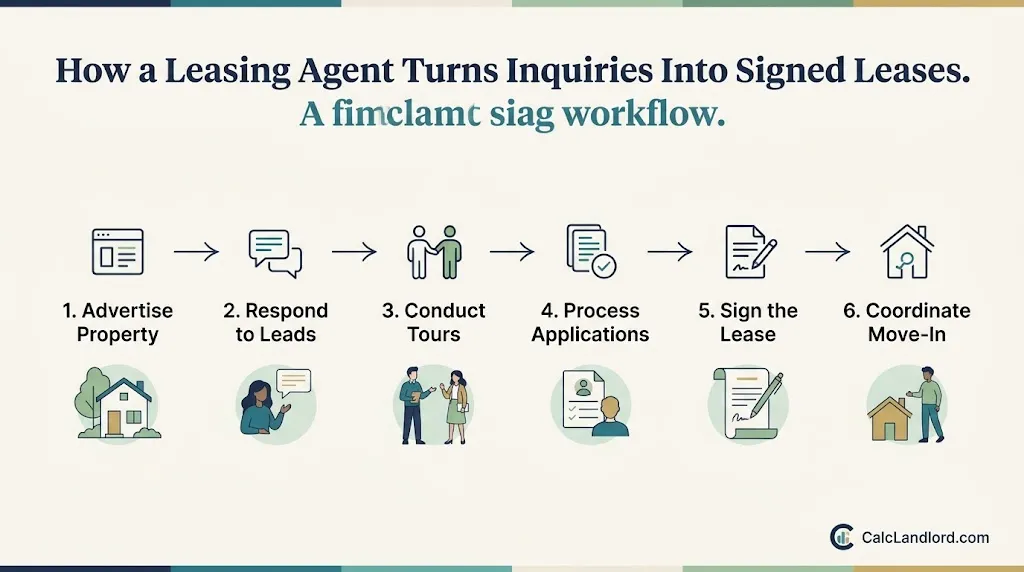
The leasing process is a sequence of steps that moves a rental property from advertised availability to an executed lease and a coordinated move-in. A consistent process makes it easier to identify delays and understand why prospects fail to complete an application.
The following workflow is a practical operating framework, not a legal requirement or a guaranteed conversion sequence.
Step 1: Advertise the available property
Confirm the rent, availability, photographs, amenities, and application criteria before publishing a listing.
Step 2: Respond and qualify the inquiry
Answer questions, explain the published criteria, and arrange an appropriate showing without applying inconsistent standards.
Step 3: Conduct the property tour
Present the unit accurately and answer questions about the rent, lease terms, utilities, and features.
Step 4: Process the application
Collect the required information securely and route the application for screening and a decision under the landlord’s established procedures.
Step 5: Coordinate lease execution
Ensure the approved lease matches the agreed terms and is signed by the appropriate parties.
Step 6: Prepare the move-in handoff
Confirm required payments, access arrangements, property readiness, and the responsible contact for maintenance or resident issues.
Why speed matters to a landlord
Consider a hypothetical apartment renting for $1,800 per month. Assuming a 30-day month, the gross rent associated with 10 vacant days is:
\[ \$1,800 \div 30 \times 10 = \$600 \]
If a better-organized leasing process reduces the vacancy period by five days, the gross rent associated with those five days would be $300.
This is an illustration, not a guaranteed saving attributable to the leasing agent. The actual financial impact depends on whether the property would otherwise have been rented sooner, the unit’s condition, market demand, tenant move-in dates, and other costs.
Landlords should therefore evaluate leasing performance alongside pricing, repairs, advertising quality, and unit readiness. The agent can influence parts of the process, but cannot control every cause of vacancy.
7. Leasing Agent vs. Property Manager: What’s the Difference?
A leasing agent primarily helps find prospective tenants and complete lease transactions. A property manager generally oversees the ongoing operation of the rental property, which can include rent collection, maintenance coordination, budgets, resident relations, and compliance administration.
The roles can overlap, particularly in smaller businesses, but their primary responsibilities are different.
| Area | Leasing agent | Property manager |
|---|---|---|
| Main objective | Fill vacancies with suitable tenants | Operate the property effectively |
| Marketing | Often directly involved | May oversee or delegate |
| Property tours | Common responsibility | May conduct or assign |
| Applications | Often coordinates processing | May supervise screening policies |
| Lease signing | Coordinates or executes when authorized | Oversees the process or delegates |
| Rent collection | May handle initial payments if authorized | Commonly manages ongoing collection |
| Maintenance | Coordinates handoffs where assigned | Typically oversees maintenance operations |
| Financial reporting | Tracks leasing activity | May manage operating budgets and financial reports |
| Resident relations | Often assists during leasing and move-in | Usually responsible throughout the tenancy |
One landlord might hire a leasing agent only when a unit becomes vacant and continue managing the property independently. Another may employ a property management company that provides both leasing and ongoing management.
The correct arrangement depends on the landlord’s time, portfolio size, expertise, and service requirements.
Before hiring either professional, request a written list of included services, fees, authority limits, reporting expectations, and any separate leasing or renewal charges.
8. Leasing Agent vs. Real Estate Agent: What’s the Difference?
The terms can overlap in practice. A leasing agent specializes in rental transactions, while a real estate sales agent typically helps clients buy or sell property and may also perform rental-related work when authorized.
| Factor | Leasing agent | Real estate sales agent |
|---|---|---|
| Primary focus | Marketing and leasing rental property | Helping clients buy or sell real estate; rental work may also be included |
| Common activities | Tours, rental applications, lease coordination | Property marketing, buyer or seller representation, negotiations, transaction paperwork |
| Compensation | May receive hourly pay, salary, bonuses, or commission | Often receives transaction-based commission, depending on the arrangement |
| Client relationship | Often focused on the rental process | May extend through a purchase or sale transaction |
| Licensing | Depends on state law and specific duties | A state real estate license is generally required to act as a real estate sales agent |
The U.S. Bureau of Labor Statistics states that real estate brokers and sales agents help clients buy, sell, and rent properties, and that states require real estate brokers and agents to be licensed. However, that occupational category should not be treated as proof that every employee with the job title “leasing agent” has identical licensing obligations.
Bureau of Labor Statistics
For job seekers, the important step is to understand the actual duties, compensation arrangement, supervision, and applicable state rules before accepting a role.
For landlords, it is equally important to verify that anyone performing regulated real estate activities has the required authorization.
9. What Skills Does a Successful Leasing Agent Need?
A successful leasing agent combines customer service with sales ability, organization, market knowledge, and consistent administrative practices. An outgoing personality can help, but reliable documentation and compliance matter just as much.
Communication: The agent should explain rent, lease length, application requirements, amenities, and next steps clearly.
Customer service: Prospects need accurate answers and respectful treatment, even when a property is unsuitable for their needs.
Sales and listening: Effective agents identify what matters to a prospect and explain relevant property features without using misleading claims or high-pressure tactics.
Organization: Multiple inquiries, tours, deadlines, and applications require a reliable tracking system.
Market awareness: Understanding competing rentals and local pricing helps the agent answer questions and share useful feedback with the landlord.
Technology: Listing platforms, spreadsheets, e-signature services, screening systems, and leasing software can improve record-keeping and communication.
Negotiation and problem-solving: Agents should know which issues they can resolve directly and which require approval from the owner or manager.
Compliance awareness: Rental advertising, screening, personal-information handling, and applicant communication must follow the rules that apply to the property and role.
Professional training can help develop these skills. The National Apartment Association’s Certified Apartment Leasing Professional (CALP) program covers topics including leasing demonstrations, marketing, prospect qualification, fair-housing practices, lease preparation, and resident relations. It is an industry credential, not a substitute for a state-required license.
National Apartment Association
For landlords who are interviewing candidates, practical questions about handling missed appointments, explaining rental criteria, and documenting an application can reveal more than a candidate’s sales pitch alone.
10. How to Become a Leasing Agent: A Step-by-Step Guide
You do not necessarily need years of property-management experience to begin exploring leasing careers. Entry requirements vary by employer, location, property type, and the duties assigned.
Step 1: Review local job requirements
Read current leasing-agent vacancies in your intended market. Compare the required experience, education, schedule, technology skills, and any stated licensing requirements.
Step 2: Build relevant experience
Customer service, hospitality, retail, administrative, and sales roles can help develop the skills used in leasing. These experiences may demonstrate communication, time management, problem-solving, and the ability to work with customers.
Step 3: Learn rental-property fundamentals
Understand how to read basic lease terms, explain listed rental costs, manage inquiries, organize property tours, and maintain confidential records.
Step 4: Check licensing before accepting duties
Determine whether your intended work requires a real estate license or another authorization in the relevant state. Do not assume an employer’s job title settles the question.
Step 5: Prepare a targeted résumé
Highlight customer service, sales, record keeping, scheduling, conflict resolution, and technology proficiency. If you have experience handling sensitive documents or meeting compliance requirements, describe it accurately.
Step 6: Apply and prepare for interviews
Be ready to explain how you would handle a busy inquiry queue, follow up with a prospect, respond to a complaint, and apply rental criteria consistently.
Step 7: Consider professional education
For residential apartment leasing, the NAA’s CALP credential is one option. The association lists requirements that include completing seven courses, passing the examination within the specified candidacy period, and meeting the leasing-experience requirement. Check the official program page for current terms before enrolling.
National Apartment Association
The best starting point is a position whose expectations match your current skills and legal authorization, with a clear opportunity to learn the leasing process.
11. Do Leasing Agents Need a Real Estate License?
There is no single nationwide licensing rule that applies identically to every person called a leasing agent. The answer depends on the state, the nature of the work, the person’s employment relationship, and any applicable exemptions.
Some on-site apartment employees may perform certain tasks under an arrangement that does not require an individual real estate license. Other roles involving leasing property for an owner, negotiating rental transactions, or receiving compensation for regulated activities may require a license.
Texas illustrates why it is important to check the details. The Texas Real Estate Commission explains that paid residential rental locators generally must hold a real estate broker or sales-agent license unless an exemption applies. Its guidance also addresses licensing for property managers who perform particular leasing or rent-handling activities.
TREC
That Texas rule should not be assumed to apply identically in other states.
How to check licensing requirements
Before accepting a job or hiring an agent:
- Identify the state where the rental property is located.
- Visit the official state real estate commission’s website.
- Check the requirements for the exact activities the person will perform.
- Verify any supervision, employment, or licensing exemptions.
- Confirm whether additional local requirements apply.
Do not rely solely on a job advertisement, a training certificate, or an employer’s verbal assurance.
For landlords, the same principle applies to property management agreements. Specify who may advertise the unit, negotiate terms, approve applications, sign leases, collect money, and communicate decisions.
A professional credential such as CALP may demonstrate relevant training, but it does not automatically authorize activities for which state law requires a real estate license.
12. How Much Do Leasing Agents Make? Salary and Commission
Leasing-agent compensation varies according to location, experience, employer, property type, working hours, and performance incentives. Common arrangements include an hourly wage, an annual salary, a base wage with bonuses, or commissions under an agreed compensation structure.
An August 17, 2026, Indeed salary page reported an average U.S. leasing-agent base pay of $19.38 per hour, with a reported range of $13.86 to $27.10 per hour. Its estimates were based on 11,700 salary figures from job postings over the preceding 36 months. This is job-posting-based data, not a federal government wage estimate or a guarantee of what a particular employer will pay.
Indeed
Actual offers can differ considerably. Check recent job listings in the city where you intend to work and compare the complete compensation package rather than relying on a single national average.
Common leasing-agent pay structures
| Pay structure | How it works | What to check |
|---|---|---|
| Hourly wage | Payment for hours worked | Expected hours, overtime eligibility, and benefits |
| Annual salary | Fixed base compensation | Work schedule, responsibilities, and benefits |
| Base plus bonus | Regular pay with performance incentives | Exact targets and when bonuses become payable |
| Commission-based arrangement | Compensation tied to qualifying transactions under the agreement | License requirements, payment conditions, and transaction definitions |
An advertised bonus should never be assumed to be guaranteed income. Ask whether the payment depends on a signed lease, a move-in, occupancy targets, renewals, or some other condition.
What affects earning potential?
The major factors include:
- Location: Local labor markets and living costs influence offers.
- Experience: Strong customer service, sales, or leasing experience may qualify candidates for more senior roles.
- Property type: Residential and commercial leasing roles can have different compensation structures.
- Portfolio size: Large communities may have formal targets and incentive plans.
- Responsibilities: Supervisory work, reporting, or additional property-management duties can change the role.
- Performance: Some employers link bonuses to completed leases, renewals, or occupancy results.
For job seekers, compare wages, benefits, schedule, travel requirements, bonus conditions, and licensing costs before accepting an offer.
For landlords, evaluate compensation against the work being performed. The lowest hourly rate is not automatically the best value if communication, documentation, or leasing follow-up is unreliable.
13. Which Leasing Agent KPIs Should Landlords Track?
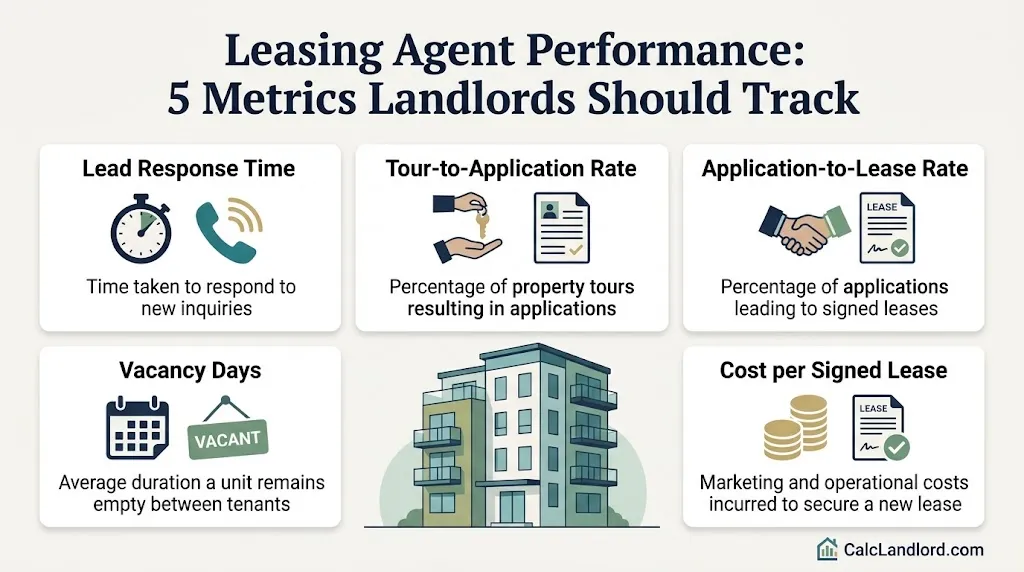
Leasing KPIs, or key performance indicators, help landlords see where prospects move forward and where they leave the leasing process. A good measurement system looks at both activity and outcomes rather than simply counting property tours.
The following are useful starting metrics. They are practical formulas, not universal industry benchmarks.
| KPI | Suggested calculation | What it reveals |
|---|---|---|
| Lead response time | Time between inquiry and first meaningful response | Whether prospects are being handled promptly |
| Tour-to-application rate | Applications received ÷ completed tours × 100 | How effectively tours lead to applications |
| Application completion rate | Complete applications ÷ applications started × 100 | Whether applicants are completing the process |
| Application-to-lease rate | Signed leases ÷ completed applications × 100 | How many completed applications result in leases |
| Average vacancy days | Total vacant days for relevant units ÷ number of vacancy events | How long units remain unoccupied |
| Occupancy rate | Occupied rentable units ÷ total rentable units × 100 | The proportion of the portfolio occupied |
| Renewal rate | Renewed eligible leases ÷ eligible leases expiring × 100 | How often eligible residents renew |
| Cost per signed lease | Defined leasing and marketing costs ÷ leases signed | The cost of converting prospects into leases |
Each rate needs a consistent denominator and time period. For example, the tour-to-application rate should compare applications with the tours completed during the same defined cohort or period, with any lag in application behavior taken into account.
An illustrative leasing-conversion example
Suppose an agent records 40 completed property tours in a month and receives 12 applications attributable to those tours.
\[ \text{Tour-to-application rate} =\frac{12}{40}\times100 =30\% \]
If six of those 12 applications eventually result in signed leases, the application-to-lease rate would be:
\[ \frac{6}{12}\times100=50\% \]
These hypothetical results do not automatically mean that the agent is performing well or poorly. The landlord should also review rental pricing, property condition, applicant eligibility, market competition, and reasons prospects did not proceed.
How landlords can use these metrics
Track results consistently, compare similar properties, and investigate changes rather than relying on arbitrary targets.
If inquiries are high but tours are low, review appointment availability and response practices. That’s tours are high but applications are limited, review the condition, pricing, and presentation of the units. If completed applications rarely become leases, examine lawful screening practices, incomplete documentation, communication delays, and prospect expectations.
Do not encourage an agent to maximize conversion at the expense of fair-housing compliance or proper tenant screening. The goal is a reliable process that serves the landlord’s legitimate rental objectives while treating applicants fairly.
14. What Mistakes Should Leasing Agents Avoid?
Small mistakes can create longer vacancies, frustrated applicants, incomplete records, and unnecessary disputes. Landlords can reduce these risks by establishing clear procedures and reviewing performance regularly.
1. Responding too slowly to inquiries. Prospects may move on when questions are not answered. Establish a response process and monitor delays.
2. Advertising inaccurate information. Incorrect rent, availability, amenities, or photographs waste time and undermine trust. Confirm listing details before publication.
3. Providing inconsistent information. All prospects should receive accurate information about rental terms and application criteria. Avoid making promises that are not reflected in the approved documents.
4. Conducting tours without understanding the property. Agents should know the listed rent, unit features, applicable fees, utility arrangements, and the correct process for answering questions they cannot resolve.
5. Failing to follow up. Record the outcome of each tour and provide relevant next steps rather than relying on memory.
10 Common Leasing Agent Mistakes That Can Cost Landlords Time and Money
6. Applying screening criteria inconsistently. Use the landlord’s approved lawful criteria consistently. Escalate unusual circumstances instead of inventing exceptions.
7. Mishandling personal information. Applications can contain sensitive financial and identifying information. Limit access to authorized people and follow applicable privacy and screening rules.
8. Overlooking licensing or authority limits. Confirm that the agent is legally authorized to perform the assigned duties and has approval for any decisions or transactions that require it.
9. Focusing on new leases while ignoring assigned renewal work. Where renewals fall within the agent’s responsibilities, track upcoming expirations and communicate early enough for the owner and resident to make informed decisions.
10. Tracking activity without evaluating results. Tours and phone calls matter, but the landlord should also review signed leases, vacancy duration, record accuracy, and the reasons prospects drop out of the process.
One of the most useful controls is a written leasing checklist covering listing accuracy, inquiry handling, tour preparation, application procedures, approvals, lease execution, record keeping, and move-in handoff.
The checklist should reflect the property and applicable law, not just a generic template.
15. Leasing Agent People Also Ask
A leasing agent helps market rental properties, conduct tours, communicate with prospective tenants, coordinate applications, and complete lease transactions within their assigned authority.
The titles are often used for similar work, especially in residential apartment communities. The actual responsibilities, seniority, compensation, and licensing requirements depend on the employer and duties.
It depends on the state and the specific activities performed. Some jobs may qualify for an exemption, while other leasing activities require a real estate license. Check the relevant state regulator before performing regulated work.
Some agents may collect application fees, security deposits, initial rent, or ongoing rent when authorized and permitted by applicable law. The authority to collect or control rental payments should be confirmed in advance.
Indeed’s U.S. leasing-agent salary page reported an average base pay of $19.38 per hour as of August 17, 2026. Actual compensation varies by location, experience, employer, and pay structure.
It can suit people who enjoy customer service, sales, organization, and real estate. Career progression may lead toward leasing supervision, assistant property management, property management, or other real estate roles, depending on experience and qualifications.
Strong leasing agents communicate clearly, respond consistently, understand the property, keep accurate records, use approved screening procedures, comply with applicable rules, and follow prospects through the leasing process.
Final takeaways for landlords and career seekers
A leasing agent does more than show an apartment. The role combines rental marketing, prospect communication, property tours, application coordination, documentation, and lease execution. Its contribution to a rental property’s performance depends on how those responsibilities are managed.
For Landlords, the practical priorities are to define the agent’s authority, document duties, check licensing requirements, maintain fair and consistent screening practices, and monitor leasing results alongside market conditions and unit readiness.
For job seekers, compare the actual duties, required qualifications, compensation terms, licensing requirements, and available training before choosing a position.
A simple next step for a landlord is to review the most recent vacancies in the portfolio and identify where delays occur: advertising, inquiry response, tours, applications, approvals, or lease signing. That review provides a much clearer starting point for deciding what kind of leasing support is needed.
Disclaimer: This article is for educational and informational purposes only. It is not legal, tax, accounting, or financial advice. Licensing, landlord-tenant rules, fair-housing requirements, and other obligations may vary by state and locality. Consult the appropriate state regulator or a qualified professional for guidance on a specific situation.
