

Savings Withdrawal Calculator: Plan How Long Your Savings Will Last
How long will your savings last if you start taking money out every month? The answer depends on more than your balance. Your withdrawal amount, interest rate, fees, and even inflation can change how long your money may support you. A savings withdrawal calculator helps estimate your timeline, test different monthly withdrawals, and project what could remain at the end. Whether you’re planning retirement, covering a career break, funding a major expense, or protecting personal savings while rental income fluctuates, a few realistic scenarios can reveal potential shortfalls early. Use the guide below to understand the numbers before making decisions.
A savings withdrawal calculator helps you estimate how long your money will last when you regularly take money out while the remaining balance earns interest. It can also estimate a monthly withdrawal amount for a specific timeline or show how much money may remain at the end of a chosen period.
For example, someone with $100,000 in savings who withdraws $500 each month may be able to fund those withdrawals for around 23 years if the account earns a constant 3% APY and withdrawals occur at the end of each month. The actual result will depend on the interest rate, withdrawal timing, fees, taxes, and whether the withdrawal amount changes.
For U.S. landlords and rental property investors, the same planning method can help estimate how long personal savings could cover expenses during a vacancy, a period between jobs, or an unexpected interruption in rental income. It can also help you avoid relying on money already reserved for property repairs.
This guide explains how savings withdrawals work, which formulas matter, how to compare different scenarios, and what to check before relying on a projection.
1. What Is a Savings Withdrawal Calculator?
A savings withdrawal calculator is a financial planning tool that estimates what happens to a savings balance when you make regular withdrawals and earn interest over time.
Unlike a basic savings calculator that estimates how much money you might accumulate through deposits, a withdrawal calculator focuses on money leaving your account.
It generally helps answer three questions: how long your money will last, how much you can withdraw for a chosen period, and how much may remain after a series of withdrawals.
For example: Suppose you have $80,000 saved and need $1,500 each month to supplement your income. A withdrawal calculator can estimate when the balance may reach zero under a specified interest-rate assumption.
This can help with:
- Retirement income planning.
- Funding a career break or temporary unemployment.
- Paying for a renovation or other planned expense.
- Covering unexpected costs.
- Managing personal reserves when rental income fluctuates.
A calculator produces an estimate based on its inputs and assumptions. It cannot guarantee future interest rates or ensure that savings will last for a particular period.
For landlords, one particularly useful distinction is between money that is genuinely available for personal spending and money reserved for property taxes, insurance, maintenance, vacancies, or other rental obligations. Only the amount you are prepared to spend should be included in your withdrawal calculation.
2. What Can a Savings Withdrawal Calculator Help You Calculate?
A complete savings withdrawal calculator should allow you to explore different questions without requiring you to rebuild your calculations from scratch.
| Calculation | What it tells you | When it helps |
| Savings duration | How many months or years your money may last | Retirement or career-break planning |
| Maximum monthly withdrawal | How much you can withdraw over a selected timeline | Establishing a spending limit |
| Ending balance | The estimated amount remaining after a chosen period | Saving for a major expense |
| Total withdrawals | The amount withdrawn over the period | Estimating available spending |
| Interest earned | The estimated contribution from interest | Comparing different rates |
| Scenario comparison | How changing inputs affects the result | Stress-testing your plan |
Imagine that you have $150,000 in savings but need the money to last for 15 years.
Rather than choosing a monthly withdrawal amount by guesswork, you can calculate a starting estimate and then test a lower or higher amount. You can also change the assumed interest rate to see how sensitive the result is to interest earnings.
For a landlord, an additional practical question is whether monthly rental cash flow can cover part of the household’s expenses. If reliable rental income reduces the amount you need to withdraw from personal savings, the withdrawal period may increase.
However, projected rent should not automatically be treated as guaranteed spending money. Vacancy, missed payments, repairs, mortgage obligations, and other costs can reduce the cash actually available.

3. How Does a Savings Withdrawal Calculator Work?
The calculator models the interaction between interest earned and money withdrawn.
In a common monthly model, interest is credited first, then the withdrawal is deducted. The resulting balance becomes the starting balance for the next month.
The calculation repeats until the selected period ends or the balance is depleted.
For example, suppose your starting balance is $100,000 and your savings earn a 3% APY. The effective monthly rate is approximately 0.2466%, equivalent to the annual yield after monthly compounding.
The first month’s interest is therefore approximately:
\[ \$100,000 \times 0.002466 = \$246.60 \]
If you withdraw $500 at the end of that month, the estimated balance becomes approximately $99,746.60.
The next month’s interest is calculated on that lower balance. As withdrawals continue, the amount of interest earned gradually declines unless the interest rate or balance increases.
A standard model assumes:
- A specified starting balance.
- A constant interest rate throughout the projection.
- A fixed withdrawal amount unless adjustments are enabled.
- A defined withdrawal frequency.
- A consistent timing convention, such as withdrawals at the end of each month.
Some calculators can also model inflation-adjusted withdrawals, changing withdrawal amounts, or an amount that you want to preserve at the end.
The important limitation is that a constant-rate projection does not predict future bank offers, account fees, or unexpected expenses. Treat the result as a scenario to test, not a promise about your financial future.
4. How to Use a Savings Withdrawal Calculator Step by Step
To get a useful result, the most important step is choosing realistic inputs.
Step 1: Enter the savings you are prepared to spend.
Use the balance genuinely available for withdrawals. If you have $120,000 saved but want to protect $20,000 for emergencies, start with $100,000.
For a landlord, keep money committed to near-term property bills or planned repairs outside the spendable balance.
Step 2: Enter the interest rate carefully.
Check whether your bank quotes an annual percentage yield (APY) or a nominal annual interest rate. These are not interchangeable when compounding is involved.
If your calculator requests APY, use that figure and ensure the calculation method converts it consistently to a monthly rate.
Step 3: Enter your realistic monthly withdrawal.
Base this amount on your expected spending requirement. Consider housing, groceries, insurance, utilities, medical expenses, and other recurring costs where relevant.
For rental property owners, also decide which expenses belong to your personal budget and which should be paid from the property’s operating funds.
Step 4: Choose the required timeline.
You may need savings for 18 months between jobs, five years until another income source begins, or a much longer retirement period.
The timeline should reflect when you need the money, not simply a convenient round number.
Step 5: Review the projected outcome.
Look at the estimated duration, total withdrawals, interest earned, and ending balance.
If the result falls short of your goal, test a lower withdrawal amount or another realistic interest assumption.
Step 6: Test more than one scenario.
Compare a base case with a more cautious scenario that assumes a lower yield or higher spending.
For example, compare a $500 monthly withdrawal with $450 and $550. That will help you see how your spending choices affect the projected duration.
Step 7: Recalculate when circumstances change.
Review the plan after a change in interest rate, income, expenses, or property obligations. A calculation made today can become outdated when your financial circumstances change.
5. What Is the Formula for Calculating How Long Savings Will Last?
For fixed monthly withdrawals and a constant monthly interest rate, a mathematical formula can estimate how long a savings balance will last.
The formula assumes that interest is credited monthly and withdrawals happen at the end of each month.
n=-(1-Pi/W)(1+i)
Where:
- n = estimated number of months until depletion.
- P = starting savings balance.
- i = effective monthly interest rate as a decimal.
- W = fixed monthly withdrawal.
- = natural logarithm.
The formula applies when the withdrawal is greater than the interest earned on the starting balance each month. When withdrawals are equal to or lower than monthly interest under a constant-rate model, the balance may not deplete.
How to convert APY into a monthly interest rate
When the annual figure is APY, the equivalent monthly rate is:
i=(1+APY)1/12-1
For a 3% APY:
i=(1.03)1/12-1
This gives a monthly effective rate of approximately 0.2466%.
If you instead have a nominal annual interest rate compounded monthly, the usual conversion is:
i=Annualnominalrate12
Do not mix these two approaches. The distinction explains why two calculators can produce slightly different projections when they use different rate conventions.
How to calculate the maximum monthly withdrawal
If you know the starting balance and want the money to last a specified number of months, use:
W=Pi1-(1+i)-n
This assumes that the entire available balance is intended to be used by the end of the selected period. If you want to preserve an ending balance, the formula must account for that amount.
How to calculate the ending balance
For fixed end-of-month withdrawals, the projected balance after n months is:
Bn=P(1+i)n-W(1+i)n-1i
Here, Bn represents the estimated ending balance.
When the interest rate is zero, the calculation simplifies to the starting balance minus the total withdrawals, provided the balance does not become negative.
These formulas are useful for checking a calculator’s logic. In practice, you should also test whether the calculator includes fees, inflation, changing rates, and the possibility of a final partial withdrawal.
6. How Much Can You Withdraw Monthly From Your Savings?
There is no universal monthly withdrawal amount that is appropriate for everyone. It depends on your balance, the length of time you need the money, the interest earned, and whether you need to preserve some principal.
A useful starting point is to define your timeline before deciding how much to withdraw.
| Planning goal | What to calculate |
| Cover expenses between jobs | Monthly spending and the expected number of months without income |
| Supplement retirement income | The difference between spending and other reliable income |
| Fund a planned purchase | The cost, timeline, and minimum remaining balance |
| Cover a rental-income interruption | Personal spending needs and reserves for property obligations |
| Preserve the principal | Whether withdrawals can be supported by ongoing interest |
Suppose a retired landlord needs $3,000 per month to cover household spending but receives $2,200 in reliable monthly income from other sources. The starting gap is $800 per month.
The $800 figure is the initial withdrawal requirement before accounting for irregular bills, changes in income, taxes, or inflation.
The next step is to determine whether the available savings can support that withdrawal over the required timeline. A calculator can help estimate the answer, but the plan should also account for unexpected expenses and changing interest rates.
Do not confuse a maximum mathematical withdrawal with a guaranteed safe withdrawal. A calculator can show the amount that exhausts savings at a chosen date under its assumptions. That does not mean you should spend the entire amount if you need flexibility or wish to leave money available for emergencies.
7. How Long Will $100,000 Last With Monthly Withdrawals?
The length of time $100,000 will last depends heavily on the monthly withdrawal and the rate earned on the remaining balance.
The following examples use monthly compounding, an effective monthly rate derived from the stated APY, and withdrawals at the end of each month. The rate is assumed to remain constant.
| Starting balance | Assumed APY | Monthly withdrawal | Approximate duration |
| $100,000 | 3% | $500 | About 23 years |
| $100,000 | 4% | $1,000 | About 10 years and 1 month |
| $500,000 | 4% | $3,000 | About 20 years and 1 month |
| $500,000 | 6% | $6,500 | About 8 years and 1 month |
These are hypothetical estimates, not forecasts of current bank rates. Duration is approximate and can include a smaller final withdrawal.
Example: $100,000 with a $500 monthly withdrawal
Assume you begin with $100,000 in a savings account earning 3% APY.
- Starting balance: $100,000
- Monthly withdrawal: $500
- Assumed APY: 3%
- Withdrawal timing: End of each month
- Estimated duration: Approximately 23 years
- Total withdrawals: Approximately $138,000
- Estimated interest earned during the withdrawal period: Approximately $38,000
The total amount withdrawn can exceed the starting balance because interest contributes to the money available along the way.
For comparison, using the same assumptions, the estimated maximum monthly withdrawal for a 25-year period is approximately $472.11, assuming the balance is intended to be depleted at the end of that period.
A modest difference in the monthly withdrawal can make a difference over a long timeline. This is why you should compare several scenarios instead of relying on a single calculation.
8. How Does APY Affect Your Savings Withdrawal Plan?
APY, or annual percentage yield, represents the annual return on a deposit after accounting for compounding. It helps you understand how interest may contribute to the balance while you make withdrawals.
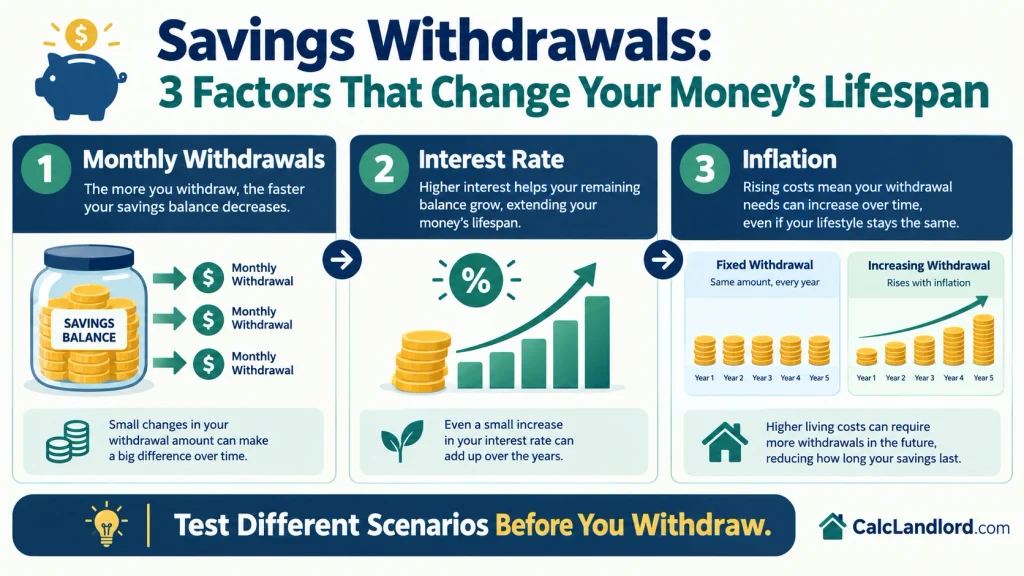
A higher APY can extend the projected life of your savings because the money remaining in the account earns more interest. However, the benefit depends on the starting balance, withdrawal amount, and how long the rate remains available.
Consider two hypothetical scenarios with the same $100,000 starting balance and $500 monthly withdrawal.
| Factor | Scenario A | Scenario B |
| Starting savings | $100,000 | $100,000 |
| Assumed APY | 2% | 4% |
| Monthly withdrawal | $500 | $500 |
| Expected effect | Faster depletion | Slower depletion |
The higher-rate scenario generally lasts longer under these assumptions. The exact difference depends on how the interest is calculated and credited.
There are three important considerations.
First, today’s APY may not remain available. If your account has a variable rate, future interest may rise or fall.
Second, compare the actual account terms. A headline yield does not tell you everything about minimum balances, fees, restrictions, or access to funds.
Third, confirm that the money remains accessible when you need it. A certificate of deposit (CD), for example, may have a specified term and an early-withdrawal penalty.
For longer-term planning, use a conservative interest-rate scenario alongside the rate you currently expect to earn. This gives you a better view of how vulnerable your plan is to lower interest earnings.
9. Should You Choose Fixed or Inflation-Adjusted Withdrawals?
A fixed withdrawal means that you take the same nominal dollar amount every month. An inflation-adjusted withdrawal increases over time to reflect rising costs.
The distinction matters because a fixed dollar amount may cover less of your living expenses in the future.
The U.S. Bureau of Labor Statistics explains that the Consumer Price Index (CPI) measures changes in consumer prices and can be used to understand changes in purchasing power.
Bureau of Labor Statistics
| Withdrawal approach | How it works | Main consideration |
| Fixed monthly withdrawals | The same amount is withdrawn each month | Easier to budget, but purchasing power may decline |
| Annual inflation adjustment | Withdrawals increase according to an assumed inflation rate | Better reflects rising costs but can deplete savings sooner |
| Variable withdrawals | The amount changes with spending needs or income | More flexible, but harder to forecast |
| Interest-only withdrawals | Withdraw the interest while aiming to preserve principal | Depends on the available yield and balance |
Example: fixed versus inflation-adjusted spending
Imagine you start by withdrawing $1,000 per month.
Under a fixed plan, you continue to withdraw $1,000 each month. Under an inflation-adjusted plan, you increase that amount annually to maintain the spending power you originally intended.
The inflation-adjusted strategy requires larger withdrawals over time. That can shorten the life of your savings, particularly if interest earnings are low or expenses rise faster than expected.
For a landlord, inflation can affect more than personal expenses. Repair materials, labor, insurance, property taxes, and other operating costs may also change, depending on the property and local circumstances.
A practical approach is to test both fixed and increasing withdrawals. Do not assume that today’s monthly budget will remain sufficient throughout a long retirement or property ownership period.
10. Can You Live Off Savings Interest Without Touching Your Principal?
You may be able to withdraw interest without reducing the principal, but it depends on the balance, interest rate, withdrawal timing, and account terms.
A simple estimate for annual interest is:
\[ \text{Annual interest} \approx \text{Balance}\times\text{Annual rate} \]
For example, $100,000 earning an assumed 4% nominal annual rate generates approximately $4,000 in annual interest before taxes and fees.
Dividing $4,000 by 12 gives about $333 per month as a rough estimate. However, if 4% is the account’s APY rather than its nominal rate, the equivalent monthly rate is different, so a precise monthly withdrawal calculation will produce a different figure.
There is another important limitation: the interest rate may change. If the balance is in a variable-rate savings account and the yield falls, the amount of interest available to withdraw will fall too.
To determine whether you can preserve principal:
- Identify the actual rate and how interest is credited.
- Estimate the monthly interest using the correct rate convention.
- Keep withdrawals at or below the amount of interest available after accounting for applicable costs.
- Recheck the calculation when the rate or account balance changes.
For rental property investors, there is also a distinction between bank interest and rental income. Rental income is not automatically profit: property taxes, insurance, maintenance, mortgage payments, vacancies, and other costs may consume part of it.
Keep personal savings separate from the operating reserves needed to maintain a rental property.
11. How Do Taxes, Account Fees, and Changing Interest Rates Affect Withdrawals?
A withdrawal projection can look comfortable on paper but produce less spendable money once taxes, fees, and unexpected costs are considered.
The assumptions you use should reflect the type of account and the financial purpose of the money.
Taxes on interest
For U.S. taxpayers, interest from many bank accounts is generally taxable when received or credited and available for withdrawal, subject to applicable exceptions. The IRS explains the general treatment in Topic No. 403: Interest Received.
Internal Revenue Service
Your actual tax situation depends on your circumstances. Retirement accounts and other tax-advantaged arrangements can have different rules, so do not assume that all withdrawals are treated like ordinary bank-account withdrawals.
Account fees and penalties
Depending on the account, costs may include:
- Monthly maintenance fees.
- Minimum-balance charges.
- Early-withdrawal penalties on certain CDs or time deposits.
- Other account-specific charges.
A calculation that ignores those costs may overstate the money available for spending.
Changing interest rates
A variable-rate account may pay a lower yield in the future. If your spending stays constant while the return falls, your savings may deplete sooner than originally projected.
Inflation and unexpected expenses
Rising everyday costs can increase the amount you need to withdraw. Unexpected medical bills, home repairs, or other expenses can also disrupt a fixed plan.
For a landlord, an emergency repair can be a substantial additional cash requirement. A roof replacement or heating-system failure may need to be funded even when rental income is temporarily reduced.
Deposit protection
If your savings are held at a U.S. bank, confirm the institution’s FDIC status and how deposit-insurance limits apply to your accounts. The FDIC explains that covered deposits at insured banks receive protection subject to its coverage rules.
FDIC
The practical lesson is to review both the financial projection and the arrangements holding your money. A withdrawal calculator is only as useful as the assumptions behind it.
12. What Are the Best Ways to Make Your Savings Last Longer?
If your savings are projected to run out before your target date, changing one or two inputs may significantly improve the plan.
Start with the following options.
Reduce the monthly withdrawal.
Even a modest reduction lowers the amount being removed from your balance. When withdrawals are taken at the end of each month, the money that remains continues to earn interest under the assumed rate.
Compare realistic interest-rate scenarios.
Compare your expected rate with a lower rate to assess how sensitive your plan is. Do not assume an account will maintain its present yield indefinitely.
Review upcoming expenses.
Separate unavoidable costs from expenses that could be delayed or reduced. This helps create a more realistic withdrawal target.
Use other income sources carefully.
Employment income, pension payments, Social Security, or rental cash flow can reduce the amount you need to take from savings. But use realistic estimates rather than treating uncertain income as guaranteed.
Maintain a separate emergency reserve.
Money earmarked for emergencies should not automatically be included in the amount available for routine spending.
This is especially important for landlords. A personal savings account should not be the only funding source for every unexpected property expense, particularly if several rentals may require repairs around the same time.
Review the plan regularly.
Recalculate when interest rates change, when expenses rise, or when your income changes. An old calculation is not necessarily a useful spending guide under new conditions.
A simple decision framework is:
| If your calculation shows… | Consider… |
| Savings run out too soon | Reducing withdrawals or increasing dependable income |
| A small margin of safety | Testing lower interest rates and higher expenses |
| Too much dependence on rental cash flow | Reviewing vacancy and repair reserves |
| An ending balance above your required reserve | Assessing whether the withdrawal amount can be adjusted |
| Results that change sharply with small input changes | Using more conservative assumptions and reviewing the plan more frequently |
No single adjustment suits everyone. The objective is to find a withdrawal plan that fits your real expenses and gives you enough flexibility for uncertainty.
13. What Common Savings Withdrawal Mistakes Should You Avoid?
A calculator can produce a mathematically consistent result that still proves impractical because the inputs overlook important details.
Avoid these common mistakes.
Mistake 1: Assuming today’s interest rate will last forever.
A variable rate can change. Test a lower-rate scenario to understand the potential effect on your savings.
Mistake 2: Confusing APY with a nominal interest rate.
APY already accounts for annual compounding. Applying the wrong conversion can produce an inconsistent projection.
Mistake 3: Forgetting inflation.
A fixed withdrawal may buy less over time. For a long-term plan, consider whether your spending must increase.
Mistake 4: Including money that is already committed.
A reserve for emergencies, property repairs, taxes, or other bills is not necessarily available for personal withdrawals.
Mistake 5: Ignoring taxes and account costs.
Interest and applicable fees can affect the amount you can actually spend. Check whether your calculator models them.
Mistake 6: Treating a projection as a promise.
A calculation based on a constant rate cannot guarantee future results when rates, expenses, and other circumstances may change.
Mistake 7: Never revisiting the plan.
Your income, spending, and financial obligations may change. Recalculating periodically helps identify shortfalls before they become more difficult to manage.
For landlords, the most serious mistake to avoid is confusing gross rent with available personal cash. Rental revenue must first be evaluated against the property’s operating expenses and financial obligations.
14. Is the 4% Rule Suitable for a Savings Withdrawal Plan?
The 4% rule is a commonly discussed retirement-planning guideline, but it is not a universal rule for bank savings accounts.
The traditional approach begins by withdrawing 4% of an investment portfolio’s value in the first retirement year and then increasing that dollar amount with inflation in subsequent years. Its purpose is to help assess retirement spending over a long horizon, not to guarantee a particular outcome. Vanguard explains the rule and its limitations for different retirement timelines.
Vanguard
For example, 4% of a $500,000 portfolio is:
\[ \$500,000\times0.04=\$20,000 \]
That equals approximately $1,667 per month during the first year before adjusting the amount for subsequent years.
But this arithmetic does not prove that $1,667 is safe for every person.
A retirement investment portfolio may experience market gains and losses. A bank savings account works differently, with interest determined by its account terms and potential rate changes. These are not interchangeable assumptions.
Before using a retirement withdrawal guideline, consider:
- How long the money needs to last.
- Whether the funds are held in cash, investments, or a combination.
- Other income, including pensions, Social Security, or rental income.
- Whether withdrawals need to rise with inflation.
- Whether you want to preserve principal or leave an inheritance.
Retirement-planning guidance can also vary by time horizon and assumptions. For instance, Charles Schwab’s withdrawal analysis considers investment allocation, time horizon, and a specified confidence range rather than treating one percentage as universally suitable.
For a simple savings withdrawal calculation, use the actual balance, the appropriate interest rate, and your required timeline. Do not assume the 4% rule automatically applies to a savings account or guarantees that your money will last for 30 years.
15. Savings Withdrawal Calculator People Also Ask
It depends on your starting balance, monthly withdrawal, interest rate, and withdrawal timing. Enter these details in a calculator to estimate the number of months or years until the balance is depleted.
There is no single correct amount. It depends on how long you need the money to last, the rate earned, and whether you must preserve an ending balance. For illustration, $100,000 earning a constant 3% APY supports a modeled withdrawal of approximately $472 per month over 25 years if the balance is intended to be depleted at the end of that period.
Yes, but the excess generally reduces your principal. Once the balance falls, it will usually earn less interest at the same rate, which can cause savings to run out sooner.
Possibly. It depends on the balance and the interest available to withdraw. You should also account for taxes, fees, and changes in the rate.
Not necessarily. Check the calculator’s assumptions. A basic projection may exclude taxes, fees, and account-specific penalties, so the actual amount available for spending may be lower.
Exclude money that you have decided to preserve for emergencies or other committed expenses. Include it only if you genuinely intend to use that money as part of the withdrawal plan.
Fixed withdrawals are easier to budget but may lose purchasing power over time. Inflation-adjusted withdrawals can better reflect rising costs, but they also increase the amount removed from savings and can shorten the depletion timeline.
Review the plan whenever your interest rate, spending, income, or financial obligations materially change. For a long-term plan, periodic reviews help you compare actual conditions with your original assumptions.
Yes. A landlord can use one to model personal savings withdrawals during a vacancy, a period with reduced income, or a planned career break. However, money reserved for property repairs, taxes, insurance, and operating expenses should be treated separately from personal spending money.
Key Takeaways
A savings withdrawal calculator helps turn a general spending goal into a financial plan you can test. Start with the amount genuinely available to spend, use the correct interest-rate convention, and compare several withdrawal amounts and timelines.
If you are a landlord, keep personal savings separate from rental property operating reserves. Test what happens if interest rates fall, costs rise, or rental income is temporarily interrupted.
For further property-specific planning, explore the CalcLandlord Cash Flow Calculator and related guides on rental property investing and property investment returns.

Pingback: Zillow Rent Estimate: 5 Ways to Check Its Accuracy