

Zillow’s Rent Estimate: How Accurate Is It and How to Set the Right Rent?
Zillow’s rent estimate can give landlords a starting point—but should you charge exactly what it says? The Rent Zestimate is an estimate, not a promise that a tenant will pay that amount. Local rental competition, property condition, upgrades, included utilities, and current demand can all change what your home can earn. Before publishing a listing, compare Zillow’s figure with similar nearby rentals and check whether the numbers support your investment goals. This guide explains how the Rent Zestimate works, when it may be less reliable, and how to use real rental comps to choose a competitive asking rent.
Zillow’s rent estimate, officially known as the Rent Zestimate, helps landlords, property investors, and renters estimate how much a property might rent for each month. It provides a useful starting point for understanding local rental prices, but the estimated amount is not a guarantee of what a tenant will pay.
For landlords, setting the right rent requires more than checking one online number. Property condition, location, comparable rentals, included amenities, and current market demand can all influence the final rental price.
In this guide, you will learn how Zillow’s Rent Zestimate works, how accurate it can be, how to compare it with real rental listings, and how to use the estimate to choose a competitive rent for your property.
Quick Answer: What Is Zillow’s Rent Estimate?
Zillow’s rent estimate, called the Rent Zestimate, is an estimated monthly rental price for a residential property based on available property information, rental market data, and comparable properties.
It helps landlords establish an initial pricing benchmark before listing a property. However, it should be checked against comparable rentals and current local market conditions before setting the final asking rent.
For example, if Zillow estimates that a three-bedroom house could rent for $2,400 per month, a landlord should compare that figure with similar houses nearby before deciding whether to list at $2,300, $2,400, or $2,500.
You can explore Zillow’s official rental pricing tool here:
What Is Zillow’s Rent Zestimate?
The Rent Zestimate is Zillow’s estimate of a property’s potential monthly rental value. It is designed to help property owners understand the rental market and make more informed pricing decisions.
The estimate may be available for properties that are not currently advertised for rent, depending on the information Zillow has for the property.
For a landlord, this can be useful when:
- Evaluating a potential rental property before purchasing it.
- Setting an initial asking rent for a vacant property.
- Reviewing rent before renewing a tenant’s lease.
- Comparing a property’s estimated rental income with its expenses.
- Checking whether the current rent appears competitive with similar properties.
However, an online estimate cannot replace a detailed review of local rental listings and the property’s actual condition.
Rent Zestimate vs. Rent Range
Zillow may display a Rent Zestimate alongside a Rent Range. These figures serve different purposes.
| Term | Meaning | Best use |
| Rent Zestimate | Zillow’s estimated monthly rent | Establishing an initial benchmark |
| Rent Range | An estimated lower-to-upper rental range | Understanding uncertainty around the estimate |
| Asking rent | The price advertised by a landlord | Assessing competing properties |
| Signed lease rent | The rent agreed upon by the landlord and tenant | Evaluating actual rental outcomes |
A wide Rent Range does not necessarily mean the estimate is wrong. It indicates that the estimate should be interpreted with care rather than treated as a precise prediction.
- Explore More: https://calclandlord.com/savings-withdrawal-calculator/

How Does Zillow Calculate Rent?
Zillow uses a proprietary estimation model that draws on available property information and rental market data. Its precise methodology and available inputs may change over time.
Property information can include characteristics such as location, bedrooms, bathrooms, square footage, and property type. Available rental listings and broader market patterns can also help inform the estimate.
Several factors can influence the estimated rent.
1. Property Size and Layout
A four-bedroom house will often command a different rent from a smaller two-bedroom property in the same neighborhood.
However, square footage alone does not determine rental value. An efficient layout, usable living space, and the number of bathrooms can also affect a property’s appeal.
2. Location and Neighborhood
Properties near employment centers, public transportation, universities, shopping areas, and desirable local amenities may attract different rental prices from otherwise similar properties elsewhere.
Even properties within the same ZIP code can have different market rents.
3. Property Features and Amenities
Features that may influence rent include:
- Updated kitchens and bathrooms.
- Central air conditioning.
- In-unit laundry.
- Off-street parking or a garage.
- Private outdoor space.
- Pet-friendly policies.
- Energy-efficient appliances.
The impact depends on local tenant preferences and competing properties.
4. Comparable Rental Listings
Comparable properties help establish the likely rental range for a home. The usefulness of this information depends on the quality, availability, and similarity of the data.
If few comparable properties are available, the estimate may be less representative of the property’s actual market.
5. Updated Property Information
Incorrect or outdated property details can undermine an estimate. Landlords should check that the listed bedroom count, bathroom count, square footage, and other available property facts are accurate.
Updating property information can help Zillow work with better inputs, although it does not guarantee a particular estimate or an immediate change in the result.
How Accurate Is Zillow’s Rent Estimate?
Zillow’s Rent Zestimate can provide a helpful starting point, but its accuracy varies by property and market. It should not be treated as a guaranteed rental price or an independent property appraisal.
The estimate may be more useful when many similar properties are available and the property’s details are complete. It may be less dependable for unusual homes, rural properties, newly renovated rentals, or markets with limited comparable data.
There is no single accuracy percentage that should be assumed to apply to every rental property.
When Zillow’s Rent Estimate May Be More Useful
The estimate may provide a stronger starting point when:
- Several similar properties are available nearby.
- The property has accurate, complete information.
- Comparable rentals have similar bedroom and bathroom counts.
- The local rental market has relatively stable conditions.
- The property is typical of other rentals in the area.
When Zillow’s Rent Estimate May Be Less Reliable
Use additional research when:
- The property has recently undergone significant renovations.
- It has unusual features or a luxury finish.
- Few similar rentals are available nearby.
- The local market is experiencing rapid changes.
- Seasonal demand significantly affects rental prices.
- The property includes utilities or services that competing rentals do not.
- Advertised rents differ substantially from the prices tenants appear willing to pay.
Practical tip: If Zillow’s estimate differs significantly from the prices of comparable properties, investigate the difference before choosing your asking rent. Do not automatically assume either figure is correct.
How to Check Zillow’s Rent Estimate Against Real Rental Comps
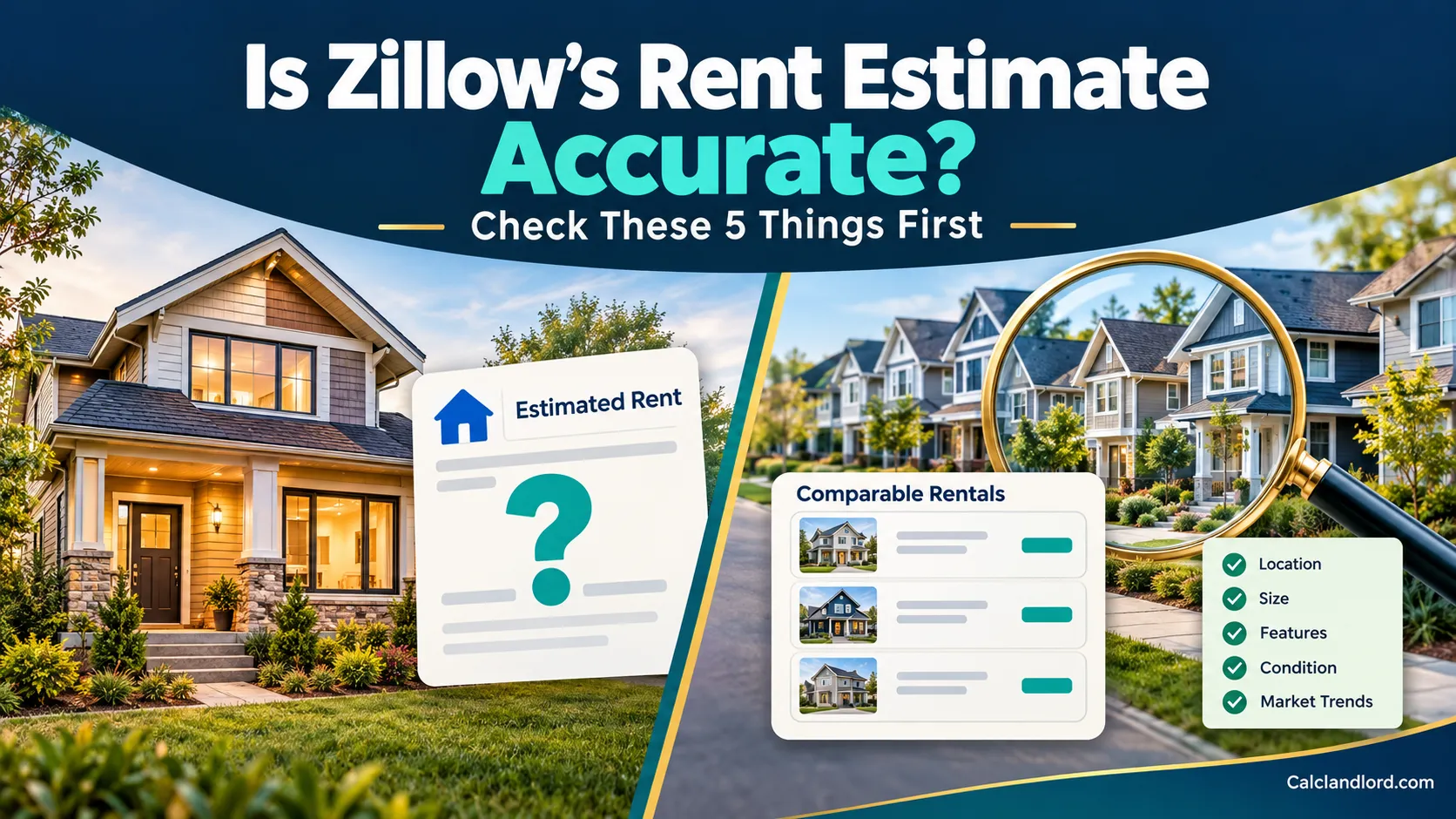
Rental comps, short for comparable rentals, are properties that compete with yours for similar tenants.
A landlord should use comps to determine whether Zillow’s estimate is reasonable for the property’s actual location, features, and condition.
Step 1: Find Similar Properties
Start with five to ten reasonably comparable rentals if enough are available.
Look for properties with similar:
- Property types, such as single-family homes or apartments.
- Bedroom and bathroom counts.
- Square footage and layout.
- Neighborhoods and access to local amenities.
- Interior condition and renovation quality.
- Parking, laundry, outdoor space, and pet policies.
In suburban areas, a wider search radius may be necessary. In dense urban areas, nearby properties in the same neighborhood or building may provide better comparisons.
Step 2: Compare Recent Listings
Review active listings to understand the competition a prospective tenant will see.
Recent listings are useful for identifying asking prices, but remember that an advertised rent is not proof that a property leased at that amount.
Where reliable information is available, recently leased properties provide additional evidence of achievable rent.
Step 3: Adjust for Property Differences
Suppose your rental includes a garage and updated kitchen, while a comparable property has older finishes and no parking.
You may be able to justify a higher rent, but the adjustment should reflect local tenant demand rather than an arbitrary amount.
Likewise, deferred maintenance, a less convenient location, or fewer amenities may justify pricing below otherwise similar rentals.
Step 4: Calculate a Comparable Rent Benchmark
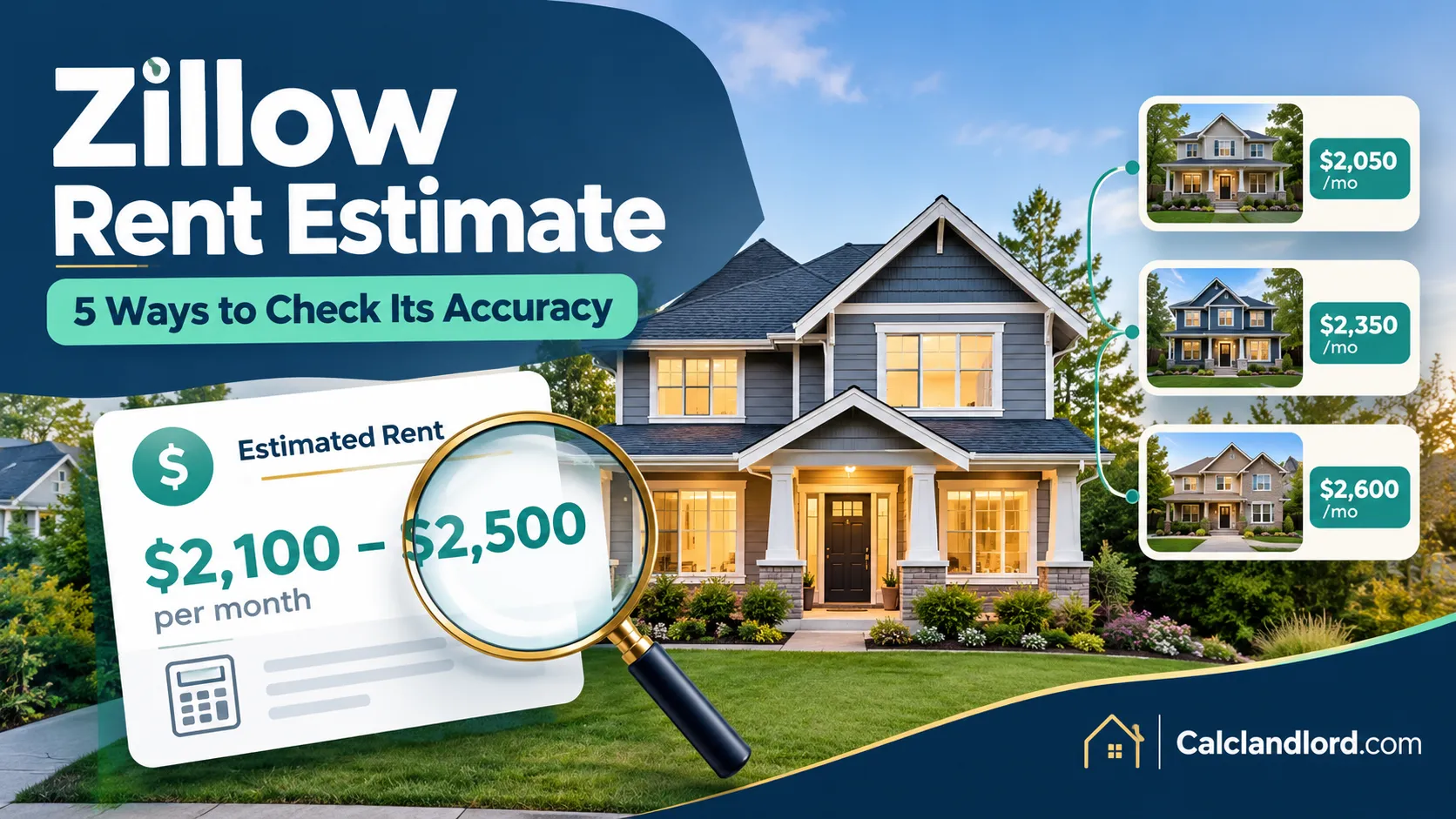
Consider these illustrative monthly asking rents:
| Comparable property | Monthly asking rent |
| Rental A | $2,250 |
| Rental B | $2,350 |
| Rental C | $2,400 |
| Rental D | $2,450 |
| Rental E | $2,550 |
The median asking rent is $2,400 per month.
If Zillow estimates your property at $2,400, the estimate is broadly consistent with this sample. That agreement supports using $2,400 as a starting point, but it does not establish that your property will lease at that amount.
The next step is to account for differences in property condition, amenities, location, and current demand.
How to Set the Right Rent Using Zillow’s Estimate
Once you have checked the estimate against comparable properties, choose a price that balances rental income with the likelihood of finding a qualified tenant.
Use the following process.
Step 1: Record the Rent Zestimate
Write down Zillow’s estimate and any available Rent Range.
Treat the estimate as a benchmark, not a final decision.
Step 2: Establish a Market Rent Range
Use your comparable rentals to establish a reasonable range for similar properties.
For example, your research might suggest a market range of $2,300 to $2,500 per month.
Step 3: Evaluate Your Property’s Position
Consider whether your rental is below average, typical, or better than comparable properties.
A recently renovated house with convenient parking may support pricing toward the upper end of the range. A property with dated interiors or deferred maintenance may need a more competitive price.
Step 4: Choose an Initial Asking Rent
Suppose Zillow estimates $2,400, and your comparable rentals support a range of $2,300 to $2,500.
Your initial price could be $2,350, $2,400, or $2,450, depending on the property’s features, competition, and your leasing priorities.
These are illustrative options, not universal pricing rules.
Step 5: Monitor the Listing
After advertising the property, review the quality and quantity of inquiries, scheduled showings, and qualified applications.
If interest remains weak, investigate whether the price, listing photographs, description, property condition, or marketing reach needs improvement.
Do not assume every slow response is caused by rent alone.
How Much Rent Do You Need to Cover Your Rental Property Expenses?
A market rent estimate helps you understand potential income, but it does not tell you whether a property will generate positive cash flow.
Landlords should compare expected rent with operating expenses, mortgage payments, vacancy, and maintenance costs.
A basic monthly cash flow formula is:
CashFlow=RentalIncome-Expenses
For a more useful estimate, include vacancy and operating costs in your calculation.
Example: Rental Income vs. Expenses
Imagine you own a single-family rental property with the following monthly figures.
| Item | Monthly amount |
| Expected rent | $2,400 |
| Vacancy allowance | $120 |
| Operating expenses | $650 |
| Mortgage payment, including principal and interest | $1,100 |
| Estimated monthly cash flow | $530 |
The calculation is:
\[ \$2,400-\$120-\$650-\$1,100=\$530 \]
Under these assumptions, the property generates an estimated $530 in monthly cash flow, or $6,360 annually.
This is an illustrative calculation, not a forecast. Actual results will depend on rent collected, repairs, insurance, property taxes, vacancies, financing, and other costs. Confirm that operating expenses do not already include an item counted separately.
You can also use a rental cash flow calculator to test different rent and expense assumptions before making an investment decision.
Zillow’s Rent Estimate vs. Other Rental Estimation Methods
Zillow is not the only way to estimate rental value. Different approaches can help answer different questions.
| Method | Main advantage | Main limitation |
| Zillow Rent Zestimate | Convenient starting estimate | May not capture every property-specific detail |
| Comparable rental listings | Shows current advertised competition | Asking rent may differ from signed lease rent |
| Recently leased properties | Helps assess achieved rents | Reliable lease data may be difficult to obtain |
| Local property manager | Offers local market experience | Quality and accuracy depend on the professional |
| Manual rental analysis | Allows detailed property-specific adjustments | Requires time and reliable information |
For most landlords, the strongest approach is to combine an automated estimate with local comparable rentals and a realistic property-level assessment.
- Explore More: https://calclandlord.com/personal-guarantee/
Common Mistakes to Avoid When Using Zillow’s Rent Estimate
Treating the Estimate as a Guaranteed Rent
An estimated value does not guarantee that a tenant will pay that amount. Always validate the figure against current local conditions.
Comparing Different Property Types
A two-bedroom apartment is not automatically comparable to a two-bedroom detached house. Property type, privacy, outdoor space, and included amenities can materially affect rent.
Ignoring the Condition of the Property
An estimate may not fully reflect recent renovations, visible wear, deferred maintenance, or the quality of interior finishes.
Confusing Asking Rent With Achievable Rent
A high asking price may remain on the market without attracting a suitable tenant. Compare advertised prices with available evidence of completed leases whenever possible.
Forgetting Expenses and Vacancy
A rental can command market rent and still produce disappointing returns. Investors should evaluate operating costs, financing, vacancy, and potential repairs alongside expected rental income.
Overlooking Local Rules
Landlords should check applicable state and local requirements before changing rent, advertising a property, or renewing a lease. Rent regulations, notice requirements, and other landlord obligations vary by jurisdiction.
People Also Ask
Zillow provides a Rent Zestimate on eligible property listings and offers rental pricing tools. Availability and features may vary by property and service. Check Zillow’s official website for the current options.
Visit Zillow’s rental pricing tool, search for your property, and review the available rental estimate and related information. You can begin at Zillow Rental Manager.
You generally cannot directly choose the model-generated estimate. If you own the property, you may be able to claim the listing and update incorrect or outdated property facts. The estimate may change as the underlying information and market data change.
The estimate may use different data, property characteristics, or market patterns from the listings you are comparing. Differences in condition, amenities, location, timing, and the limited availability of comparable rentals can also explain the gap.
Landlords can use it as a starting point, but should verify it with comparable rentals, property-specific adjustments, and local market knowledge before setting a final price.
Conclusion
Zillow’s Rent Zestimate is a useful starting point for estimating monthly rental income, but it should not be the only factor in your pricing decision.
The most reliable approach is to compare the estimate with similar local rentals, adjust for your property’s condition and amenities, and monitor real tenant demand after listing.
For landlords, the goal is not simply to achieve the highest advertised rent. It is to choose a defensible price that attracts qualified tenants while supporting the property’s long-term financial performance.
