
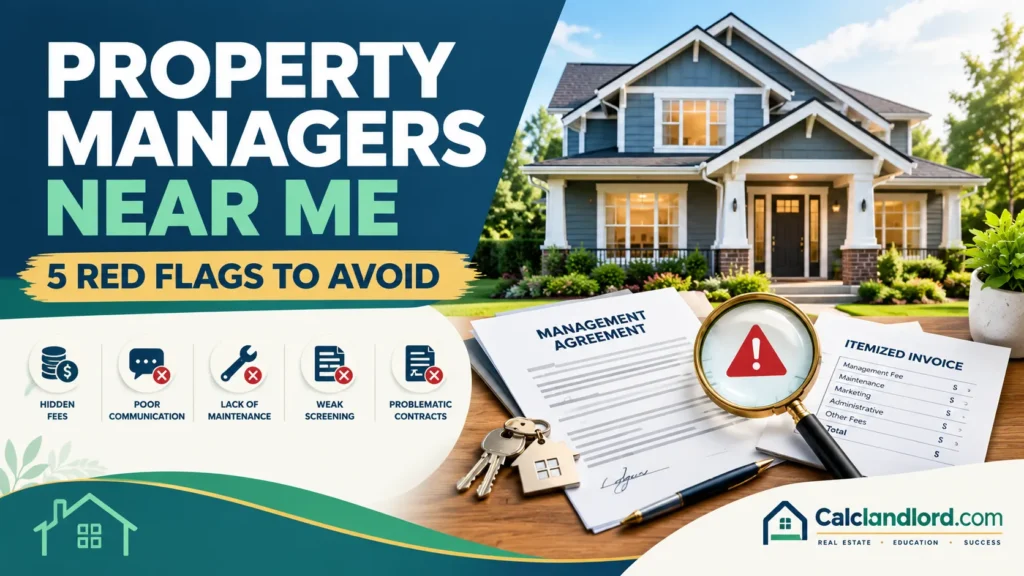
Property Managers Near Me: How to Choose the Right Local Property Manager
Searching for property managers near me is a common first step for landlords who want to protect their rental properties without handling every tenant issue, repair, and payment themselves. But choosing the right company takes more than comparing Google ratings or selecting the nearest office.
A reliable property manager should understand your local rental market, communicate clearly, handle maintenance responsibly, screen tenants consistently, and explain every fee before you sign an agreement. The wrong choice can create unnecessary expenses, prolonged vacancies, and frustrating disputes.
Whether you own a single-family rental, condominium, duplex, multifamily property, or vacation rental, this guide explains how to find, compare, and hire a property management company that fits your needs.
Quick Answer: How Do I Find the Best Property Managers Near Me?
To find the best property managers near you, search for companies that serve your property’s neighborhood and specialize in your rental type. Compare three to five candidates, review recent customer feedback, verify applicable licensing, request owner references, and examine their complete fee schedules and management agreements.
Choose the company with the strongest combination of local expertise, transparent pricing, reliable maintenance procedures, and clear financial reporting—not necessarily the lowest advertised fee.
What Do Property Managers Near Me Do?
A property manager handles some or all of the everyday responsibilities involved in operating a rental property. The exact services depend on the company’s package and the agreement you sign.
Common property management services include:
| Service | What the manager does |
| Rental pricing | Recommends rent based on comparable properties and market conditions |
| Marketing and leasing | Advertises vacancies, arranges showings, and processes applications |
| Tenant screening | Evaluates applicants using consistent, lawful criteria |
| Lease administration | Coordinates lease signing, renewals, and documentation |
| Rent collection | Tracks payments and follows up on overdue balances |
| Maintenance coordination | Arranges repairs and communicates with vendors |
| Property inspections | Documents conditions and identifies maintenance concerns |
| Tenant communication | Handles questions, complaints, and routine requests |
| Financial reporting | Provides owner statements and expense records |
| Compliance support | Helps administer applicable rental procedures and required notices |
Some companies offer full-service residential management, while others specialize in tenant placement, apartment management, or short-term rentals.
Before searching, decide which responsibilities you want to delegate. An owner who needs help finding tenants may not need the same package as an investor who wants someone to manage every aspect of a rental property.

How to Find Property Managers Near You
Finding a suitable company becomes easier when you follow a consistent process rather than relying on the first search result.
1. Search Using Your City and Property Type
Start with the phrase “property managers near me,” then narrow your search by location and property type.
Useful searches include:
- Property management companies in [your city]
- Residential property managers near me
- Rental property management in [your neighborhood]
- Single-family property managers in [your city]
- Apartment management companies near me
- Vacation rental property managers in [your city]
Location matters because rental pricing, tenant demand, vendor availability, and local requirements can differ substantially between neighborhoods.
A company experienced in managing single-family homes may be less suitable for a large apartment building. Similarly, short-term rental management involves different operational demands from traditional long-term leasing.
Look for evidence that the company actively manages properties similar to yours in the area you serve.
2. Build a Shortlist of Three to Five Companies
Create a simple comparison sheet for each candidate.
Record the company’s experience, service area, management fees, property types, communication procedures, and contract terms. This gives you a consistent basis for comparison.
You can also use the National Association of Residential Property Managers directory to find residential property management professionals. Membership can be a useful screening factor, but it does not replace checking references, credentials, and actual service quality. The association also publishes guidance on hiring property managers.

narpm.org
+1
3. Read Online Reviews for Repeated Problems
A high average rating can be encouraging, but it does not establish whether a company is suitable for your property.
Read recent reviews and look for recurring themes involving:
- Delayed maintenance or emergency responses
- Unexplained fees and repair invoices
- Difficulty contacting the assigned manager
- Poor communication about vacancies
- Problems with owner statements or payments
- Disagreements over move-outs or security deposits
- Complications when terminating a contract
One complaint may reflect an isolated incident. Repeated complaints about the same issue deserve closer attention.
Ask the company how it handles the specific problems you identify. Clear procedures are more reassuring than general promises.
4. Verify Credentials and Ask for References
Property management licensing requirements vary by state and by the activities performed. Check the relevant state real estate regulator to determine which licenses or broker supervision requirements apply.
Ask for appropriate insurance information and references from owners whose properties resemble yours. A manager experienced with a comparable property can provide more relevant evidence than one whose entire portfolio consists of a different rental type.
When speaking with references, ask whether the company responds promptly, explains expenses, handles maintenance responsibly, and delivers understandable financial reports.
What to Look for in a Local Property Manager
The best local property managers should be able to explain how they operate, how they make decisions, and how they protect your investment.
Local Rental Market Knowledge
Ask how the company determines the rental price for your property.
A thoughtful recommendation should consider comparable rentals, neighborhood conditions, property features, current competition, and the condition of the unit.
Be cautious if a manager promises exceptionally high rent without explaining the evidence. An inflated asking price can lead to a longer vacancy, potentially offsetting the additional income you hoped to earn.
Ask what information the company uses to estimate leasing time and how it adjusts its strategy if a unit remains vacant.
Consistent Tenant Screening
Tenant screening can influence rent collection, property condition, tenant retention, and the amount of time you spend resolving disputes.
Ask how the company verifies applicant information, reviews rental history, evaluates income, and applies its screening criteria.
The U.S. Department of Housing and Urban Development explains that the Fair Housing Act applies to housing decisions, including decisions involving tenant-screening technology. Your manager should have a consistent process designed to avoid discriminatory decisions and comply with applicable fair housing requirements.
archives.hud.gov
You should also ask who makes the final approval decision and how applicants are informed about screening outcomes.
Maintenance and Repair Management
Maintenance is one of the most important areas to investigate before hiring a manager.
A property manager should have a documented process for handling routine requests, urgent repairs, vendor selection, repair approvals, and invoices.
Ask these questions:
- Who answers emergency calls outside normal business hours?
- What repair amount requires my approval?
- Does the company use in-house technicians or outside contractors?
- Will I receive itemized invoices?
- Are maintenance markups charged?
- How are recurring repair problems tracked?
For example, a manager might arrange a $900 plumbing repair. You should be able to see what work was completed, who performed it, whether approval was required, and whether the invoice includes additional charges.
Clear documentation helps you assess costs and catch recurring problems before they become expensive.
Financial Reporting and Communication
You should understand what your rental earns, what it costs to operate, and how much money is available for distribution.
Ask to see a sample monthly owner statement. It should clearly identify rental income, management fees, maintenance costs, other expenses, and owner payments.
Also ask whether you will have access to an online portal, how frequently reports are delivered, and whom you should contact about urgent matters.
The ability to review financial information promptly is particularly valuable if you own several properties or live far from your rental.
How Much Do Property Managers Near Me Charge?
Property management fees depend on the local market, property type, services included, and pricing structure.
As a general benchmark, a September 2026 survey of advertised management companies across 80 U.S. metropolitan areas reported an average percentage-based management fee of 8.49% of monthly rent. Advertised rates varied considerably, and individual markets may differ from the overall average.

iPropertyManagement.com
Use this figure as a starting point, not a guaranteed rate for your property.
Common Property Management Fees
| Fee | What to check |
| Monthly management fee | Percentage of rent collected or flat monthly charge |
| Tenant placement fee | Charge for advertising, screening, and placing a tenant |
| Lease renewal fee | Cost of processing a new lease term |
| Setup fee | Initial onboarding and account setup |
| Inspection fee | Charges for specific property inspections |
| Maintenance coordination | Separate charges or markups associated with repairs |
| Vacancy fee | Whether fees continue while a unit is empty |
| Termination fee | Charges and notice requirements for ending the agreement |
Not every company charges every fee. Request a written fee schedule and confirm which services are included in the quoted rate.
Example: Calculate the Annual Management Fee
Suppose your rental collects $2,000 per month and the property manager charges 10% of rent collected.
| Calculation | Amount |
| Monthly rent collected | $2,000 |
| Management fee percentage | 10% |
| Monthly management fee | $200 |
| Annual rent collected, assuming 12 paid months | $24,000 |
| Annual management fee | $2,400 |
Your rental would have $21,600 remaining after management fees alone. This is not your final profit because you still need to account for property taxes, insurance, maintenance, vacancies, and other expenses.
Compare the total estimated annual cost of each company, including leasing, renewal, inspection, and maintenance charges. A company advertising a lower monthly percentage may cost more once all fees are included.
Local Property Manager vs. National Company
A local firm may have strong neighborhood knowledge and established relationships with nearby vendors. A national company may offer standardized procedures and centralized reporting systems.
Neither option is automatically better.
| Factor | Local company | National company |
| Market knowledge | May have detailed neighborhood experience | Depends on local team expertise |
| Owner communication | May offer direct access to the manager or owner | May use assigned representatives or centralized support |
| Maintenance | Often relies on local vendor relationships | May use regional or approved vendors |
| Technology | Varies by company | May offer standardized systems |
| Service consistency | Depends on staffing and procedures | May benefit from standardized processes |
| Potential fit | Owners seeking local, hands-on service | Owners seeking established systems or broader coverage |
Ask who will actually manage your property, how many properties that person handles, and what happens if your assigned manager leaves.
For a larger portfolio, assess whether the company can provide consistent reporting and management across all locations.
- Explore More: https://calclandlord.com/zillows-rent/
18 Questions to Ask Before Hiring a Property Manager
Use these questions during interviews and compare the answers across companies.
Experience and Leasing
- How many rental properties do you manage in my area?
- What types of properties do you specialize in?
- How do you determine the recommended rent?
- How do you market vacancies and track leasing performance?
- What tenant-screening process do you follow?
Fees and Maintenance
- Is your management fee based on rent collected or scheduled rent?
- What additional charges could I incur during a typical year?
- Do you add markups to maintenance invoices?
- What repair amount requires my approval?
- Who handles emergency repairs after hours?
Communication and Reporting
- How often will I receive financial statements?
- Can I see a sample owner statement?
- Who will be my main contact?
- How do you handle urgent owner inquiries?
- How do you manage overdue rent, lease violations, and tenant complaints?
Contracts and Accountability
- Can you provide references from current property owners?
- What are the cancellation requirements and termination fees?
- How do you measure performance and resolve owner complaints?
Write down the answers rather than relying on memory. Pay particular attention to differences in service scope, repair approvals, and total costs.
Property Management Red Flags
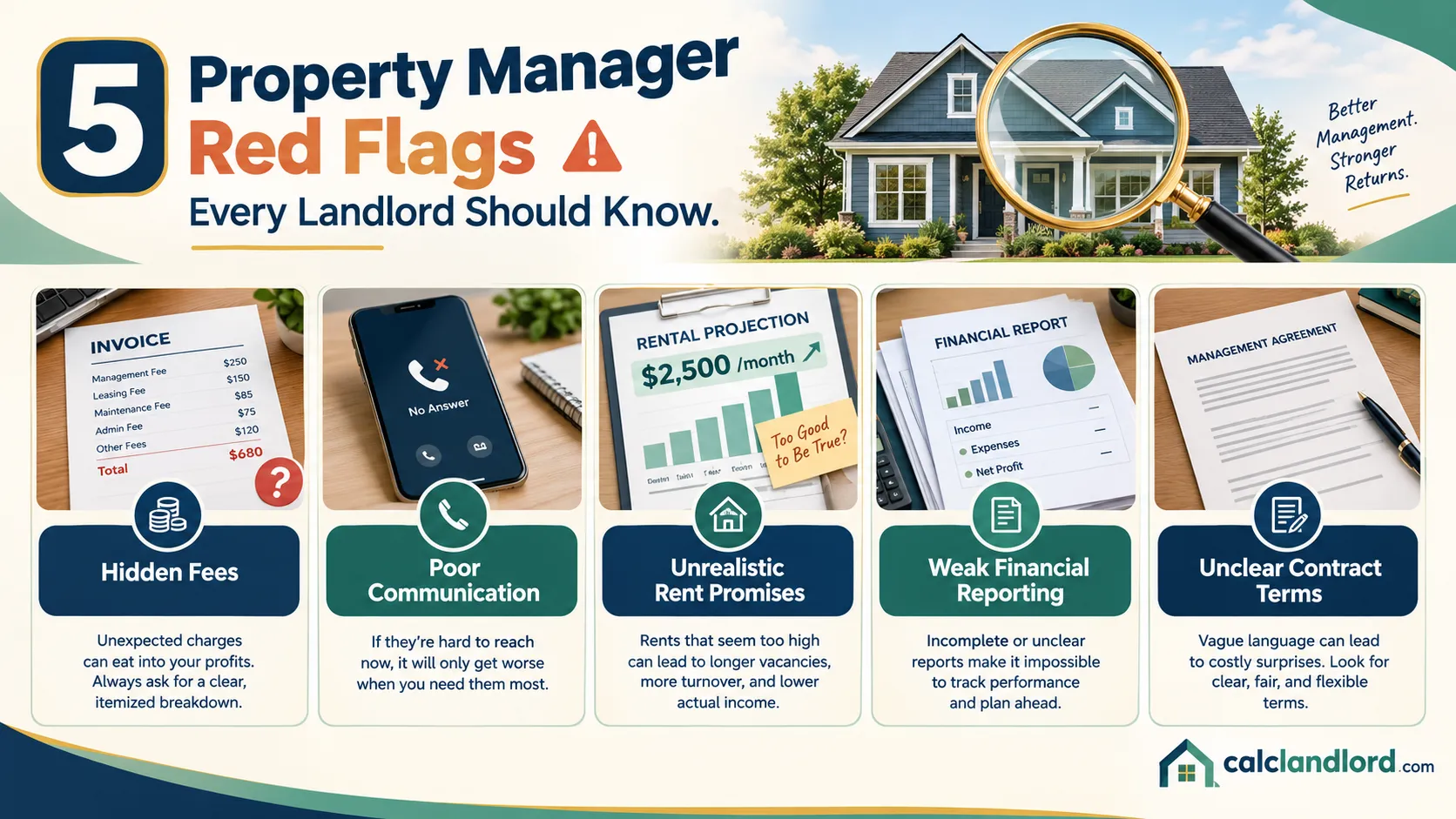
Certain warning signs justify additional questions or may indicate that another company is a better choice.
- Unclear pricing: The company will not provide a complete written fee schedule.
- Unrealistic rent promises: High projected rent comes without supporting comparisons.
- Hidden maintenance charges: The company will not explain vendor markups or related fees.
- Poor communication: Representatives are difficult to reach before you sign.
- Weak reporting: The company cannot demonstrate how it tracks income and expenses.
- Inconsistent screening: Staff cannot explain how applicant criteria are applied lawfully and consistently.
- Unclear repair authority: You cannot determine when the manager may approve spending.
- Restrictive cancellation terms: Termination penalties or notice requirements are difficult to understand.
- No relevant references: The company cannot provide credible evidence of experience with similar rentals.
- Pressure to sign immediately: You are discouraged from comparing proposals or reviewing the agreement carefully.
A single warning sign does not automatically mean a company is unsuitable. Several unresolved concerns, however, should make you cautious about handing over responsibility for your investment.
How to Compare Property Management Proposals
Once you have received proposals, use a scorecard to evaluate each company consistently.
Give each category a rating from 1 to 5, where 1 means poor and 5 means excellent.
| Evaluation category | Maximum score |
| Local market expertise | 5 |
| Experience with your property type | 5 |
| Fee transparency | 5 |
| Tenant-screening process | 5 |
| Maintenance management | 5 |
| Financial reporting | 5 |
| Communication | 5 |
| Reviews and references | 5 |
| Contract flexibility | 5 |
| Total | 45 |
A scorecard helps organize your decision, but it does not guarantee future performance. Verify important statements, review the agreement, and investigate any concerns before hiring.
Also consider which factors matter most for your circumstances. An out-of-state landlord might prioritize emergency response and financial reporting, while an owner with multiple apartment buildings might place more weight on maintenance systems and portfolio reporting.
What Should a Property Management Agreement Include?
Your management agreement should clearly explain the responsibilities of both parties.
Before signing, review the following terms:
- Services included and excluded
- Monthly management fee and additional charges
- Rent collection and handling of property funds
- Repair approval limits and emergency procedures
- Tenant screening and leasing responsibilities
- Inspection procedures and reporting frequency
- Financial statement delivery and owner payments
- Insurance and liability responsibilities
- Contract duration and renewal provisions
- Cancellation notice and termination charges
- Transfer of leases, records, funds, and tenant information
- Procedures for resolving disputes
Pay particular attention to affiliated maintenance companies, repair authorization, and any charge the manager can impose without obtaining advance approval.
Ask for unclear terms to be explained in writing. Licensing, security deposits, landlord-tenant obligations, notices, and eviction procedures may vary by state and locality. Consult the relevant regulator or a qualified attorney when you need jurisdiction-specific guidance.
Is Hiring a Property Manager Worth It?
Hiring a property manager is worthwhile when the value of the services, time saved, and potential operating improvements justify the cost.
It may make sense if you live far from your rental, have multiple properties, lack time to handle tenant requests, or need a more structured way to manage leasing and maintenance.
Self-management may be a reasonable alternative if you have the necessary time, knowledge, local availability, and willingness to handle tenant communication and repairs.
Example: Self-Management vs. Professional Management
Assume a rental produces $30,000 in annual rent collected and has $9,000 in other operating expenses before management fees.
| Annual item | Self-managed | Professionally managed |
| Rent collected | $30,000 | $30,000 |
| Management fees | $0 | $3,000 |
| Other operating expenses | $9,000 | $9,000 |
| Net operating income after listed expenses | $21,000 | $18,000 |
In this simplified example, professional management reduces net operating income by $3,000 if all other factors remain unchanged.
Actual results may differ if a manager improves tenant retention, reduces vacancy, prevents maintenance problems, or charges additional fees. Your own time also has value, even if it does not appear as an accounting expense.
Use a rental cash flow calculator to compare realistic income and expense scenarios before deciding whether professional management makes financial sense.
How to Get Better Results From Your Property Manager
Hiring a property manager does not mean giving up oversight of your investment.
Set Expectations Early
Agree on communication channels, reporting frequency, repair approval limits, emergency procedures, and leasing responsibilities before management begins.
- Explore More: https://calclandlord.com/rent-ledger/
Review Monthly Statements
Check rent collected, management fees, maintenance invoices, and owner distributions. Ask questions about unexplained expenses or changes in operating costs.
Track Vacancies
Ask how quickly comparable properties are leasing and what the manager will change if your unit remains vacant. A prolonged vacancy may outweigh a small difference in management fees.
Keep a Maintenance Reserve
Maintain accessible funds for unexpected repairs and major replacements. Agree on how urgent repairs will be handled when immediate action is necessary.
Review Performance Periodically
Compare actual results with your rental budget. Review the company’s communication, tenant retention, maintenance costs, and reporting quality rather than evaluating performance by rent collection alone.
Maintain Your Own Records
Keep copies of agreements, owner statements, invoices, leases, and important correspondence. Organized records make financial reviews easier and help you prepare information for tax reporting.
People Also Ask About Property Managers Near Me
Search for companies that manage properties in your area, shortlist three to five candidates, review recent feedback, verify applicable licensing, and request references from current owners. Compare written fee schedules, maintenance procedures, communication standards, and contract terms before hiring.
Many residential property managers quote fees as a percentage of rent collected, with 8% to 12% often used as a general benchmark. Actual prices vary by property, location, and service package. Ask about leasing, renewal, inspection, setup, and maintenance charges before comparing offers
It can be worthwhile if you want to reduce your workload, live far from the property, or need help coordinating tenants and maintenance. Compare the annual management cost with the time saved and realistic improvements in property operations.
A leasing agent generally focuses on marketing a rental and placing a tenant. A property manager typically handles ongoing operations, including rent collection, maintenance coordination, tenant communication, inspections, lease renewals, and owner reporting. Some companies provide both services.
Choose based on the quality of the actual management team, local knowledge, reporting, communication, pricing, and contract terms. Local firms may offer direct access and neighborhood expertise, while national firms may provide more standardized systems. Evaluate each company individually.
Conclusion
Finding the right property managers near me requires more than comparing ratings, advertised fees, and office locations. You need a company that understands your rental market, manages tenants professionally, coordinates maintenance transparently, and provides clear financial reporting.
Compare multiple firms, verify their experience, and read the full management agreement before signing. Most importantly, evaluate the decision against your investment goals and expected net rental income.
A good property manager should make rental ownership easier to manage while helping you protect your investment. Use a rental cash flow calculator to compare management costs with your other expenses and make a decision based on realistic financial projections.
