

How Long Will My Retirement Savings Last?
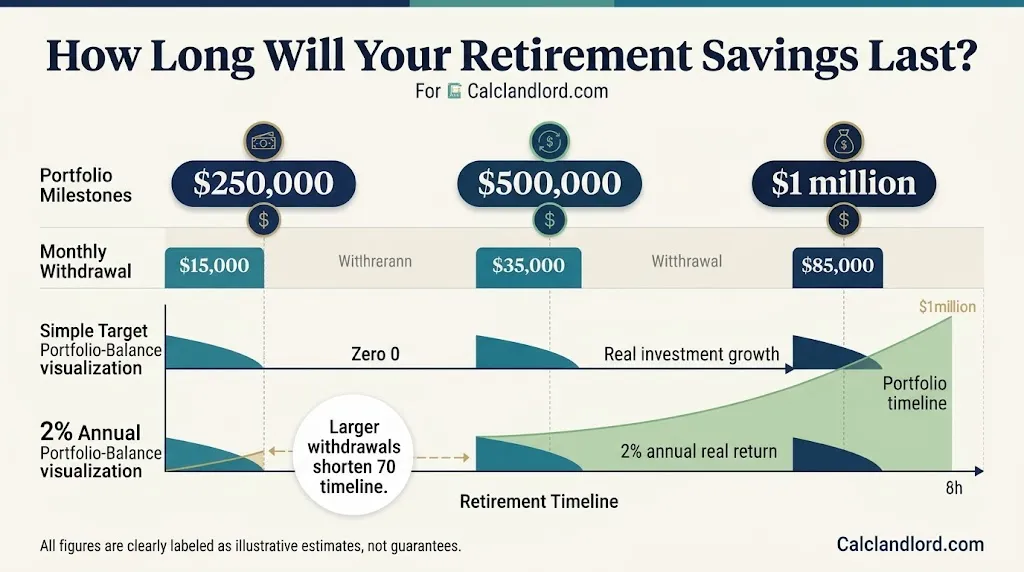
Your retirement savings might last 10 years, 25 years, or longer—but the balance in your account alone cannot tell you. The answer depends on how much you withdraw, what Social Security or a pension covers, how prices rise, and how your investments perform. A $500,000 portfolio, for example, faces a very different outlook when it must provide $2,000 a month than when it must cover $4,000. This guide helps you estimate your retirement savings timeline, compare practical withdrawal scenarios, and spot assumptions that could put your plan at risk. Start with your spending gap, then test the numbers first.
How long your retirement savings last depends on three major factors: how much money you have saved, how much you withdraw, and how your investments perform over time. Social Security, pension income, inflation, taxes, healthcare costs, and unexpected expenses can also change your retirement timeline.
For example, $500,000 in retirement savings could cover a $2,000 monthly spending gap for approximately 20.8 years without investment growth. With a hypothetical 2% annual return after inflation, the same savings could support that gap for approximately 27.2 years under a simplified mathematical model.
These are estimates, not guarantees. Investment returns fluctuate, expenses change, and actual withdrawals may be subject to taxes. Even a seemingly small difference in your monthly spending can significantly affect how long your money lasts.
The best way to estimate your retirement timeline is to calculate how much your savings must provide after accounting for other income, then test several investment and inflation scenarios.
The Quick Answer: How Long Will Your Retirement Savings Last?
Your retirement savings will generally last longer when your withdrawals are smaller relative to your starting balance and your investments generate positive returns after inflation. Higher spending, taxes, poor investment performance, and unexpected expenses can shorten that period.
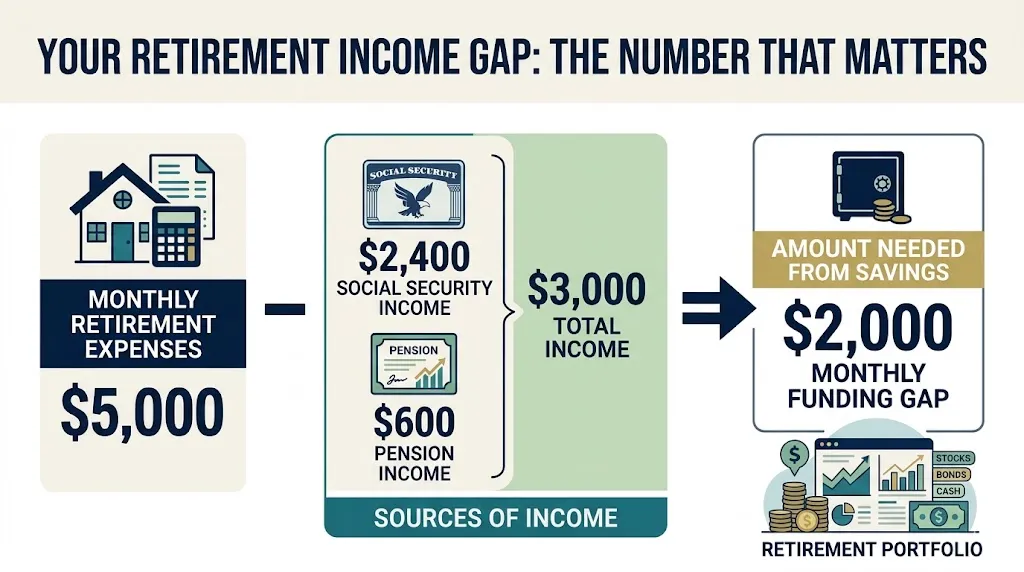
Start by calculating your retirement income gap:
Monthly retirement income gap = Monthly expenses − Monthly income from other sources
For example, suppose your household has the following retirement budget:
| Retirement income or expense | Monthly amount |
| Total retirement spending | $5,000 |
| Social Security income | $2,400 |
| Pension income | $600 |
| Amount needed from savings | $2,000 |
Your savings must provide $2,000 per month, or $24,000 per year, before accounting for any additional taxes on withdrawals.
If your retirement portfolio is worth $500,000, your initial withdrawal rate would be:
[
\frac{$24,000}{$500,000}\times100=4.8%
]
This 4.8% figure is an initial withdrawal rate, not a prediction of how long the portfolio will last. To estimate longevity, you must also consider investment returns, inflation, withdrawal timing, and your retirement horizon.
How to Calculate How Long Your Retirement Savings Will Last
You can estimate your retirement savings longevity by following five steps. These calculations work for retirees relying on a 401(k), an IRA, taxable investments, cash savings, or a combination of accounts.
Step 1: Determine Your Available Retirement Savings
Start with the money you expect to use to support your retirement lifestyle.
Include relevant assets such as:
- Traditional and Roth IRAs.
- Employer-sponsored retirement accounts, including 401(k) plans.
- Taxable investment portfolios.
- Cash savings specifically reserved for retirement.
- Other investments you realistically expect to sell or use for income.
Avoid counting the same money twice. If your savings are spread across several accounts, combine their balances only after checking for overlapping figures.
Also distinguish liquid investments from assets you do not intend to sell. A home worth $400,000 is not equivalent to $400,000 in a brokerage account if you plan to continue living in that home.
If you expect to sell your home, downsize, or use a rental property’s equity to fund retirement, model that decision separately. Include expected transaction costs, remaining debt, and the timing of the proceeds.
Step 2: Estimate Your Total Retirement Expenses
Your spending plan should reflect the lifestyle you actually expect to maintain, rather than a percentage of your former salary.
Include recurring expenses such as:
- Housing, utilities, and property taxes.
- Groceries and household purchases.
- Transportation and vehicle expenses.
- Health insurance, Medicare-related costs, and medical care.
- Debt payments and insurance premiums.
- Travel, hobbies, and entertainment.
- Family support and charitable contributions.
You should also budget for expenses that do not occur every month, including vehicle replacement, dental work, home repairs, and major medical bills.
Homeowners may need additional reserves for roofs, heating and cooling systems, and other large repairs. Retirees who own rental properties must also account for vacancies, maintenance, insurance, property taxes, and capital improvements.
A budget that excludes irregular expenses can make a retirement plan appear more sustainable than it really is.
Step 3: Subtract Social Security, Pensions, and Other Income
Next, estimate how much money you expect to receive without withdrawing it from the investment portfolio being modeled.
Possible sources include Social Security, pension payments, annuity income, part-time employment, and dependable net income from rental properties.
Suppose your monthly expenses are $4,500, Social Security provides $2,000, and a pension provides $500.
Your portfolio-funded spending gap is:
[
4,500-2,000-500=2,000
]
Your portfolio would need to provide $24,000 annually before any additional tax adjustments.
The timing of income is important. Someone who retires at 62 but delays Social Security until a later age may need larger portfolio withdrawals during the intervening years.
Use different income amounts for different retirement periods instead of assuming that every income source starts when retirement begins.
Step 4: Account for Taxes on Retirement Withdrawals
The balance shown on a retirement account statement is not necessarily the amount you can spend after taxes.
Traditional IRA distributions are generally taxable as ordinary income, although the taxable amount can depend on the account’s contribution history and other circumstances. Qualified Roth IRA distributions generally receive tax-free treatment when applicable requirements are met.
The IRS explains these distinctions in its guidance on traditional and Roth IRA distributions.
Consider a simplified example in which you need $24,000 annually after tax and assume an effective 15% tax cost on every dollar withdrawn.
The required gross withdrawal would be:
[
\text{Gross withdrawal}=\frac{$24,000}{1-0.15}
]
[
\text{Gross withdrawal}\approx $28,235
]
On a $500,000 portfolio, that represents an initial withdrawal rate of approximately 5.65%, rather than 4.8%.
This is only an illustration. Actual taxes depend on your income, filing status, account types, taxable portions of withdrawals, and applicable state and federal rules. A flat 15% assumption does not represent everyone’s tax situation.
For a more realistic projection, model the tax treatment of each account separately or obtain an estimate from a qualified tax professional.
Step 5: Test Different Investment and Inflation Scenarios
Avoid relying on a single investment return assumption.
A projection based on steady growth may show your savings lasting for decades, but real markets do not produce identical returns every year.
Compare several scenarios:
| Scenario | What to examine |
| No real investment growth | How long savings last without increasing purchasing power |
| Modest positive real return | How inflation-adjusted growth affects longevity |
| Lower returns early in retirement | Whether initial market losses threaten the plan |
| Higher inflation | Whether expenses grow faster than expected |
| Unexpected major expense | How a medical bill or home repair changes the timeline |
| Reduced discretionary spending | Whether temporary spending cuts improve resilience |
A real investment return measures investment performance after inflation.
For a simplified calculation:
[
\text{Real return}=\frac{1+\text{Nominal return}}{1+\text{Inflation}}-1
]
For example, a 5% nominal return and 3% inflation produce a real return of approximately 1.94%, before any additional fees or taxes not already included.
Use returns that are consistent with the model’s fee, tax, and inflation assumptions. Otherwise, you may count the same cost twice or overlook it entirely.
How Long Could $250,000, $500,000, or $1 Million Last?
Your withdrawal needs can matter as much as the amount you have saved. The following examples compare several starting balances and monthly spending gaps.
| Starting savings | Monthly amount needed from savings | Years at 0% real return | Years at 2% annual real return |
| $250,000 | $2,000 | 10.4 | 11.8 |
| $250,000 | $3,000 | 6.9 | 7.6 |
| $500,000 | $2,000 | 20.8 | 27.2 |
| $500,000 | $3,000 | 13.9 | 16.4 |
| $500,000 | $4,000 | 10.4 | 11.8 |
| $750,000 | $3,000 | 20.8 | 27.2 |
| $1,000,000 | $3,000 | 27.8 | 41.0 |
| $1,000,000 | $4,000 | 20.8 | 27.2 |
Methodology: These are illustrative mathematical estimates, not personalized forecasts. Monthly spending gaps are multiplied by 12 and treated as annual, inflation-adjusted withdrawals made at the end of each year. The model assumes constant real returns, no separately deducted taxes or unexpected expenses, and no additional contributions. Actual monthly withdrawals and fluctuating market returns produce different results.
The 2% real-return scenario assumes that purchasing-power growth remains steady. Actual investment returns can be negative, especially during individual years.
The comparison demonstrates why a balance alone cannot answer the question. Under the illustrative 2% real-return model, $500,000 lasts approximately 27.2 years with a $2,000 monthly gap but only 16.4 years with a $3,000 monthly gap.
Increasing the spending gap by $1,000 per month means withdrawing an additional $12,000 every year. That change can materially shorten the period your investments support your lifestyle.
How Long Will $500,000 Last in Retirement?
With a $2,000 monthly spending gap, $500,000 lasts approximately 20.8 years without real investment growth. Under the hypothetical 2% annual real-return model, the estimate increases to approximately 27.2 years.
With a $4,000 monthly gap, the same starting balance lasts approximately 10.4 years without real growth or 11.8 years under the 2% real-return scenario.
These estimates exclude additional taxes and unexpected costs. Your actual outcome depends on investment performance, withdrawal timing, and changes in spending.
How Long Will $1 Million Last in Retirement?
A $1 million portfolio could support a $3,000 monthly spending gap for approximately 27.8 years without real growth or 41 years under the hypothetical 2% annual real-return model.
At a $4,000 monthly gap, the corresponding estimates are approximately 20.8 and 27.2 years.
A larger portfolio provides more flexibility, but it does not guarantee that your savings will last throughout retirement. A higher spending rate, an unexpectedly long retirement, or unfavorable investment returns can still create a shortfall.
What Is the Formula for Retirement Savings Longevity?
A basic formula estimates how long a savings balance lasts when there is no investment growth.
[\text{Years}=\frac{\text{Starting savings}}{\text{Annual withdrawal}}]
For example, with $500,000 in savings and annual withdrawals of $24,000:
[\frac{$500,000}{$24,000}\approx20.8\text{ years}]
This formula is useful as a starting point, but it ignores investment growth and changes in purchasing power.
Formula With a Constant Positive Real Return
For a simplified model with constant positive real returns and annual withdrawals at the end of each year, the estimated number of years is:
[
n=\frac{-\ln(1-rP/W)}{\ln(1+r)}
]
Where:
- (n) = estimated years until portfolio depletion.
- (P) = starting portfolio balance.
- (W) = annual inflation-adjusted withdrawal.
- (r) = annual real investment return expressed as a decimal.
- (\ln) = natural logarithm.
The formula assumes that annual withdrawals exceed the modeled real investment growth. If withdrawals are equal to or less than the model’s annual growth, it does not produce a finite depletion date.
That result should not be interpreted as proof that savings can never run out. Actual returns vary, expenses are uncertain, and real-world withdrawals may include taxes and other costs.
Does the 4% Rule Mean Your Retirement Savings Will Last 30 Years?
No. The 4% rule is a retirement withdrawal guideline, not a guarantee that your savings will last for 30 years.
The traditional approach starts with a withdrawal equal to 4% of the initial portfolio and then increases the dollar amount to account for inflation in subsequent years. It does not mean withdrawing exactly 4% of the account’s current balance every year.
For example, suppose you retire with $1 million:
- Initial withdrawal at 4%: $40,000.
- Following-year withdrawal after a hypothetical 3% inflation adjustment: $41,200.
- Later withdrawals: adjusted according to the plan’s inflation assumptions.
Actual results depend on the timing of market gains and losses, the portfolio’s composition, inflation, and how long withdrawals continue.
What Does Retirement Withdrawal Research Suggest for 2026?
Morningstar’s retirement-income research for 2026 estimated a 3.9% starting withdrawal rate for retirees seeking consistent, inflation-adjusted portfolio withdrawals over a 30-year period, with a modeled 90% probability of having money remaining at the end.
The analysis used forward-looking market and inflation assumptions and identified a base-case portfolio with approximately 30% to 50% allocated to equities. Its portfolio withdrawal rate excluded Social Security and other income sources outside the investment portfolio.
These findings are discussed in Morningstar’s 2026 retirement withdrawal-rate research.
The assumptions matter:
- A 30-year retirement is a planning horizon, not a universal retirement length.
- A modeled 90% probability of success is not certainty.
- Investment allocation, future returns, and inflation can change outcomes.
- Flexible spending strategies may support higher starting withdrawals, but spending may need to decrease during unfavorable periods.
Someone retiring at 55 may need to plan for a longer horizon than someone retiring at 70. Do not apply a withdrawal guideline without considering the length of your expected retirement, other income, and ability to adjust spending.
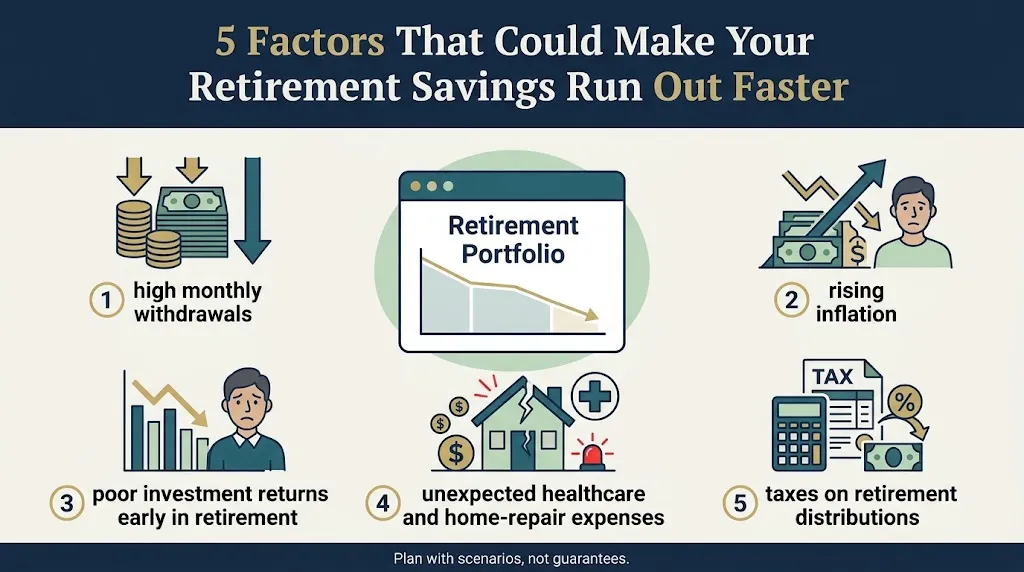
What Can Make Retirement Savings Run Out Earlier?
Several risks can cause your savings to deplete sooner than a straightforward calculator projection suggests.
Poor Investment Returns Early in Retirement
Sequence-of-returns risk occurs when the order of investment gains and losses affects portfolio longevity.
Imagine that two retirees earn similar average returns over a long period. One experiences large losses at the beginning of retirement, while the other encounters those losses much later.
The first retiree may face greater depletion risk because withdrawals made during market declines permanently remove assets that could otherwise participate in a recovery.
Morningstar’s retirement research identifies poor returns during the opening years of retirement as an important risk, particularly when retirees do not reduce spending after losses.
A calculator that assumes identical returns every year cannot fully capture this risk.
Inflation That Exceeds Your Assumptions
Inflation raises the cost of maintaining your lifestyle.
At a hypothetical 3% annual inflation rate, an expense costing $3,000 per month today would cost approximately $5,418 per month in 20 years.
Your retirement income may not increase at the same pace. If expenses rise faster than your income sources, your investment portfolio must provide a growing share of the budget.
This is why a meaningful retirement projection should account for inflation rather than treating today’s monthly expenses as a permanent dollar amount.
Unexpected Healthcare and Household Expenses
Healthcare expenses, major repairs, and family emergencies can require withdrawals beyond your normal spending plan.
Consider a retiree who expects to withdraw $24,000 annually but needs an additional $30,000 for an unexpected expense in year five. That additional withdrawal reduces the amount remaining to fund later years.
Test major expenses explicitly rather than assuming your regular budget will cover everything.
Retiring Earlier or Living Longer
Your retirement age affects the number of years your savings must support your lifestyle.
Retiring at 55 may mean funding several additional years of spending compared with retiring at 65 or 70. It can also mean spending years without Social Security or pension income.
Longer life expectancy can create a different challenge: your savings must continue funding expenses even after an initially reasonable retirement plan has lasted for decades.
Plan for a time horizon that reflects your circumstances instead of assuming your savings only need to last until a conventional retirement age.
Taxes and Required Minimum Distributions
Taxes can reduce the amount available for spending, while required minimum distributions can affect how and when you withdraw money from particular retirement accounts.
RMDs are not the same as your personal spending needs. Certain accounts may require distributions even when you do not need to spend the full amount.
The applicable rules depend on account type, birth year, and other circumstances. Review the IRS’s Publication 590-B on IRA distributions and required minimum distributions and your workplace plan’s requirements.
How to Make Your Retirement Savings Last Longer
The goal is not simply to earn the highest possible investment return. It is to build a withdrawal plan that can withstand changing expenses, market conditions, and income needs.
Reduce the Amount Your Portfolio Must Provide
Start by finding expenses that can be reduced without undermining your essential needs.
If you reduce spending by $300 per month, your portfolio needs to provide $3,600 less per year. That reduction can improve retirement longevity without requiring a more optimistic return assumption.
Review housing expenses, recurring subscriptions, transportation costs, debt obligations, and discretionary purchases.
Separate essential costs from expenses you could temporarily reduce during a difficult market period. This helps you understand how much flexibility your budget provides.
Evaluate When to Claim Social Security
Claiming Social Security earlier generally reduces your monthly benefit compared with claiming at full retirement age. Delaying benefits beyond full retirement age can increase the monthly payment, with delayed retirement credits ending at age 70.
The Social Security Administration explains the trade-offs in its retirement benefits guidance.
Delaying benefits is not automatically the best choice for every household. You may need to draw more heavily on savings while waiting, and the result depends on your health, household income, expected longevity, and financial circumstances.
Compare the higher future benefit with the portfolio withdrawals needed during the waiting period.
Keep Discretionary Spending Flexible
Some retirement expenses are difficult to reduce, while others can be adjusted when markets perform poorly.
Housing, food, and essential healthcare may require relatively stable funding. Travel, major purchases, gifts, and some leisure expenses may offer more flexibility.
A flexible withdrawal plan can allow more spending in favorable years and less spending when investments decline. The trade-off is that your annual income may become less predictable.
Decide in advance which expenses you would reduce if your portfolio fell sharply. Having a defined approach can make it easier to respond before a shortfall becomes severe.
Review Your Investment Allocation
Your portfolio needs to balance growth potential with the risk of losses.
A portfolio invested too conservatively may struggle to keep pace with inflation over a long retirement. A portfolio carrying too much risk may suffer declines that are difficult to recover from while you are withdrawing money.
The appropriate allocation depends on your time horizon, financial resources, income stability, and tolerance for market volatility.
Do not assume that increasing stock exposure automatically makes withdrawals safer. Compare suitable scenarios and consider professional financial guidance when the trade-offs are difficult to assess.
Revisit the Plan as Your Circumstances Change
Update your retirement projection when important inputs change.
Examples include a new pension estimate, a change in Social Security benefits, unexpected medical expenses, a move to a different home, or a major portfolio loss.
An annual review can help identify a growing spending gap before it becomes more difficult to correct. You do not need to predict one exact depletion date and never revisit the plan; you need to understand whether the plan remains workable as circumstances evolve.
Can Rental Property Income Help Your Retirement Savings Last Longer?
Rental property income can help fund retirement expenses by reducing the amount you need to withdraw from stocks, bonds, or retirement accounts. However, rental income should be modeled carefully.
Consider a landlord whose retirement budget requires $5,000 per month. Social Security and pension income provide $3,000, leaving a $2,000 portfolio-funded gap.
If the landlord also receives $800 per month in dependable net rental cash flow, the remaining gap could fall to $1,200 per month, assuming the rental income is not already included in the original $5,000 budget and all figures are treated consistently for taxes.
The distinction between gross rent and net income is crucial.
Before treating rent as retirement income, account for:
- Vacancy and unpaid rent.
- Property taxes and insurance.
- Repairs, ongoing maintenance, and capital expenditures.
- Property management costs.
- Mortgage principal and interest payments.
- Taxes and other property-specific obligations.
Rental cash flow can fluctuate, and a property may require substantial spending in a year when rent is temporarily lost.
You should also distinguish rental income from property equity. Equity may offer future financial flexibility, but it does not automatically produce spendable cash unless you sell, refinance, or otherwise access it.
A realistic retirement plan can model both investment withdrawals and net rental income, but it should not count gross rent or the full value of a property as immediately available retirement cash.
How to Use a Retirement Savings Longevity Calculator
A retirement savings longevity calculator can help estimate how long your money may last by combining a starting balance, withdrawals, investment returns, and other assumptions.
For a useful result, check whether the calculator includes the following inputs:
| Input | Why it matters |
| Starting savings balance | Establishes the initial amount available for withdrawals |
| Monthly or annual spending | Determines how much income your retirement requires |
| Social Security and pensions | Reduces the amount your portfolio must provide |
| Income start dates | Models periods before benefits begin |
| Inflation | Adjusts future spending for purchasing power |
| Investment return | Estimates portfolio growth or decline under the model |
| Fees and taxes | Helps distinguish account balance from spendable funds |
| One-time expenses | Shows how large unexpected costs change the result |
| Planning horizon | Allows you to test whether savings could support retirement through a chosen age |
| Desired ending balance | Accounts for money you want to preserve rather than spend completely |
Before relying on an estimate, ask whether the tool assumes a constant return or models different market outcomes. Those approaches answer different questions.
A constant-return calculator can show what happens under a defined mathematical scenario. It cannot, by itself, establish the probability that your money will last.
Use the output to compare scenarios instead of treating it as a guaranteed depletion date.
Common Mistakes When Estimating Retirement Savings Longevity
A retirement savings calculation becomes less useful when key assumptions are inconsistent or missing.
Using total spending instead of the portfolio-funded gap: Social Security, pension income, and other dependable income can reduce the amount your investments must provide.
Ignoring inflation: A fixed dollar withdrawal may provide less purchasing power over time. Make sure your calculation distinguishes nominal returns from real returns.
Assuming investments earn a steady return: Smooth projections do not capture the risks of market losses early in retirement.
Forgetting taxes: The gross amount withdrawn from a tax-deferred account may exceed the amount you can actually spend.
Counting rental income before expenses: Gross rent is not the same as cash available after vacancies, operating costs, debt payments, repairs, and reserves.
Using a single spending estimate: Healthcare costs, household repairs, and lifestyle changes can alter your plan substantially.
Treating a withdrawal rule as a guarantee: The 4% rule and other guidelines provide a starting point for planning, not certainty about future outcomes.
The best improvement is to test realistic assumptions and revisit them whenever your financial circumstances change.
People Also Ask
With a $2,000 monthly spending gap, $500,000 lasts approximately 20.8 years with no real investment growth, or 27.2 years under a hypothetical 2% annual real-return model. With a $4,000 monthly gap, the estimates fall to approximately 10.4 and 11.8 years, respectively. These examples exclude additional taxes and unexpected expenses.
With fixed, inflation-adjusted withdrawals, $1 million lasts approximately 20.8 years without real investment growth or 27.2 years under a constant 2% annual real-return model. These are illustrative calculations rather than forecasts of actual market performance.
Possibly, depending on your total spending, Social Security benefits, retirement age, other income, and financial obligations. Calculate the amount left after Social Security and pension income, then determine whether your portfolio can reasonably support that gap throughout your expected retirement.
There is no universal percentage that guarantees success. Morningstar’s 2026 retirement-income research estimated a 3.9% initial withdrawal rate for a specific 30-year scenario involving inflation-adjusted spending and a modeled 90% probability of retaining assets at the end. Your appropriate rate may differ according to your portfolio, retirement horizon, income sources, and ability to adjust spending.
Test several changes separately: reduce discretionary spending, adjust your retirement date, evaluate Social Security timing, identify additional income sources, or revise your withdrawal strategy. Compare the effects before changing multiple assumptions simultaneously. Do not solve a shortfall merely by entering an unrealistically high investment return.
Yes. Rental income can contribute to your retirement budget, but use realistic net income rather than gross rent. Account for vacancies, operating expenses, mortgage payments, maintenance, capital improvements, taxes, and reserves. Remember that property equity is separate from spendable rental cash flow.
No. Required minimum distributions are withdrawals mandated from certain retirement accounts under applicable tax rules. Your actual living expenses are a separate matter. Review your account type and current IRS guidance to determine which rules apply to you.
A calculator can accurately solve the mathematical scenario represented by its inputs and assumptions. It cannot guarantee future market returns, inflation, taxes, healthcare expenses, or personal spending. More detailed projections can model a wider range of outcomes, but estimates still depend on the assumptions used.
Conclusion: Plan for a Range of Outcomes, Not One Date
How long your retirement savings last depends on the relationship between your available assets, withdrawals, investment performance, and other retirement income.
Start by calculating your actual spending gap after Social Security, pensions, and other dependable income. Then account for taxes, inflation, and the possibility of poor investment returns early in retirement.
Compare multiple scenarios using realistic assumptions, including unexpected costs and potential changes in spending. If you own rental properties, include their expected net cash flow separately from their equity and gross rental income.
A retirement savings longevity calculator can help you understand these trade-offs, but the most useful result is not a single projected depletion date. It is a clearer understanding of which financial decisions can help your savings support the retirement you want.
Disclaimer: This article provides general educational information, not individualized financial, investment, or tax advice. The examples are hypothetical and do not guarantee future performance. Consider consulting qualified financial and tax professionals when developing a retirement withdrawal plan.

Pingback: 7 Secrets Top Leasing Agents Never Tell You