

Rental Property Finance: The Complete 2026 Guide to Financing Your First (or Next) Investment
Most rental property deals don’t fall apart because the property is bad. They fall apart because the financing doesn’t match the plan — the wrong loan for the investor’s credit, capital, or timeline.
This guide walks through every major way to finance a Rental Property in the U.S. today, what lenders actually require in 2026, and a simple framework for matching a loan to your specific situation — whether you’re buying your first duplex with $15,000 or scaling a portfolio past ten doors.
Quick answer: Most landlords finance rental property using one of three paths: a conventional investment-property mortgage (best rate, strictest income rules), a DSCR loan (qualifies on the property’s rent, not your paycheck), or a low-down-payment owner-occupied loan like FHA or VA used for “house hacking.” Which one fits depends on your capital, your income documentation, and how many properties you’re trying to finance.
This article is educational information, not financial or legal advice. Mortgage rates, underwriting rules, and loan limits change frequently and vary by lender and state — verify current terms with a licensed loan officer before making a decision.
1. What Is Rental Property Finance?
Rental property finance refers to the loans, down payment structures, and funding strategies investors use to buy or refinance income-producing real estate — as opposed to a mortgage on a home you live in.
The core difference from a regular home loan is that lenders treat rental property as higher risk. If a tenant stops paying or a unit sits vacant, an investor is statistically more likely to default than someone financing their own home. That risk shows up in three places on every rental property loan:
- Higher interest rates than an owner-occupied mortgage
- Larger down payments, typically 15–25%+ instead of 3–20%
- Stricter reserve requirements — cash left in the bank after closing
Understanding these three levers is the foundation for everything else in this guide, because every financing option below is really just a different way of trading off rate, down payment, and documentation.
2. Why Your Financing Choice Matters as Much as the Property You Buy
Two investors can buy the identical $300,000 property and end up with completely different outcomes depending on how they finance it. A higher rate or larger down payment doesn’t just cost more — it can turn a cash-flowing rental into a break-even one, or free up (or lock up) capital you need for your next deal.
Financing choice affects:
- Monthly cash flow — rate and loan amount drive your principal-and-interest payment
- Cash-on-cash return — how much down payment you tie up relative to the cash flow it produces
- Speed to close — conventional loans can take 30–45 days; hard money can close in under two weeks
- Scalability — some loan types cap out after four to ten properties; others don’t
We’ll walk through a real side-by-side example in Section 10.
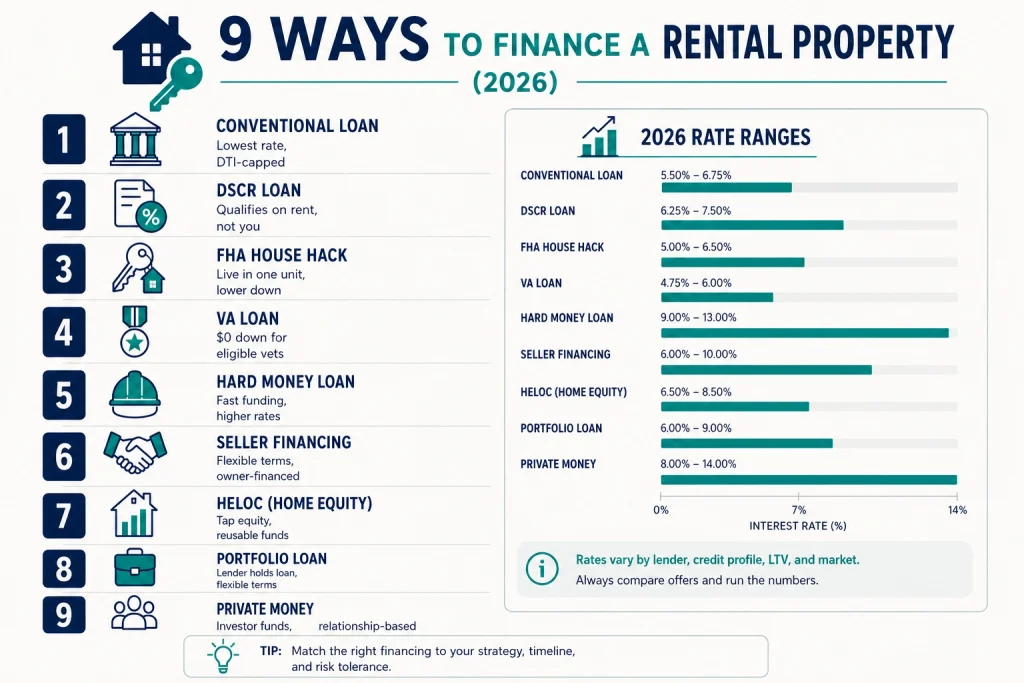
3. The 9 Main Ways to Finance a Rental Property
Here’s a practical rundown of the financing paths available to U.S. investors in 2026, roughly ordered from most conventional to most creative.
Conventional investment-property loan — A standard Fannie Mae/Freddie Mac–backed mortgage for a 1–4-unit rental, underwritten based on your personal income, credit, and debt-to-income (DTI) ratio—generally the lowest available rate for investors who qualify on paper.
DSCR loan — Qualifies you based on the property’s rental income rather than your personal income. No tax returns, no W-2s, no DTI calculation. Popular with self-employed investors and anyone scaling past the point where a conventional lender will count the properties against their DTI.
FHA loan (house hacking) — A low-down-payment, owner-occupied loan usable on 2–4 unit properties if you live in one unit and rent the others. Not a true “rental property loan,” but the most common low-capital entry point for first-time landlords.
VA loan (house hacking) — Same owner-occupancy concept as FHA, available to eligible veterans and service members, with the option for 0% down.
Hard money loan — Short-term, asset-based financing (based on the property’s value, not your income) used mainly for renovation/flip and BRRRR purchases. Fast to close, expensive to hold.
Seller financing — The seller acts as the lender, and the terms are negotiated directly between buyer and seller. Useful for off-market deals or when a buyer doesn’t fit conventional underwriting.
HELOC / home equity loan
— Borrowing against equity in an existing property (often your primary residence) to fund a down payment or renovation on a rental. A bridge tool, not a permanent rental loan.
Portfolio/blanket loan — Held and underwritten by a local or regional bank rather than sold to Fannie/Freddie, sometimes covering multiple properties under one loan. Common once an investor’s deal complexity outgrows conventional underwriting.
Private money/partnerships — Capital from individuals in your network, structured as a loan or equity partnership. Flexible, but built entirely on trust and legal documentation quality.
4. 2026 Rental Property Financing Rates and Requirements at a Glance
Rates move daily, so treat the figures below as directional ranges based on rate-tracking data from late August–early September 2026, not a locked quote. As of that window, average 30-year conventional owner-occupied mortgage rates were sitting in roughly the mid-6% range, with FHA and VA typically pricing modestly below that and investment-property and DSCR loans pricing above it.
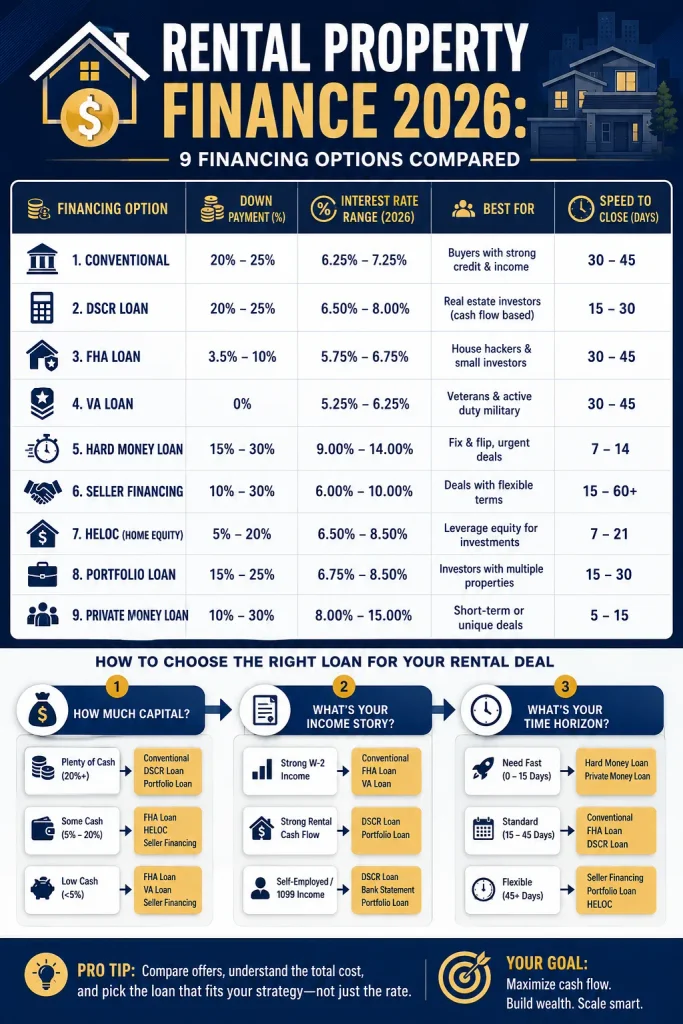
| Loan Type | Typical Down Payment | Approx. 2026 Rate Range* | Qualifies On | Property Limit |
| Conventional investment | 15–25% | ~7.0%–7.8% | Personal income + credit (DTI) | Up to 10 financed properties |
| DSCR | 20–25% (up to 30% for weaker ratios) | ~6.5%–8.75% | Property’s rental income (DSCR ≥ 1.0–1.25 typical) | Effectively unlimited |
| FHA house hack | 3.5% | ~5.9%–6.5% | Personal income + credit; must owner-occupy | 1 property at a time |
| VA house hack | 0% (eligible veterans) | ~5.6%–6.5% | VA eligibility; must owner-occupy | 1 property at a time |
| Hard money | 10–20% | High single digits to low-to-mid teens, plus 1–3 points | Property value / after-repair value (ARV) | Effectively unlimited, short-term only |
| Seller financing | Negotiable (often 5–20%) | Negotiated; frequently near or above prevailing mortgage rates | Seller’s own criteria | Deal-specific |
| HELOC (bridge) | N/A — borrows against existing equity | Variable, tied to prime rate | Equity + credit on the source property | N/A |
| Portfolio/blanket | 20–30%+ | Bank-specific, often above conventional | Bank’s own underwriting | Varies by lender |
*Ranges reflect general market data as of early September 2026 and will differ by lender, credit score, LTV, and property. Always request a current, written quote before comparing loans.
Minimum credit scores generally run 680+ for conventional, 620–660+ for DSCR (with 700+ needed for the best pricing), and 580+ for FHA. VA loans focus more on eligibility and residual income than a hard credit floor, though most lenders still want mid-600s or better in practice.
5. How Much Down Payment Do You Actually Need?
Down payment is usually the single biggest gate between an investor and their first — or next — property. Here’s how the paths break down:
- Under $20,000 in capital: FHA house hacking (3.5% down) or a VA loan (0% down, if eligible) are typically the only realistic entry points, and both require you to live in the property.
- $20,000–$80,000: This is the range where conventional investment loans (15–25% down) and DSCR loans (20–25% down) become realistic on moderately priced properties.
- $80,000+ or existing home equity: Adds flexibility — a HELOC can fund a down payment on a second property without selling the first, and larger down payments on DSCR loans improve pricing.
Worth knowing: on DSCR loans specifically, a larger down payment doesn’t just reduce your loan balance — it directly improves your DSCR ratio (since a smaller loan means a smaller required payment relative to rent), which can unlock a meaningfully better rate.
6. Conventional Loans vs. DSCR Loans: Which Fits Your Situation?
These are the two workhorse loans for most buy-and-hold landlords, and the choice usually comes down to income documentation and how many properties you already have financed.
Choose conventional if:
- You have stable W-2 or well-documented income
- You’re within your first 1–6 financed properties
- You want the lowest available rate and don’t mind full income/asset documentation
Choose DSCR if:
- You’re self-employed or have income that’s hard to document on paper
- You’re past the point where a lender will count more properties against your personal DTI
- You’re buying through an LLC and want the loan tied to the property, not your personal financial profile
The trade-off in one sentence: conventional loans are generally cheaper but limited by your personal income and DTI; DSCR loans cost more but scale with the property, not with you.
7. FHA and VA Financing: House Hacking Your Way In
FHA and VA loans aren’t “rental property loans” in the traditional sense — they’re owner-occupied loans — but they’re the most accessible way for many first-time investors to get into a 2–4 unit property with minimal cash.
How it works: you buy a duplex, triplex, or fourplex, live in one unit for at least 12 months (a standard occupancy requirement for both programs), and rent out the rest. Lenders will often count a portion of the projected rental income from the other units toward qualifying you for the loan.
FHA: 3.5% down payment, credit scores as low as 580 accepted by many lenders (though rates and terms improve with higher scores), and mortgage insurance premiums that in some cases last for the life of the loan if the down payment is under 10%.
VA: available to eligible veterans, active-duty service members, and some surviving spouses, with the option for 0% down and no monthly private mortgage insurance — generally the lowest-cost entry point in this guide for those who qualify, offset by a one-time VA funding fee (often reduced or waived for veterans with a service-connected disability).
The catch with both: you must live there. Once the required occupancy period passes, many investors refinance into a conventional or DSCR loan and repeat the process — sometimes called “serial house hacking.”
8. Low- and No-Money-Down Paths (And Their Real Trade-offs)
True no-money-down rental financing is rare outside of VA loans. When it does show up, it comes with a trade-off worth understanding before you count on it:
- VA loan (0% down): Requires eligibility and owner-occupancy — not usable for a pure rental with no intent to live there.
- Seller financing with minimal down: Possible when a motivated seller wants a fast, simple sale, but terms are entirely up to what the seller will accept, and buyers typically face a shorter loan term or a balloon payment.
- Partnership / private money: You bring the deal-finding and management skill; a partner brings the capital. This isn’t “no money down” so much as “no money down for you” — someone is still funding the deal, and the partnership terms need clear legal documentation.
There’s no loophole for a fully hands-off rental with no capital and no partner — every low/no-down path above requires either occupancy, a cooperative seller, or a capital partner.
9. Hard Money, Private Money, and Seller Financing
These three options share one theme: speed and flexibility in exchange for higher cost or more relationship risk.
Hard money loans are short-term, asset-based loans, typically used to buy and renovate a property before refinancing into permanent financing (see the BRRRR section below). They can close in days rather than weeks because underwriting focuses on the property’s value — current or after-repair — rather than your income. That speed comes at a real cost: rates run well above conventional and DSCR pricing, plus origination points, which makes hard money a poor fit for anything you plan to hold long-term without refinancing.
Seller financing means the seller takes on the role of the bank. Terms — down payment, rate, length, balloon payment — are whatever the buyer and seller agree to, which makes it useful for off-market deals, unusual properties, or buyers who don’t fit conventional underwriting. The main risk is a balloon payment: many seller-financed deals come due in full after a set number of years, which means the buyer needs a clear refinance plan well before that date, not just hope that one materializes.
Private money and partnerships draw on capital from your own network rather than an institution. There’s no standard rate or structure — it’s whatever you negotiate — but the informality that makes it flexible also makes it risky. Every private money or partnership deal should be documented with a written agreement covering rate or equity split, repayment terms, and what happens if the deal underperforms, exactly as you would with an institutional lender.
10. How Financing Choice Changes Your Cash Flow (Real Example)
Here’s a simplified, hypothetical example showing how two financing paths change the outcome on the identical property. Figures are illustrative and use rate ranges from Section 4 — your actual numbers will differ.
Property: $300,000 single-family rental, $2,600/month market rent
| Conventional (20% down, ~7.2%) | DSCR (25% down, ~8.0%) | |
| Down payment | $60,000 | $75,000 |
| Loan amount | $240,000 | $225,000 |
| Approx. principal & interest | ~$1,630/month | ~$1,650/month |
| Estimated PITI (with taxes/insurance) | ~$2,050/month | ~$2,070/month |
| Rent | $2,600/month | $2,600/month |
| Cash flow before other expenses | ~$550/month | ~$530/month |
| Capital tied up | $60,000 | $75,000 |
This example excludes property management, maintenance, vacancy, and CapEx reserves — always underwrite a deal with those included before deciding it “works.” Use a full cash flow or cash-on-cash return calculator to model your actual numbers.
The takeaway: in this scenario, the conventional loan produces slightly better monthly cash flow and ties up less capital — but only if the borrower actually qualifies for it on income and DTI. For an investor who doesn’t qualify conventionally, the DSCR loan’s higher rate is the real-world cost of not needing to document personal income.
11. The BRRRR Financing Strategy, Step by Step
BRRRR — Buy, Rehab, Rent, Refinance, Repeat — is a financing sequence, not a single loan product, and it’s where hard money most commonly shows up in a landlord’s toolkit.
- Buy using hard money or another short-term loan, often based on the property’s after-repair value (ARV) rather than its purchase price.
- Rehab the property to increase both rent-readiness and appraised value.
- Rent it to a tenant, establishing the income a permanent lender will use to qualify the refinance.
- Refinance into a DSCR or conventional loan once the property is stabilized — the goal is to pull most or all of your original cash back out.
- Repeat with the recycled capital on the next deal.
The strategy lives or dies on the refinance step. If the property doesn’t appraise high enough, or doesn’t rent for enough to hit the new lender’s DSCR requirement, an investor can get stuck holding expensive hard money debt far longer than planned — which is exactly why Section 9 flags hard money as a poor fit for anything without a clear, realistic refinance exit.
12. A 3-Question Decision Framework to Pick Your Loan
Rather than reading every option and guessing, run your situation through these three questions in order.
Question 1 — How much capital do you have?
- Under ~$20K: FHA or VA house hacking are usually the only realistic paths.
- $20K–$80K: Conventional or DSCR become viable, depending on the property price.
- $80K+ or available home equity: All options are on the table, including HELOC-funded down payments.
Question 2 — How well-documented is your income?
- Stable W-2, 2+ years: Conventional is typically the cheapest qualifying option.
- Self-employed or complex income: DSCR or portfolio loans avoid the personal-income documentation problem entirely.
- No desire to document income at all: DSCR, hard money, or seller financing.
3 — What’s your time horizon and closing speed need?
- Long-term hold, standard timeline: Conventional, DSCR, or seller financing.
- Rehab-and-hold (BRRRR): Hard money for acquisition, refinance to DSCR or conventional once stabilized.
- Need to close in under two weeks: Hard money, seller financing, or private money — conventional and DSCR underwriting timelines rarely move that fast.
13. Scaling Your Financing From Property #1 to #10+
Financing strategy should evolve as a portfolio grows, largely because of one mechanic: conventional lenders count the debt and (partial) income from every financed property against your personal DTI.
- Properties 1–4: Conventional loans are usually the cheapest option and the easiest to qualify for on straightforward income.
- Properties 5–10: This is where DTI typically becomes the binding constraint, not cash or credit. Many investors shift toward DSCR loans for new acquisitions while keeping earlier conventional loans in place.
- Properties 10+: DSCR becomes the default for new purchases; portfolio or blanket loans from local/regional banks become worth exploring, especially for investors buying multiple properties at once or holding through an LLC.
- BRRRR investors at any stage: Continue cycling hard money into DSCR refinances to keep recycling the same capital rather than saving up a fresh down payment for every deal.
The mistake to avoid here isn’t picking the “wrong” loan type early — it’s not planning for the DTI ceiling at all and getting surprised by a declined conventional application on property #5.
More Explore: https://calclandlord.com/property-investment-returns/
14. Common Rental Property Financing Mistakes
- Using hard money for a long-term hold. The rate that makes sense for a 6-month rehab will quietly erase your cash flow over years of holding.
- Over-leveraging a HELOC against your primary residence. It’s flexible financing, but it puts a home you live in at risk if a deal underperforms.
- Ignoring prepayment penalties. DSCR and hard money loans frequently carry step-down prepayment penalties (often declining over three to five years) — read the terms before assuming you can refinance early without a cost.
- Underwriting only principal, interest, taxes, and insurance. Skipping vacancy, maintenance, and CapEx reserves in your cash flow math is the single most common way a “profitable” deal turns out not to be.
- Choosing a lender on rate alone. Closing speed, reserve flexibility, and how a lender handles multi-property borrowers often matter as much as the headline rate, especially for investors planning to scale.

15. People Also Ask
For most buyers with steady W-2 income, a conventional investment-property loan (15–25% down) is the most straightforward option. For buyers with limited capital, FHA house hacking (3.5% down, live-in required) is typically the lowest-capital entry point.
Rarely, and generally only through a VA loan (0% down, must owner-occupy) or a negotiated deal — seller financing or a private-money partnership — where someone else is effectively funding the down payment.
Conventional financing typically caps around ten financed properties per borrower. DSCR, portfolio, and private-money financing generally don’t have a hard cap, since they aren’t underwritten against your personal DTI.
As a general guide: conventional loans typically want 680+ (720+ for the best pricing), DSCR loans commonly start around 620–660 (with 700+ needed for top-tier rates), and FHA allows scores as low as 580 for many lenders. VA loans focus more on eligibility and residual income, though most lenders still prefer mid-600s or better.
A 30-year term generally protects monthly cash flow, which is usually the priority for buy-and-hold landlords. A 15-year term builds equity faster and can carry a lower rate, but the higher payment eats into (or eliminates) monthly cash flow — better suited to investors prioritizing payoff speed over near-term income.
Key Takeaways
- Financing terms move a “good deal” into or out of Profitability — evaluate the loan alongside the property, not after it.
- Conventional loans are usually cheapest but capped by your personal DTI; DSCR loans cost more but scale with the property instead of you.
- FHA and VA house hacking remain the lowest-capital entry points, with the trade-off of a required occupancy period.
- Hard money belongs in short-term BRRRR or rehab situations with a clear refinance exit — not as long-term rental financing.
- Run every deal through full cash flow math — including vacancy, maintenance, and CapEx — before comparing loan options, since the “cheaper” loan isn’t always the better cash-flow outcome once real expenses are included.
Next step: Before you approach a lender, run your target property through a cash flow or DSCR calculator using the rate ranges above and your actual credit and capital position, so you walk into the conversation already knowing which loan type fits your deal.
Educational content only — not legal, tax, accounting, or financial advice. Mortgage rates, underwriting requirements, and loan programs change frequently and vary by lender, state, and individual circumstances. Consult a licensed mortgage professional, accountant, or attorney for advice specific to your situation.

Pingback: 15 Hidden Rental Expenses Destroying Your Profit