

Hidden Rental Property Expenses That Quietly Destroy Landlord Monthly Profit Margins
Most landlords check one number every month: rent collected minus mortgage paid. If it’s positive, they call it profit. It isn’t.
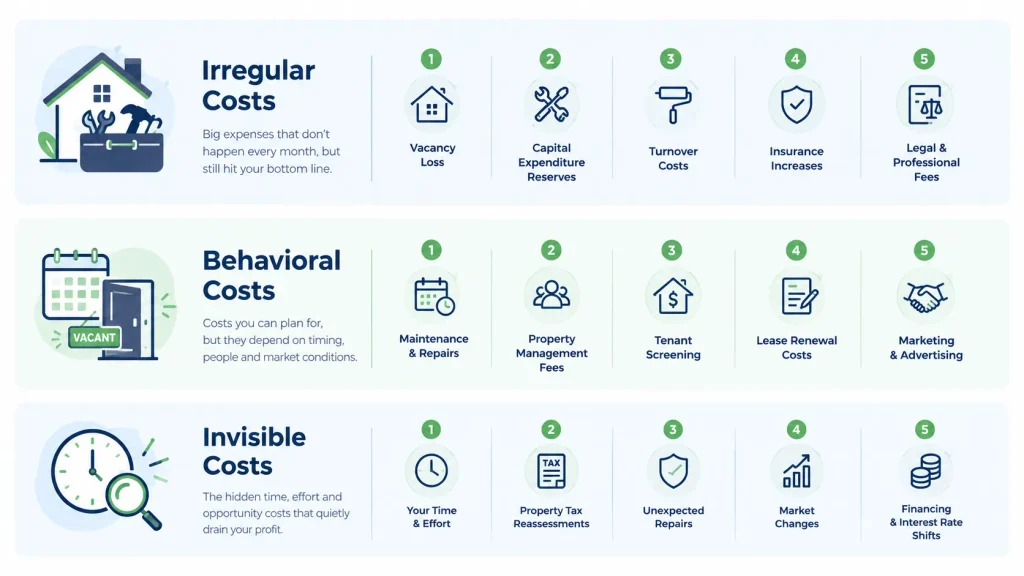
That simple math misses at least ten real costs — vacancy, capital expenditures, insurance creep, turnover, legal fees — that don’t show up every month but hit hard when they do. A property can look like it’s clearing $700 a month and actually be losing money once those costs are properly reserved.
This guide breaks down all 15 hidden expenses quietly draining Landlord Profit Margins, walks through a real worked example, and gives you the exact formula to calculate your true monthly number.
The rental expenses that hurt landlords most aren’t the ones on the mortgage statement — they’re the irregular ones that never appear in a monthly budget: vacancy loss, capital expenditure reserves, turnover costs, the full property-management fee schedule (not just the headline percentage), and the landlord’s own unpaid time. Individually small, together they can turn a property that looks profitable on a spreadsheet into one that loses money in real cash terms.
This guide walks through each of those costs with current data, shows a hypothetical worked example of how they compound, and gives you a formula to calculate your actual monthly margin instead of the simplified “rent minus mortgage” number most landlords track.
This content is for educational purposes only and isn’t legal, tax, or financial advice. Costs, rules, and averages vary by state, property type, and lender — verify your own numbers before making a financial decision.
Why “Rent Minus Mortgage” Isn’t Your Real Profit
Most landlords track profit like this:
Rent Collected − Mortgage Payment = Profit
That’s a cash-flow snapshot for a single “normal” month — it’s not a profit calculation, because it excludes every cost that doesn’t happen every month: a roof replacement, a two-week vacancy, an eviction, an insurance renewal that jumped 12%. A property can show positive cash flow for eleven months and still lose money for the year once you count the twelfth.
A more complete version:
True Monthly Profit = Gross Rent − (Mortgage + Property Tax + Insurance + Vacancy Reserve + Maintenance Reserve + CapEx Reserve + Management/Admin Costs + Turnover Reserve + Legal/Professional Reserve)
Rule of thumb, not a fact: the “50% Rule” — a commonly cited industry heuristic — suggests that operating expenses (everything except mortgage principal and interest) tend to run close to half of gross rental income over the life of a property. It’s a planning shortcut, not a guarantee for any individual property; older properties, self-managed properties, and properties in high-tax states can run meaningfully higher or lower.
15 Hidden Costs That Erode Landlord Profit Margins
1. Vacancy Loss
What it is: Income lost while a unit sits empty between tenants. Formula: Vacancy Rate = Vacant Days ÷ 365
The national rental vacancy rate was reported at 7.3% for Q2 2026 by the U.S. Census Bureau’s Housing Vacancy Survey — up from 7.0% a year earlier — with notable regional variation (the South running higher, the West lower). At 7.3%, that’s roughly 26 vacant days a year on average, though your specific market may run meaningfully above or below the national figure.
Why it’s hidden: A landlord budgeting “$0 vacancy” because the current tenant renewed isn’t accounting for the years they won’t renew.
2. Turnover and Re-Leasing Costs
What it is: Cleaning, painting, minor repairs, marketing, and screening every time a unit turns over. Typical range: Marketing commonly runs $150–$600 per vacancy; full turnover costs (cleaning, minor repairs, make-ready work) are frequently cited in the $1,200–$3,200 range for a single-family or small multifamily unit, though the actual figure depends heavily on unit condition and local labor costs.
3. The Full Cost of Property Management — Not Just the Headline Percentage
What it is: The advertised management fee, typically 8–12% of collected rent, is usually only part of what a management contract actually costs. What’s often missing from the estimate: leasing/placement fees (commonly 50–100% of one month’s rent), lease-renewal fees ($200–$500), and maintenance markups or ancillary fees that can add roughly 30–50% on top of the base management percentage in some contracts.
Decision check: Before signing, request the full fee schedule in writing and calculate a projected annual total — not just the monthly percentage — so you’re comparing the real cost across providers.
4. Landlord Insurance
What it is: Insurance for a rental property typically costs more than a standard homeowner’s policy — commonly cited at 15–25% higher — because it covers landlord-specific risks like loss of rental income and tenant liability. Typical Range: Roughly $1,200–$1,900 per year for a single-family rental is a commonly cited baseline, rising with location risk (wildfire, flood, hurricane exposure), claims history, and coverage limits. Short-term rental properties frequently carry premiums 20–50% higher than long-term rental policies due to different risk classification.
5. Capital Expenditure (CapEx) Reserves
What it is: Major, infrequent replacements — roof, HVAC, water heater, major appliances — that can run $5,000–$15,000+ per event. Rule of thumb: Reserving roughly 1–2% of the property’s value per year specifically for CapEx (separate from routine maintenance) is a commonly used planning benchmark, though older properties or older mechanical systems may need more.
6. Routine Maintenance and Repairs
Ordinary wear and tear (minor plumbing, HVAC servicing, general upkeep) is typically budgeted separately from CapEx, often at another 1% of property value per year as a starting benchmark.
7. Legal and Professional Fees
Landlord-tenant attorney consultations are commonly cited in the $200–$500 per hour range, and rental-income tax preparation frequently runs $300–$1,000 depending on complexity (multiple properties, an LLC structure, or depreciation schedules increase cost).
8. Property Tax Increases
Property tax is one of the fastest-rising ownership costs currently reported by landlords — cited by 60% of surveyed owners as a driver of increased costs over the past year, according to industry survey data. Reassessments after a sale, renovation, or a rising local market can increase your bill mid-lease while rent stays fixed until renewal.
9. HOA Dues and Special Assessments
HOA dues are predictable; special assessments for roof, siding, or parking-lot repairs are not, and can arrive as a four- or five-figure bill with limited notice. Reviewing a reserve fund study before purchase (and periodically after) can flag an underfunded HOA before it becomes your problem.
10. Utilities During Vacancy and Landlord-Paid Utilities
Utilities during a vacancy come out of pocket with no offsetting rent. If utilities are included in rent, unmonitored usage can also quietly increase costs month over month.
11. Bad Debt and Eviction Costs
Unpaid rent, NSF fees, and the eviction process (court costs, legal fees, lost rent during the process, and turnover once the unit is regained) can run into the thousands even in states with faster eviction timelines. Costs vary significantly by state — CalcLandlord’s Eviction Cost Calculator lets you model this by state rather than relying on a national average.
12. Pest Control, Landscaping, and Seasonal Services
Lawn care, snow removal, pest treatment, and pool maintenance are recurring but easy to leave out of a first-year budget — small individually, consistent monthly drains cumulatively.
13. Software, Banking, and Administrative Costs
Rent collection platforms, accounting software, bookkeeping, banking fees, and mileage for property visits are real, recurring costs of running a rental as a business.
14. The Opportunity Cost of Self-Managing
If you self-manage to avoid an 8–12% management fee, your time still has value. Screening applicants, handling after-hours maintenance calls, and coordinating repairs is unpaid labor — it doesn’t appear on a P&L, but it’s a real cost against the hours you could spend elsewhere.
15. Inflation on Recurring Costs
Materials, labor, insurance, and property taxes have risen in many markets faster than typical rent increases. A maintenance or CapEx budget set even two years ago is very likely underfunded today relative to current replacement costs.
Hypothetical Example: How a “$700/Month Profit” Becomes a Loss
The figures below are a hypothetical illustration, not a real property or transaction. They’re built to be internally consistent, not to represent any specific market.
Property: $250,000 value, $1,800/month rent, $1,100/month mortgage payment (principal and interest).
| Line Item | Monthly Amount |
| Gross Rent | $1,800 |
| Mortgage (P&I) | −$1,100 |
| “Profit” as most landlords calculate it | $700 |
| Property Tax (annual ÷ 12) | −$180 |
| Landlord Insurance (annual ÷ 12) | −$130 |
| Vacancy Reserve (7% of rent) | −$126 |
| Maintenance Reserve (1%/yr of value ÷ 12) | −$208 |
| CapEx Reserve (1.5%/yr of value ÷ 12) | −$313 |
| Property Management (10% of rent) | −$180 |
| Turnover/Leasing Reserve (1 mo rent/yr ÷ 12) | −$150 |
| Admin/Legal Reserve | −$50 |
| True Monthly Profit | −$337 |
The $700 “profit” this hypothetical landlord expected was never real cash flow — it only held true in a month with zero vacancy, zero maintenance, and no upcoming CapEx. Once irregular costs are converted into monthly reserves, this property runs at a loss on a true-margin basis, even though it “cash flows” most months on paper.
Run your own numbers instead of relying on this hypothetical: CalcLandlord’s Cash Flow Calculator projects your monthly and annual cash flow using your actual rent, mortgage, and expense inputs, and the Annual Expense Tracker helps you total the recurring costs most budgets miss.
Scenario Analysis: What Changes the Outcome Most
Using the same hypothetical property above, here’s how the true monthly profit shifts under three vacancy/CapEx assumptions. This isn’t a forecast — it’s meant to show which variable moves the number most.
| Scenario | Vacancy Assumption | CapEx Reserve | True Monthly Profit |
| Conservative | 10% (high-vacancy market) | 2%/yr | −$493 |
| Base Case | 7% (near-national-average) | 1.5%/yr | −$337 |
| Optimistic | 4% (strong local demand) | 1%/yr | −$79 |
Even in the optimistic scenario, this hypothetical property is still not truly cash-flow positive. Vacancy and CapEx assumptions move the outcome more than almost any other line item — which is exactly why they’re the two most commonly underbudgeted costs.
How to Calculate Your True Rental Property Profit Margin
True Profit Margin (%) = (Gross Rent − All Reserved and Actual Expenses) ÷ Gross Rent × 100
- List every expense category above, including ones you haven’t paid yet this year (vacancy, CapEx, legal).
- Convert annual or irregular costs into a monthly reserve (annual cost ÷ 12).
- Subtract total costs from gross rent.
- Divide by gross rent and multiply by 100.
As a general planning benchmark (not a guarantee), a true margin in the 15–25% range after all reserves gives most landlords a workable cushion; below roughly 10%, a single unplanned repair or vacancy stretch can push the property into a loss for the year.
DIY Landlord vs. Property Manager: Real Cost Comparison
| Cost Category | Self-Managed | Professionally Managed |
| Management fee | $0 cash, but 5–10 hrs/month of unpaid time | 8–12% of rent |
| Leasing/placement | Your time + marketing spend | Often 50–100% of one month’s rent |
| Tenant screening | DIY tools, ~$25–$50/applicant | Frequently included |
| Maintenance coordination | Your time, retail vendor rates | Included, often contractor rates |
| After-hours emergencies | Handled directly by you | Handled through PM’s system |
| Legal/eviction handling | You hire an attorney directly | Often coordinated by PM (fees still apply) |
Self-managing shifts cost from a visible line item to unpaid time — it isn’t automatically the cheaper option once your time is valued. Whether it’s worth it depends on portfolio size and what an hour of your time is realistically worth.

7 Ways to Protect Your Profit Margin From Hidden Costs
- Reserve monthly, not reactively. Convert every annual/irregular cost into a monthly line item, even if the cash just sits in a separate account.
- Re-shop insurance annually. Premiums drift upward every year even without a claim.
- Track true vacancy cost, not just “days empty.” Include remarketing spend and lost-rent days together.
- Get full fee schedules from property managers in writing before comparing headline percentages.
- Build a dedicated CapEx account funded at 1–2% of property value per year, separate from your operating account.
- Screen harder, evict less. The cost of thorough screening is a fraction of one eviction.
- Recalculate your true margin quarterly, not annually — costs move faster than most landlords update their spreadsheets.
Common Mistakes That Widen the Gap Between Paper Profit and Real Profit
- Budgeting $0 for vacancy because the current tenant hasn’t left yet.
- Treating maintenance as “if it happens” instead of a monthly reserve.
- Comparing property managers based solely on headline percentages, ignoring leasing and renewal fees.
- Never re-shopping landlord insurance, letting premiums drift upward at renewal.
- Valuing self-managed time at $0 when comparing DIY to a property manager.
- Using last year’s expense numbers in an environment where insurance, taxes, and materials have all risen.
Risks and Limitations to Keep in Mind
- Vacancy rates, insurance costs, and management fee structures vary significantly by state and metro — national averages are a starting point, not a substitute for local data.
- Property tax reassessment rules and eviction timelines/costs are set at the state and sometimes county level; verify local rules before budgeting.
- Rules of thumb (50% Rule, 1–2% CapEx reserve) are planning heuristics used across the industry, not guarantees tied to any specific property.
- This guide doesn’t account for tax treatment (depreciation, deductions) — CalcLandlord’s Depreciation Calculator and Tax Calculator can help estimate how deductions offset some of these costs.
People Also Ask
Vacancy and turnover combined are commonly the highest hidden cost, because they bundle lost rent, remarketing spend, and make-ready repairs into an irregular event that’s easy to leave out of a monthly budget.
The 50% Rule is a widely cited planning heuristic suggesting operating expenses (excluding mortgage principal and interest) run close to half of gross rent over time — it’s a rule of thumb, not a fixed rate that applies to every property.
Commonly cited benchmarks are roughly 1% of property value per year for routine maintenance and a separate 1–2% for capital expenditures like roofs and HVAC systems — actual needs vary with property age and condition.
No. It converts many irregular costs into a more predictable percentage fee, but CapEx, insurance, property taxes, and vacancy still apply — and management contracts often include leasing and renewal fees beyond the advertised percentage.
A thin cash margin can still fit a long-term strategy built on equity paydown and appreciation, but a thin margin with no reserves leaves little room to absorb an unplanned repair or vacancy stretch. CalcLandlord’s ROI Calculator can help evaluate total return (cash flow plus appreciation plus principal paydown) rather than monthly cash flow alone.
Bottom Line
Rental property margins are rarely destroyed by one large expense — they’re worn down by a set of smaller, irregular costs that never made it into the original budget. Converting those costs into monthly reserves, recalculating your true margin regularly rather than annually, and comparing property-management costs on a full-fee basis are the practical steps that keep a “profitable on paper” property profitable in cash terms too.
To model your own numbers rather than relying on the hypothetical example above, use CalcLandlord’s Cash Flow Calculator, Cap Rate Calculator, and Annual Expense Tracker — or read more on how rental property investing fundamentals fit together.
Educational content only — not legal, tax, or financial advice. Consult a qualified professional for guidance specific to your property, state, and situation.
Use The Free Calculator
Pingback: 7 Smart Ways to Build a Rental Reserve You Can Trust
Pingback: Rental Yields by State: The Comparison Investors Miss