

What Is DSCR for a Rental Property?
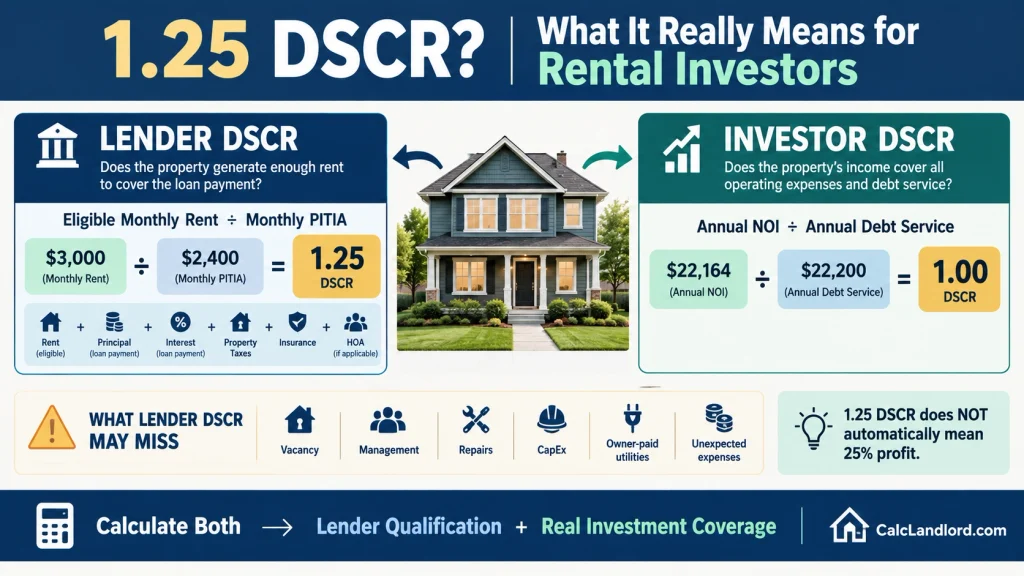
A rental property can show a 1.25 DSCR and still leave you with surprisingly little cash flow. That is because “DSCR” can mean different things depending on whether you are qualifying for a residential DSCR loan or analyzing the investment itself. One method may compare eligible rent with PITIA, while another uses NOI and annual debt service. Mix them up, and your deal can look stronger—or weaker—than it really is. Before making an offer, learn which formula applies, what lenders count, and how vacancy, repairs, taxes, insurance, and future payments can change the numbers. Here’s how to calculate DSCR correctly.
DSCR stands for debt service coverage ratio. For rental property investing, it is a measure of whether a property’s income is sufficient to cover its debt obligation.
A DSCR of 1.00 means the income being used in the calculation exactly equals the debt payment being measured. A ratio above 1.00 means there is some coverage cushion, while a ratio below 1.00 means the selected income is less than the selected debt payment.
The important catch is that DSCR does not always use the same formula.
For many residential DSCR loan programs, the lender may calculate the ratio using qualifying rent divided by the property’s qualifying PITIA payment. Investors and commercial lenders commonly use a different approach based on net operating income (NOI) divided by annual debt service.
That distinction matters because the two calculations can produce very different results for the same rental property.
For example, a house may have a lender DSCR of 1.25 and still generate little actual cash flow after vacancy, management, repairs, and capital expenditures.
So there are really two questions:
- Will the property meet a lender’s DSCR calculation?
- Does the property actually produce enough operating income to justify the debt?
A good rental-property analysis should answer both.
Important: This article is for educational purposes only. DSCR loan requirements, qualifying-rent rules, credit requirements, LTV limits, reserves, prepayment penalties, and property eligibility vary by lender and loan program. Tax and legal rules also vary by location. Verify the current terms with your lender, mortgage professional, attorney, insurance provider, and tax professional before relying on a calculation or making an investment decision
The Two DSCR Formulas Every Rental Investor Should Know
1. Residential lender DSCR formula
For many long-term residential DSCR programs, the calculation is:
Lender DSCR = Eligible Monthly Rent ÷ Monthly PITIA
PITIA generally represents:
- P = Principal
- I = Interest
- T = Property Taxes
- I = Property Insurance
- A = Association dues, such as HOA or condominium fees, when applicable
For an eligible interest-only structure, the qualifying payment may instead use ITIA during the interest-only period:
Interest-Only DSCR = Eligible Monthly Rent ÷ Monthly ITIA
A current example from the Lender uses $4,000 of qualifying rent and $3,200 of PITIA to produce a 1.25 DSCR.
The exact rent source and payment methodology are determined by the specific lender’s underwriting guidelines.
2. Investor or commercial DSCR formula
For property-level investment analysis, the traditional formula is:
Investor DSCR = Annual NOI ÷ Annual Debt Service
Where:
NOI = Effective Gross Income − Operating Expenses
This approach asks a different question:
After normal property operating expenses, how much income remains to cover the property’s debt service?
That makes it particularly useful when comparing rental properties, evaluating leverage, stress-testing an acquisition, or analyzing portfolio performance.
Why the two formulas can disagree
The lender-style formula may begin with gross qualifying rent.
The investor formula begins with NOI, which accounts for operating costs and vacancy assumptions.
Consider:
| Metric | Example |
| Eligible monthly rent | $4,000 |
| Monthly PITIA | $3,200 |
| Lender DSCR | 1.25 |
| Annual NOI | $30,360 |
| Annual principal & interest | $29,400 |
| Investor DSCR | 1.03 |
Both ratios can be mathematically correct because they measure different things.
The first evaluates a lender-defined property-payment relationship. The second evaluates operating-income coverage of debt.
The double-counting mistake
One of the most common DSCR errors is combining the two methods incorrectly.
For example:
NOI ÷ PITIA
can create a distorted calculation if your NOI has already deducted property taxes, insurance, and HOA dues and you then put those same costs into the debt-payment denominator.
Use a consistent framework:
| Purpose | Numerator | Denominator |
| Residential DSCR loan qualification | Eligible gross rent | Qualifying PITIA or ITIA |
| Investor property analysis | NOI | Annual principal-and-interest debt service |
| Commercial underwriting | Lender-defined property income | Lender-defined debt service |
Always label which formula you are using.
How to Calculate DSCR for a Rental Property
Calculating DSCR is simple mathematically. The difficult part is choosing realistic inputs.
Step 1: Decide why you are calculating DSCR
Start by asking:
Am I estimating loan qualification or analyzing the investment?
For a DSCR mortgage application, use the lender’s current methodology.
For your own acquisition analysis, calculate NOI-based DSCR and full cash flow.
Ideally, calculate both.
Step 2: Determine eligible rental income
Do not automatically use the highest rent number you can find.
Potential documentation can include:
- Current signed lease
- Rent roll
- Rental collection history
- Appraisal-supported market rent
- Comparable rental listings
- Property-management statements
- Permitted short-term-rental income documentation
The rent you believe a property could achieve may not be the rent a lender accepts for underwriting.
Current mortgage appraisal guidance illustrates the importance of documented market-rent analysis. Fannie Mae’s Form 1007 is a Single-Family Comparable Rent Schedule used to obtain market rent for certain conventional single-family investment properties, although its 2026 appraisal framework has moved much of this rental information into the newer URAR/UAD 3.6 process.
DSCR lenders are not automatically bound by Fannie Mae underwriting. Their own program matrix determines which rent documentation they accept.
Step 3: Calculate the qualifying property payment
For a fully amortizing loan, determine:
PITIA = Principal + Interest + Taxes + Insurance + Association Dues
Use the qualifying payment specified by the lender rather than relying solely on a generic online mortgage payment calculator.
The payment can change significantly based on:
- Loan amount
- Interest rate
- Amortization period
- Fixed or adjustable rate
- Interest-only period
- Property taxes
- Insurance
- HOA or condo dues
Step 4: Calculate NOI
For investor analysis:
NOI = Effective Gross Income − Operating Expenses
Start with gross scheduled rent and other recurring property income.
Then account for realistic vacancy and credit loss.
After that, subtract normal operating expenses such as property taxes, insurance, management, repairs, HOA dues, utilities paid by the owner, landscaping, pest control, leasing costs, and similar recurring expenses.
Do not subtract mortgage principal and interest from NOI.
Debt service comes after NOI.
Step 5: Match the time period
Use matching periods.
Correct:
Monthly Rent ÷ Monthly PITIA
Also correct:
Annual NOI ÷ Annual Debt Service
Incorrect:
Monthly Rent ÷ Annual Debt Service
The numerator and denominator must represent the same period.
Step 6: Stress-test your result
Do not stop with the base-case DSCR.
Recalculate after assuming:
- Lower rent
- Higher vacancy
- Higher insurance
- Higher property taxes
- Higher HOA dues
- More repairs
- A management fee
- A capital-expenditure reserve
- Higher future interest rates
- A higher post-interest-only payment
A rental property that works only when every assumption goes perfectly deserves a much closer look.
DSCR Rental Property Formula Examples
Example 1: Lender DSCR
Suppose you are evaluating a single-family rental with:
| Item | Monthly Amount |
| Eligible rental income | $3,000 |
| Principal & interest | $1,850 |
| Property taxes | $300 |
| Insurance | $175 |
| HOA | $75 |
| Total PITIA | $2,400 |
The lender DSCR is:
DSCR = $3,000 ÷ $2,400
DSCR = 1.25
The qualifying rental income is therefore 125% of the qualifying property payment.
But the investor should not interpret the $600 difference as $600 of actual monthly profit.
That $600 does not account for costs such as vacancy, management, maintenance, turnover, or capital expenditures unless the lender’s formula specifically incorporates them.
Example 2: Investor DSCR
Now analyze the same property using NOI.
| Item | Annual Amount |
| Gross scheduled rent | $36,000 |
| Vacancy & credit loss | -$1,800 |
| Effective gross income | $34,200 |
| Management | -$2,736 |
| Repairs & maintenance | -$1,800 |
| Property taxes | -$3,600 |
| Insurance | -$2,100 |
| HOA | -$900 |
| Other operating costs | -$900 |
| NOI | $22,164 |
| Annual principal & interest | $22,200 |
Investor DSCR:
DSCR = $22,164 ÷ $22,200
DSCR ≈ 1.00
That is a very different picture from the 1.25 lender DSCR.
The property may satisfy a particular lender’s qualification method while providing almost no NOI cushion against an unexpected expense.
Example 3: Same lender DSCR, different properties
Now compare two rentals:
| Metric | Property A | Property B |
| Eligible monthly rent | $3,000 | $3,000 |
| Monthly PITIA | $2,400 | $2,400 |
| Lender DSCR | 1.25 | 1.25 |
| Annual non-mortgage costs | $4,500 | $9,500 |
| Estimated annual NOI | $26,100 | $21,100 |
| Annual principal & interest | $22,200 | $22,200 |
| Investor DSCR | 1.18 | 0.95 |
A lender-style calculation makes these properties look identical because the qualifying rent and PITIA are the same.
The investor-level analysis does not.
Property B has materially less operating income available to service debt.
That is why DSCR should be considered alongside:
- NOI
- Cash flow
- Cap rate
- Cash-on-cash return
- Vacancy
- Reserves
- Capital expenditures
- Financing cost
Example 4: Interest-only versus amortizing debt
Suppose eligible rent is $4,000 per month.
| Payment Structure | Monthly Qualifying Payment | DSCR |
| Interest-only ITIA | $2,850 | 1.40 |
| Fully amortizing PITIA | $3,200 | 1.25 |
The interest-only structure produces the higher initial DSCR because the required payment is lower.
That does not necessarily mean the loan is safer.
During an interest-only period, principal is not being paid down. Once amortization begins, the payment can rise materially.
Always analyze the property using the future payment, not just the introductory payment.
What Is a Good DSCR for a Rental Property?
There is no single DSCR that every lender requires, and the ratio alone does not determine whether an investment is good or bad.
Lender requirements vary by program, credit profile, leverage, property type, reserves, loan purpose, and pricing. Current lender examples show that some programs target ratios around 1.10–1.25 while others offer different structures, including programs that may permit lower ratios with additional conditions.
For educational purposes, here is how the mathematics work:
| DSCR | Mathematical Meaning | What It Tells You |
| Below 1.00 | Income is below the selected debt payment | The selected income does not fully cover debt |
| 1.00 | Income equals debt payment | No coverage cushion |
| 1.10 | Income is 10% above debt payment | Small cushion |
| 1.20 | Income is 20% above debt payment | Larger cushion |
| 1.25 | Income is 25% above debt payment | Meaningful mathematical cushion |
| 1.50 | Income is 50% above debt payment | Substantially larger cushion |
The key is not to treat these numbers as universal lender approval thresholds.
DSCR below 1.00
A ratio below 1.00 means the numerator is smaller than the debt payment under the selected formula.
For example:
$2,700 income ÷ $3,000 payment = 0.90 DSCR
The selected income covers only 90% of the selected payment.
Some loan programs may permit ratios below 1.00, but such financing should not be confused with strong property-level coverage.
DSCR of 1.00
At 1.00:
Income = Debt Service
There is effectively no mathematical cushion.
A modest vacancy event, repair bill, tax increase, or insurance increase can push the property’s cash flow negative.
DSCR of 1.10 to 1.25
This range provides a greater coverage cushion than 1.00, but the actual risk depends heavily on how the numerator and denominator were calculated.
A 1.25 lender DSCR based on gross qualifying rent does not necessarily mean a property has a 25% operating-profit margin.
DSCR above 1.25
A higher DSCR means more income relative to the debt payment being measured.
But higher is not automatically better if the higher ratio comes from unrealistic rent assumptions.
A 1.40 DSCR based on unsupported projected rent may be less useful than a 1.20 DSCR supported by stable, documented income.
Your investment minimum may be different from the lender’s minimum
A lender determines whether a loan fits its underwriting model.
You determine whether the property fits your investment strategy.
Those are not the same decision.
DSCR Loan Requirements for Rental Properties
DSCR loans are commonly structured for non-owner-occupied investment properties and focus heavily on the property’s rental-income characteristics.
They are generally not “no-document” mortgages.
A lender can still review the borrower, property, collateral, credit, reserves, insurance, title, entity structure, appraisal, and other underwriting factors.
Current lender examples show significant variation in minimum credit scores, down-payment requirements, DSCR targets, LTV, reserve requirements, and property eligibility.
| Requirement | What a Lender May Review |
| Occupancy | Whether the property is non-owner-occupied |
| Property type | SFR, townhouse, condo, 2–4 unit, or other eligible property |
| Rental income | Lease, rent schedule, rent roll, or approved income documentation |
| DSCR | Program-specific qualifying ratio |
| Credit | FICO or other credit requirements |
| Down payment | Required equity based on program and borrower profile |
| LTV | Maximum leverage permitted by the program |
| Reserves | Cash or liquid assets required after closing |
| Appraisal | Property value and rental-income support |
| Insurance | Required hazard, flood, or other coverage |
| HOA | Dues, restrictions, and potential assessments |
| Entity documents | LLC, partnership, trust, or corporate documentation |
| Title | Ownership and legal review |
Down payment and LTV
Many lender programs require substantial equity.
Current lender examples commonly cite purchase LTVs around 75%–80%, meaning approximately 20%–25% down, although the actual maximum varies by program and borrower profile.
Do not assume that putting down 20% automatically gives you 80% LTV.
Property type, DSCR, credit, loan purpose, reserves, and lender pricing can all affect the available leverage.
Credit score
Credit still matters on a DSCR loan.
Even when personal income is not the primary qualification method, a lender may use credit history to determine eligibility, pricing, leverage, reserve requirements, or other terms.
There is no single industry-wide DSCR credit-score requirement. For example, current NASB material describes a 700 minimum for its DSCR product, while other lender programs publish different thresholds.
Cash reserves
Many DSCR lenders require reserves.
The purpose is straightforward: rental income is not guaranteed every month.
A property can experience:
- Tenant turnover
- Vacancy
- Emergency repairs
- Insurance increases
- Property-tax changes
- Special assessments
- Delayed rent collections
A lender may measure reserves in months of PITIA or under another program-specific methodology.
Ask the lender exactly what counts as an acceptable reserve and when the funds must be verified.
How Lenders Determine Eligible Rent
Your projected rent and your lender’s qualifying rent are not necessarily the same number.
Current lease versus market rent
Suppose a property is currently leased for $2,500 but comparable properties suggest market rent around $2,900.
You should not assume the lender will automatically use $2,900.
The lender may apply its own rules based on:
- Existing lease
- Appraisal
- Market rent
- Vacancy status
- Property condition
- Type of rental
- Loan program
- Local market
Similarly, if an online rent estimate suggests $3,200 but comparable properties support only $2,800, the higher number may not survive underwriting.
Appraisal and rent documentation
Appraisal-supported rent is particularly important for financing because the lender needs evidence that the assumed rental income is reasonable.
Fannie Mae’s current guidance requires rental-income documentation for qualifying certain one-to-four-unit investment properties and identifies appraisal-based market-rent documentation such as the Single-Family Comparable Rent Schedule or applicable appraisal form.
The exact process for a DSCR loan depends on the lender.
Vacant properties
Vacancy creates a simple problem:
There may be no current lease proving what the property produces.
The lender may therefore rely more heavily on appraiser-supported market rent, comparable properties, or its specific program rules.
Ask the lender how vacant properties are treated before assuming projected rent will qualify.
Long-term rentals
Long-term rental properties are usually easier to model because the income stream is generally tied to a lease or market rental analysis.
Still, verify:
- Lease amount
- Lease term
- Security deposit
- Collection history
- Renewal terms
- Included utilities
- Concessions
- Current occupancy
Short-term and mid-term rentals
Short-term rentals can create additional underwriting complexity because income may vary substantially by season and occupancy.
Depending on the lender, documentation may include:
- Booking history
- Platform statements
- Management statements
- Operating history
- Market-rent analysis
- Local licensing
- Permit documentation
- Additional reserves
A lender may use a conservative revenue methodology instead of your highest-performing months.
Current DSCR lender materials specifically note that short-term-rental programs may have separate income, reserve, DSCR, and LTV requirements.
The investor should go further than the lender.
Underwrite cleaning, utilities, platform fees, furnishings, management, supplies, maintenance, and occupancy volatility.
What Costs Are Included in PITIA?
PITIA is fundamental to many residential lender-style DSCR calculations.
Principal and interest
Your principal-and-interest payment depends on:
- Loan amount
- Interest rate
- Amortization period
- Loan term
- Fixed or adjustable rate
- Interest-only structure
A lower loan balance generally lowers the payment and can improve the DSCR.
Property taxes
Do not simply copy the seller’s current tax bill into your underwriting.
Property taxes can change because of:
- Reassessment
- Transfer of ownership
- Local tax-rate changes
- Improvements
- Loss of exemptions
Ask the local assessor or a qualified professional how the purchase may affect future taxes.
Insurance
Get an actual insurance quote whenever possible.
Insurance costs can vary based on:
- Location
- Property age
- Construction
- Roof condition
- Claims history
- Flood exposure
- Wind exposure
- Wildfire exposure
- Coverage limits
- Deductibles
A $200-per-month insurance assumption can make a deal look very different from the actual $350-per-month quote.
HOA and condo dues
Include recurring HOA or condominium dues when the lender’s calculation requires them.
Also review:
- Special assessments
- Reserve funding
- Deferred maintenance
- Rental restrictions
- Short-term-rental rules
- Association litigation
- Insurance arrangements
A property can have an attractive DSCR today but deteriorate financially after a major assessment.
How to Calculate NOI for Investor DSCR
NOI is one of the most useful concepts in rental-property analysis because it connects operating income to valuation, cap rate, and debt coverage.
NOI formula
So NOI = Effective Gross Income − Operating Expenses
And:
Effective Gross Income =
Gross Scheduled Rent + Other Operating Income − Vacancy & Credit Loss
Operating expenses commonly included in NOI
Depending on the property and underwriting convention, these can include:
- Property taxes
- Insurance
- HOA or condo dues
- Property management
- Repairs and maintenance
- Landscaping
- Snow removal
- Pest control
- Cleaning
- Owner-paid utilities
- Leasing expenses
- Advertising
- Administrative costs
- Licensing and inspection expenses
- Security or other owner-paid services
Costs generally excluded from NOI
NOI is calculated before financing and income-tax effects, so it generally excludes:
- Mortgage principal
- Mortgage interest
- Depreciation
- Federal and state income taxes
- Initial acquisition costs
- Financing costs
Standard property analysis also generally handles major capital expenditures separately from NOI.
Examples include:
- Roof replacement
- HVAC replacement
- Major plumbing
- Structural work
- Large electrical projects
- Parking-lot resurfacing
- Major exterior renovation
Even when CapEx is excluded from NOI, the investor should still create a realistic capital reserve.
NOI is not taxable income
Do not confuse NOI with taxable rental income.
Taxable income can be affected by depreciation, interest deductions, passive-activity rules, entity structure, and other tax provisions.
Use NOI for operating and investment analysis.
Use a qualified tax professional for tax reporting and tax planning.
DSCR vs. Cash Flow
So DSCR and cash flow answer related but different questions.
DSCR asks: How much income is available relative to the debt payment under a particular formula?
Cash flow asks: How much money actually remains after the property’s relevant expenses and financing costs?
A simplified investor cash-flow model might be:
Cash Flow Before Tax =
Effective Gross Income
− Operating Expenses
Debt Service
− Capital Expenditure Reserve
For a property with $3,500 of effective monthly income, $1,400 of operating expenses, and $1,700 of debt service:
$3,500 − $1,400 − $1,700 = $400
The property produces $400 before considering any additional investor-specific reserves or taxes.
That is much more informative for purchase decisions than simply knowing the lender DSCR.
DSCR vs. Cap Rate
Cap rate and DSCR should not be treated as interchangeable.
So, cap rate:
Cap Rate = NOI ÷ Property Value
Investor DSCR:
DSCR = NOI ÷ Annual Debt Service
Cap rate primarily evaluates the relationship between operating income and property value.
DSCR evaluates the relationship between operating income and debt.
For example:
| Metric | Property A | Property B |
| NOI | $30,000 | $30,000 |
| Property value | $500,000 | $600,000 |
| Cap rate | 6.0% | 5.0% |
| Annual debt service | $24,000 | $20,000 |
| Investor DSCR | 1.25 | 1.50 |
The same NOI can produce different cap rates because property values differ, and different DSCRs because debt structures differ.
That is why rental-property investors should use both valuation and financing metrics.
Related internal article: [Rental Property Cap Rate Explained]
DSCR vs. DTI
A conventional mortgage typically places substantial emphasis on the borrower’s personal income, debts, assets, credit profile, and debt-to-income calculations.
A DSCR loan is designed around property-level rental income and debt coverage instead.
This can be useful for investors whose personal income does not fit neatly into conventional underwriting.
However, DSCR financing does not mean the borrower’s financial profile is irrelevant.
Lenders can still review credit, assets, reserves, entity information, property details, and other underwriting factors. NASB, for example, describes its DSCR product as a Non-QM mortgage solution that evaluates property cash flow while still applying borrower and property requirements.
DSCR Loan vs. Conventional Investment Loan
| Feature | DSCR Loan | Conventional Investment Mortgage |
| Primary qualification focus | Property rental income | Borrower income plus property factors |
| Personal income documentation | Often lighter | Usually more extensive |
| DTI | Generally less central to primary qualification | Important underwriting factor |
| Tax returns/W-2s | May not be the primary qualification basis | Commonly reviewed |
| Credit | Still important | Important |
| Down payment | Program dependent; often substantial | Depends on loan type and property |
| Reserves | Often required | Program dependent |
| Entity ownership | Often available through LLC/entity structures | Rules vary |
| Interest rate | May be higher than a strong conventional option | Can be lower for well-qualified borrowers |
| Prepayment penalty | Present in many DSCR programs | Less common in standard agency-style financing |
| Best use | Property-based investment underwriting | Investors who qualify under conventional income rules |
Current lender comparisons similarly show that DSCR products can reduce reliance on traditional personal-income documentation while carrying different pricing and prepayment considerations.
Neither structure should be judged by the interest rate alone.
Compare:
Total Financing Cost =
Interest + Points + Fees + Required Reserves + Prepayment Costs + Other Loan Costs
Also examine the loan’s payment structure and potential refinance or sale costs.
How to Improve DSCR Before Applying
A low DSCR can often be improved, but the best solution depends on whether the weakness comes from rent, expenses, loan size, or the financing structure.
Increase the down payment
A larger down payment reduces the loan balance and usually reduces principal and interest.
For example:
$400,000 purchase
20% down = $320,000 loan
25% down = $300,000 loan
The lower loan balance can improve the debt-service side of the equation.
But avoid using every dollar of available cash simply to obtain a higher DSCR.
A rental property still needs reserves.
Negotiate a lower purchase price
A lower purchase price can reduce the amount borrowed and improve financing metrics.
It can also affect cap rate and cash-on-cash return because the acquisition basis changes.
Calculate your maximum payment
One useful shortcut is:
Maximum PITIA = Eligible Monthly Rent ÷ Target DSCR
Suppose eligible rent is $3,000 and your target lender DSCR is 1.25:
Maximum PITIA = $3,000 ÷ 1.25
Maximum PITIA = $2,400
This does not tell you the property’s exact maximum purchase price, because PITIA includes taxes, insurance, HOA, and mortgage principal and interest.
But it gives you a useful payment ceiling.
You can then work backward to estimate the maximum loan amount that fits your target ratio.
Improve verified rental income
Potential rent increases should be based on evidence.
Examples include:
- Updating an outdated unit
- Improving curb appeal
- Adding legally permitted amenities
- Improving parking or storage
- Adding laundry
- Correcting below-market rents at renewal
- Improving leasing and marketing
Do not manufacture rent numbers simply to improve DSCR.
The strongest income improvement is one supported by comparable leases, legal use, market demand, and documentation.
Reduce recurring operating costs
Look at:
- Insurance quotes
- Utility usage
- Management fees
- Maintenance contracts
- Vendor pricing
- Vacancy
- Tenant turnover
- HOA costs
Reducing an expense by $100 per month adds $1,200 per year to NOI.
That can affect both investor DSCR and property value.
Be careful with interest-only financing
Interest-only financing can dramatically improve the initial DSCR because the scheduled payment is lower.
But it can also introduce:
- Payment shock
- Lower principal reduction
- Higher lifetime interest
- Refinance risk
- Rate risk
- Prepayment costs
The property should be analyzed using the future payment, not just the introductory period.
DSCR Stress Testing: The Step Many Investors Skip
The base-case DSCR is only the beginning.
Real rental properties experience changing rents and expenses.
Create at least three scenarios:
Base case
Use your verified or supportable rent and realistic operating expenses.
Downside case
Reduce rent and increase expenses.
For example:
Rent: −10%
Insurance: +15%
Property taxes: +10%
Repairs: higher than normal
Vacancy: increased
Then recalculate cash flow and DSCR.
Severe but plausible case
Test a scenario involving:
- Extended vacancy
- Major repair
- Insurance increase
- Tax reassessment
- Higher HOA dues
- Lower rent
- Higher future interest rate
- Refinance at less favorable terms
A useful stress-test table looks like this:
| Scenario | Income Assumption | Expense/Payment Assumption | What to Check |
| Base case | Verified rent | Current expenses | DSCR & cash flow |
| Rent decline | Rent -5% to -10% | Same costs | Coverage after rent reduction |
| Vacancy | One or more vacant months | Same fixed costs | Reserve sufficiency |
| Tax increase | Same rent | Higher taxes | Revised cash flow |
| Insurance increase | Same rent | Higher premium | Revised DSCR |
| Repair year | Same rent | Higher maintenance | Reserve requirement |
| IO reset | Same rent | Higher amortizing payment | Post-IO DSCR |
| Refinance | Conservative future rate | New payment | Refinance feasibility |
Property-tax reassessment
A rental can look attractive using the seller’s historic tax bill and become substantially weaker after purchase.
Use realistic post-closing assumptions.
Insurance escalation
This deserves special attention in markets where property insurance is volatile.
Get an actual quote during due diligence rather than waiting until closing.
Capital-expenditure reserve
A property does not need a new roof every month.
But the investor should still recognize that major systems have finite useful lives.
A building with an aging roof, HVAC, plumbing, or electrical system can have a materially different economic profile from a recently renovated property even when their lender DSCRs look identical.
Common DSCR Mistakes
1. Mixing lender and investor formulas
Avoid combining gross rent, NOI, PITIA, and debt service without defining exactly what each number contains.
2. Double-counting taxes and insurance
If taxes and insurance were already deducted in NOI, do not deduct them a second time as though they were additional debt service.
3. Using monthly rent against annual debt service
Always match the time period.
4. Confusing DSCR with cash flow
A lender’s gross-rent DSCR can look healthy while actual cash flow is weak.
5. Using optimistic rent
A seller’s projection or online estimate is not automatically lender-eligible.
6. Ignoring vacancy
A property that needs 100% occupancy every month to cover its costs has little operating cushion.
7. Ignoring management because you self-manage
Self-management has an economic cost.
For a more conservative analysis, model what professional management would cost even if you currently manage the property yourself.
8. Using stale tax figures
The seller’s existing tax bill may not represent your post-purchase tax burden.
9. Underestimating insurance
Obtain actual quotes whenever possible.
10. Forgetting HOA assessments
Recurring dues are only part of the HOA analysis.
Review special assessments and association financial health.
11. Forgetting the post-interest-only payment
Calculate the payment after amortization begins.
12. Ignoring prepayment penalties
A loan with a strong initial DSCR can still become expensive if you sell or refinance before a prepayment penalty period ends.
13. Treating calculator output as loan approval
A DSCR calculator is a planning tool.
The lender’s underwriting system, appraisal, rent methodology, reserves, title review, credit requirements, and program matrix determine actual eligibility.
How to Use DSCR When Setting an Offer Price
DSCR can become an acquisition tool rather than merely a financing metric.
Suppose:
Eligible monthly rent = $3,750
Target DSCR = 1.25
Then:
Maximum PITIA = $3,750 ÷ 1.25
Maximum PITIA = $3,000
Now suppose taxes, insurance, and HOA total $650 per month.
That leaves approximately:
$3,000 − $650 = $2,350
available for principal and interest.
You can then work backward from the $2,350 mortgage payment to determine a loan amount under the assumed interest rate and amortization period.
That helps you answer:
At what purchase price does this property stop meeting my target DSCR?
This is much more useful than asking only whether the seller’s asking price produces an acceptable ratio.
DSCR and BRRRR Refinancing
DSCR is also relevant when analyzing a BRRRR strategy:
Buy → Rehab → Rent → Refinance → Repeat
The refinance exit needs to work on its own.
Before buying a property based on a projected BRRRR refinance, estimate:
- Stabilized rent
- Post-rehab value
- Refinance loan amount
- New PITIA
- Qualifying DSCR
- Investor DSCR
- Closing costs
- Prepayment penalty on the existing loan
- Remaining cash invested
A project can reach a high after-repair value and still fail to generate sufficient rental income to support the intended refinance.
The DSCR analysis should therefore happen before the purchase, not after the renovation.
DSCR Rental Property Checklist
Making an offer Before
- Confirm the property is legally rentable.
- Verify current rent and lease terms.
- Review rent collection history.
- Analyze comparable rents.
- Estimate conservative market rent.
- Request preliminary property-tax information.
- Obtain an insurance quote.
- Review HOA or condo documents.
- Check for special assessments.
- Calculate lender-style DSCR.
- Calculate investor DSCR.
- Calculate actual projected cash flow.
- Include vacancy.
- Include management.
- Include maintenance.
- Include a CapEx reserve.
- Stress-test rent and expenses.
- Determine your maximum supportable payment.
- Set your offer price based on your required return and risk assumptions.
Before applying for financing
- Gather leases and rent rolls.
- Gather rental-income records where required.
- Prepare entity documents.
- Verify down-payment funds.
- Verify closing-cost funds.
- Verify reserves.
- Review credit.
- Compare multiple lender programs.
- Confirm minimum DSCR.
- Confirm maximum LTV.
- Confirm reserve requirements.
- Confirm rent documentation requirements.
- Ask how vacant properties are treated.
- Ask how short-term rental income is calculated.
- Ask whether interest-only payments are permitted for qualifying.
- Ask whether a prepayment penalty applies.
Before closing
- Review the final appraisal.
- Review the rent analysis.
- Recalculate DSCR using final loan terms.
- Verify taxes.
- Verify insurance.
- Verify HOA dues.
- Review special assessments.
- Review the note and closing documents.
- Review the prepayment provision.
- Confirm rental-property insurance.
- Confirm post-closing reserves remain adequate.
During ownership
- Track actual rent collection.
- Track vacancy.
- Track operating expenses.
- Update insurance assumptions.
- Update property-tax assumptions.
- Monitor NOI.
- Monitor debt service.
- Monitor DSCR.
- Fund reserves for major capital items.
- Recalculate the property’s economics before refinancing or selling.
People Also Ask About DSCR for Rental Properties
For many residential DSCR loan programs, the calculation is:
DSCR = Eligible Monthly Rent ÷ Monthly PITIA
For investor property analysis, a traditional formula is:
DSCR = Annual NOI ÷ Annual Debt Service
The correct formula depends on what you are trying to measure and the specific lender’s underwriting rules.
There is no universal DSCR requirement.
Current lender programs publish different minimums depending on credit, LTV, property type, reserves, loan structure, and other factors. Current examples include programs targeting roughly 1.10–1.25, while other programs may allow lower ratios with additional conditions.
Always ask the lender for the current program matrix rather than relying on an industry-wide number.
Some programs may permit a DSCR below 1.00 with additional conditions such as stronger credit, lower leverage, additional reserves, or different pricing.
A ratio below 1.00 means the income used in that particular calculation is less than the debt payment.
That is a financing fact, not evidence that the underlying investment has adequate cash flow.
For many lender-style residential DSCR calculations, taxes and insurance are included through PITIA.
For an NOI-based investor DSCR, property taxes and insurance are generally operating expenses deducted before NOI is calculated.
Do not deduct the same costs twice.
Many DSCR programs emphasize property income instead of using traditional personal income as the primary qualification method.
However, DSCR loans are not necessarily documentation-free.
Lenders may still review credit, assets, reserves, property records, appraisal, title, entity documents, insurance, and other information.
Is a DSCR loan better than a conventional investment-property mortgage?
The two loan structures solve different underwriting problems.
DSCR financing can reduce reliance on traditional personal-income documentation and may be useful for certain investment-property borrowers.
A conventional investment-property mortgage can be attractive to borrowers who qualify under conventional income and debt rules and receive favorable pricing.
Compare the complete economics, including:
- Interest rate
- APR
- Points
- Closing costs
- Reserves
- LTV
- Prepayment penalties
- Loan term
- Payment structure
- Future refinance requirements
What credit score is needed for a DSCR loan?
There is no universal minimum.
Individual lenders publish their own standards. For example, NASB currently states a 700 minimum for its DSCR product, while other lenders publish different requirements.
Treat any quoted score as lender-specific, not an industry-wide rule.
How much down payment is required for a DSCR loan?
Requirements vary.
Current lender materials commonly describe purchase financing around 75%–80% LTV for certain programs, which corresponds to approximately 20%–25% down. Actual leverage depends on the lender, property, credit, DSCR, and other factors.
Does DSCR use gross rent or net income?
It depends on the calculation.
Many residential DSCR loan programs use a lender-defined qualifying gross-rent measure divided by PITIA or ITIA.
Traditional property-level analysis uses NOI divided by debt service.
Never assume the term DSCR automatically tells you which formula is being used.
Final Takeaway
DSCR is one of the most useful rental-property financing metrics—but only when you understand exactly what is being measured.
For many residential DSCR loans, the calculation is:
Eligible Monthly Rent ÷ Monthly PITIAFor traditional property-level investment analysis:
Annual NOI ÷ Annual Debt ServiceThose formulas should not be mixed.
The lender-style calculation helps you estimate whether the property fits a particular financing program.
The NOI-based calculation helps you understand the property’s operating ability to support its debt.
Then go one step further.
Calculate actual cash flow. Add vacancy. Include management. Account for repairs. Build a CapEx reserve. Verify taxes and insurance. Test lower rents. So Test higher expenses. Test the payment after an interest-only period. Review the prepayment penalty before assuming you will refinance or sell.
Most importantly, do not confuse loan qualification with investment quality.
A rental property should work because its economics make sense—not simply because a lender is willing to finance it.
Before buying, the better question is not only:
“Does this property meet the DSCR requirement?”
It is:
That is how DSCR becomes more than a loan-approval number. It becomes part of a disciplined rental-property underwriting process.
Next tool to use: Run the property through a DSCR calculator, then compare the result with your projected NOI, cash flow, CapEx reserve, and stress-tested downside case.

Pingback: Property Management Near Me: 7 Checks Before You Hire
Pingback: Sign With RowCal? 12 Questions to Protect Your Money
Pingback: Tenant Filed Bankruptcy? 5 Steps Landlords Should Take
Pingback: How Interest Rates Affect Rental Property: 7 Crucial Effects