
Force Majeure for Landlords: Meaning, Lease Clauses & Examples
Force Majeure is a contract provision that can provide relief when an extraordinary event outside a party’s reasonable control interferes with contractual performance. For landlords, property managers, investors, and tenants, the important question is not simply whether something unexpected happened—it is whether the contract covers the event, the event actually affected performance, and the required contractual procedures were followed.
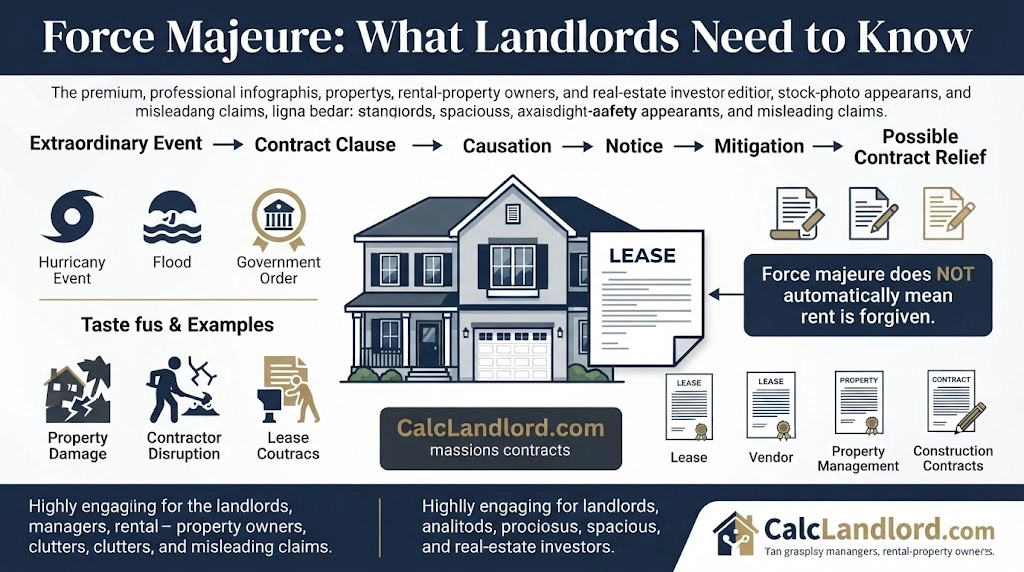
A hurricane, flood, government order, major utility disruption, war, or other extraordinary event may potentially trigger a clause. But force majeure does not automatically cancel a lease, forgive rent, or eliminate every contractual obligation.
The exact wording of the agreement and applicable law determine what happens.
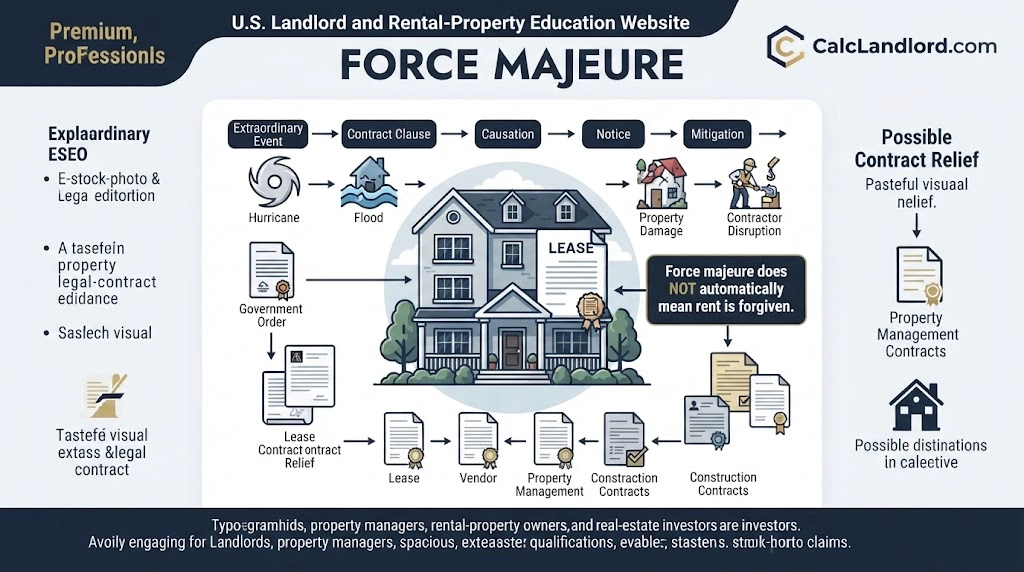
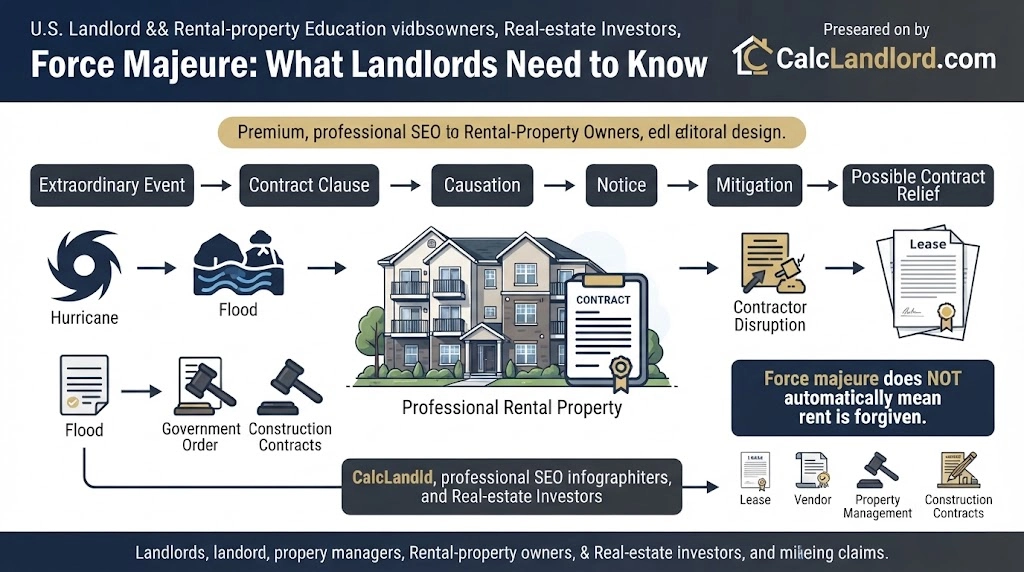
Quick answer: Force majeure is a contractual risk-allocation mechanism. Whether it excuses, delays, suspends, or changes an obligation depends primarily on the clause, the event, causation, notice requirements, mitigation duties, and governing law.
For CalcLandlord readers, understanding these details can help prevent costly assumptions when drafting or reviewing residential leases, commercial leases, property-management agreements, vendor contracts, and construction agreements.
What Is Force Majeure in a Contract?
Force majeure is a contractual concept addressing extraordinary circumstances that may prevent or interfere with a party’s ability to perform its obligations.
The phrase comes from French and is commonly translated as “superior force.”
In U.S. contracts, force majeure generally operates through the language written into the agreement rather than functioning as a universal excuse for nonperformance. Cornell’s Legal Information Institute explains that clauses typically address extraordinary events beyond a party’s control that prevent performance.
Common examples can include:
- Natural disasters
- Hurricanes
- Floods
- Earthquakes
- Fires
- Government actions
- War
- Terrorism
- Strikes
- Certain labor disruptions
- Major infrastructure failures
- Other specifically listed extraordinary events
However, an event being serious, unexpected, or expensive does not automatically make it force majeure.
Consider two situations:
Example 1: A hurricane damages an apartment building and prevents access to part of the property.
Example 2: A landlord experiences higher insurance premiums and lower rental demand.
The first situation might potentially fall within a clause depending on the agreement and circumstances. The second generally cannot simply be treated as force majeure because the landlord’s operating costs increased.
The contract controls.
How Does a Force Majeure Clause Work?
A force majeure clause establishes the circumstances under which a party may receive contractual relief after an extraordinary event.
A typical clause may address:
- Covered events
- Required level of interference
- Notice requirements
- Mitigation obligations
- Suspension or delay of performance
- Duration of relief
- Termination rights
- Excluded obligations
The wording matters enormously.
For example, one contract might say a party is excused when an event “prevents” performance.
Another might provide relief when an event “delays, hinders, or materially interferes with” performance.
Those formulations can create different questions about when the clause applies.
Legal commentary also emphasizes that the contractual language can determine the required degree of interference.
A simple landlord example
Suppose a commercial property-management agreement requires a contractor to perform repairs within a specified period.
A major hurricane destroys roads and makes the property inaccessible.
The contract contains a clause covering hurricanes and government restrictions.
The contractor may have an argument for additional time—but that does not necessarily mean every obligation disappears.
The landlord should examine:
- Whether hurricanes are expressly covered
- Whether access was actually prevented
- Whether alternative performance was reasonably possible
- Whether notice was required
- Whether notice was provided
- Whether mitigation was required
- How long the event affected performance
This is why contract interpretation matters more than the label “force majeure.”
What Events Can Qualify as Force Majeure?
There is no single universal list of events that qualifies in every contract.
The strongest candidates are generally extraordinary circumstances outside the affected party’s reasonable control that fall within the contract’s wording and materially interfere with performance.
Natural disasters
Depending on the clause, these might include:
- Hurricanes
- Tornadoes
- Floods
- Earthquakes
- Wildfires
- Severe storms
- Certain catastrophic weather events
For rental property owners, natural disasters are particularly important because they can affect:
- Property access
- Building habitability
- Repairs
- Utilities
- Contractor availability
- Government inspections
- Construction schedules
- Property management
Government actions
Some contracts specifically include:
- Government orders
- Regulations
- Emergency restrictions
- Evacuation orders
- Permitting restrictions
- Import or export restrictions
But again, the specific contract language matters.
War and civil disturbances
Some clauses expressly address:
- War
- Terrorism
- Civil unrest
- Military actions
- Embargoes
Whether a particular event qualifies depends on the wording and applicable law.
Labor and supply disruptions
Contracts sometimes include:
- Strikes
- Lockouts
- Labor shortages
- Transportation disruptions
- Supply-chain interruptions
But these categories require careful analysis because ordinary commercial difficulties may not meet the contractual threshold.
The important rule
The more specific the contract is, the less room there may be for arguing that an unlisted event qualifies.
That makes drafting particularly important for landlords.
What Usually Does Not Qualify as Force Majeure?
One of the biggest mistakes is assuming that anything unexpected or financially painful qualifies.
Generally, ordinary business problems are not automatically events.
Potentially excluded situations may include:
- Poor financial performance
- Loss of profits
- Ordinary market fluctuations
- Increased operating costs
- Poor planning
- Lack of funds
- Ordinary business losses
- A contractor’s avoidable scheduling problems
- Failure to maintain equipment
- Events caused by the party’s own negligence
For example, suppose a landlord’s property becomes less profitable because local demand falls.
That financial pressure alone does not necessarily transform the landlord’s obligations into force majeure obligations.
Cornell’s legal overview similarly notes that ordinary economic difficulty generally is not enough by itself.
“Unexpected” is not the same as “force majeure”
This distinction is crucial.
Unexpected event: Something the party did not anticipate.
Force majeure event: An event that falls within the contractual provision and satisfies the applicable requirements for relief.
Those are not necessarily the same thing.
What Should a Landlord Check in a Force Majeure Clause?
Landlords should avoid reading a force majeure clause as a single sentence. Treat it as a risk-allocation section of the contract.
Check these components carefully.
1. Covered events
Look for specific language concerning:
- Natural disasters
- Government Actions
- War
- Strikes
- Utility failures
- Epidemics or pandemics
- Transportation disruptions
- Supply-chain problems
2. Causation
Ask:
Did the force majeure event actually cause the failure or delay?
A covered event may exist without actually causing the contractual nonperformance.
3. Performance threshold
Does the clause require performance to be:
- Prevented?
- Delayed?
- Hindered?
- Rendered impossible?
- Materially impaired?
These words can matter.
4. Notice
Determine:
- How quickly notice must be provided
- Who must receive it
- What information must be included
- Whether written notice is required
- Whether continuing updates are required
5. Mitigation
Some contracts require the affected party to make reasonable efforts to reduce the impact.
That means force majeure should not automatically be treated as permission to stop trying.
6. Duration
Check whether relief lasts:
- Only while the event continues
- For a specified period
- Until performance becomes possible
- Until termination rights arise
7. Exclusions
Look for language excluding:
- Payment obligations
- Rent
- Taxes
- Insurance
- Certain financial obligations
- Ordinary market conditions
8. Termination
Some agreements provide termination rights after a force majeure event continues for a specified period.
This can be particularly important in long-term commercial contracts.
Does Force Majeure Excuse Rent or Other Payment Obligations?
Not automatically.
This is one of the most important points for landlords.
A force majeure clause does not universally mean:
“The tenant does not have to pay rent.”
Whether rent is affected depends on the lease language, applicable law, and circumstances.
A clause might:
- Excuse certain performance
- Delay certain obligations
- Suspend particular duties
- Address property access
- Provide termination rights
- Exclude monetary obligations entirely
Why landlords should be careful
Suppose a commercial tenant’s business is forced to close temporarily because of a government order.
The tenant may argue that the force majeure clause applies.
But the landlord should not assume either:
“Rent definitely continues.”
or
“Rent is definitely suspended.”
Instead, review:
- The force majeure clause
- The rent provision
- Any casualty provision
- Business interruption provisions
- Insurance provisions
- Any governmental-order language
- Applicable state law
- Other related lease provisions
Force majeure and financial obligations
Many contracts distinguish between obligations involving performance and obligations involving payment.
That distinction can be critical.
A lease may contain a broad force majeure provision but separately address rent and monetary obligations.
Therefore, never promise a tenant that rent is automatically forgiven based solely on the existence of a force majeure clause.
For a real dispute, landlords should obtain advice based on the actual lease and governing law.
How Can Force Majeure Affect a Rental Property or Lease?
Force majeure can potentially affect many parts of rental-property operations.
Property access
A disaster may temporarily prevent:
- Tenant access
- Contractor access
- Property inspections
- Repairs
- Maintenance
- Deliveries
Repairs and construction
A contractor may be unable to perform because:
- Roads are closed
- Materials cannot be obtained
- Government restrictions apply
- The property is unsafe
- Workers cannot access the site
Property management
Property managers may face disruptions involving:
- Inspections
- Maintenance
- Vendor coordination
- Emergency response
- Tenant communications
Commercial operations
For commercial landlords, disruptions may affect:
- Retail operations
- Office access
- Industrial facilities
- Construction schedules
- Tenant operations
But the force majeure clause does not automatically determine every consequence.
A lease may have separate provisions addressing casualty, condemnation, repairs, rent abatement, insurance, access, and termination.
Think beyond the clause
For landlords, force majeure should be analyzed together with the rest of the contract.
A useful review looks like:
Force majeure + casualty + insurance + repair obligations + rent provisions + default + termination
rather than treating force majeure as an isolated paragraph.
Force Majeure in Residential vs. Commercial Leases
The impact can differ substantially depending on the type of lease.
| Issue | Residential Lease | Commercial Lease |
| Primary concern | Habitability and access | Business operations and contractual performance |
| Property damage | Often critical | Often addressed through detailed casualty provisions |
| Rent questions | Highly fact- and law-dependent | Often heavily negotiated |
| Business interruption | Usually less central | Often significant |
| Operating expenses | Usually simpler | May involve complex expense provisions |
| Tenant improvements | Less common | Potentially significant |
| Negotiated risk allocation | Varies | Often extensive |
| Termination provisions | May be statutory/contractual | Frequently detailed in lease |
- Explore More: https://calclandlord.com/landlord-blog/
Residential leases
For residential properties, landlords should consider how a disaster affects:
- Habitability
- Utilities
- Access
- Repairs
- Relocation
- Tenant safety
- Local landlord-tenant requirements
State and local law can be particularly important.
Commercial leases
Commercial leases may contain much more detailed provisions dealing with:
- Force majeure
- Casualty
- Rent abatement
- Operating expenses
- Business interruption
- Construction
- Insurance
- Restoration
- Termination
This makes commercial lease review especially dependent on the exact contract.
Force Majeure vs. Impossibility, Impracticability & Frustration
These concepts are related but not interchangeable.
Force majeure
Usually arises from a contractual clause.
The contract identifies events and consequences.
Impossibility
Generally concerns situations where performance has become impossible under applicable legal principles.
Impracticability
May apply where performance becomes excessively difficult or burdensome under circumstances recognized by applicable law.
Frustration of purpose
Generally focuses on whether an unexpected event substantially destroys the principal purpose of the contract.
Simple comparison
| Concept | Main Focus |
| Force majeure | Contractual allocation of extraordinary-event risk |
| Impossibility | Performance cannot legally/physically be completed |
| Impracticability | Performance becomes excessively difficult under applicable doctrine |
| Frustration of purpose | Contract’s principal purpose is substantially undermined |
The exact legal standards can vary by jurisdiction.
A landlord should therefore avoid assuming that failure to satisfy a force majeure clause automatically means no other legal doctrine could apply—or vice versa.
How to Invoke Force Majeure and Give Proper Notice
If a party believes a force majeure provision applies, notice can be extremely important.
Start by reading the contract before sending anything.
Step 1: Identify the event
Document:
- What happened
- When it happened
- Where it happened
- Who was affected
Step 2: Identify the contractual provision
Locate the exact force majeure language.
Step 3: Establish causation
Explain how the event affected the specific obligation.
For example:
Hurricane damage → building access restricted → contractor unable to enter → scheduled repair delayed.
That is much stronger than simply stating:
“The hurricane caused force majeure.”
Step 4: Follow notice requirements
Check:
- Deadline
- Delivery method
- Recipient
- Required supporting information
Step 5: Document mitigation
Keep records showing reasonable efforts to reduce the impact.
Examples:
- Alternative contractors contacted
- Temporary repairs arranged
- Alternate access considered
- Replacement materials sought
- Government updates monitored
Step 6: Continue communicating
If the disruption continues, provide updates where required.
Keep evidence
Potential documentation includes:
- Photos
- Government orders
- Inspection reports
- Contractor communications
- Utility notices
- Repair estimates
- Insurance correspondence
- Delivery records
- Emails and written notices
Good documentation can become extremely valuable if the parties later disagree about what happened.
What Happens After a Force Majeure Event?
The end of the event does not necessarily mean every issue disappears immediately.
The parties should determine:
- Whether performance can resume
- Which obligations were affected
- Whether deadlines move
- Whether notice remains necessary
- Whether mitigation continues
- Whether damages or costs remain disputed
- Whether termination rights have arisen
- Whether another contractual provision controls
Landlord recovery checklist
After the disruption, review:
Property → Contract → Insurance → Repairs → Tenant obligations → Vendor obligations → Financial impact
For example, if a storm damages a rental property, the landlord may need to separately evaluate:
- Insurance coverage
- Property restoration
- Tenant access
- Rent provisions
- Contractor obligations
- Government requirements
- Mortgage obligations
- Cash-flow effects
Force majeure is only one piece of the overall risk picture.
How to Draft a Better Force Majeure Clause for Property Contracts
Landlords should avoid vague clauses whenever possible.
A useful force majeure provision should clearly address what events qualify and what happens afterward.
Identify covered events
Instead of relying only on:
“Events beyond the party’s control”
consider whether the contract should specifically address relevant risks.
For a property-related agreement, those might include:
- Hurricanes
- Floods
- Earthquakes
- Wildfires
- Government orders
- War
- Strikes
- Utility failures
- Transportation disruptions
- Certain supply shortages
Define the performance standard
Specify whether the event must:
- Prevent Performance
- Delay performance
- Materially interfere with performance
- Make performance impossible
Address notice
Specify:
- Who receives notice
- How notice must be delivered
- How quickly it must be provided
- What information is required
Address mitigation
Consider requiring reasonable efforts to reduce the effects of the event.
Address money obligations clearly
If the parties intend to treat rent or other payment obligations differently, say so clearly.
Do not leave this issue to assumptions.
Address duration and termination
Consider what happens when disruption continues for:
- 30 days
- 60 days
- 90 days
- Another negotiated period
The appropriate period depends on the transaction.
Important drafting principle
A longer clause is not automatically a better clause.
The goal is clarity about risk allocation.
For high-value leases and contracts, professional legal review is appropriate.
Common Force Majeure Mistakes Landlords Should Avoid
Mistake 1: Assuming every disaster qualifies
A disaster must still satisfy the contract and applicable law.
Mistake 2: Assuming force majeure automatically cancels rent
It doesn’t universally do so.
Mistake 3: Ignoring causation
A covered event must actually relate to the affected performance.
Mistake 4: Missing the notice deadline
A contract may impose specific notice requirements.
Mistake 5: Failing to mitigate
If reasonable mitigation is required, simply stopping performance may create additional problems.
Mistake 6: Ignoring other lease provisions
Casualty, insurance, repairs, access, rent, and termination provisions may be equally important.
Mistake 7: Treating all leases the same
Residential and commercial leases can allocate risks differently.
Mistake 8: Relying on another state’s interpretation
Contract and landlord-tenant rules vary by jurisdiction.
Mistake 9: Using vague drafting
A clause that sounds comprehensive may still leave major questions unanswered.
Mistake 10: Failing to document the event
Without evidence, proving the relationship between an extraordinary event and nonperformance can become difficult.
Force Majeure Examples for Landlords and Property Investors
Example 1: Hurricane damages an apartment building
A hurricane causes substantial damage and local authorities restrict access.
The lease contains a force majeure provision covering natural disasters.
What to examine:
- Whether the hurricane is covered
- Whether access was actually prevented
- Whether repairs were affected
- Whether casualty provisions apply
- Whether rent provisions address the damage
- Whether notice is required
The result should not be assumed without reviewing the lease and applicable law.
Example 2: Government order closes a commercial property
A government authority temporarily prohibits certain operations.
The commercial lease contains language addressing government restrictions.
The parties should examine:
- The precise government action
- Whether it prevents or merely reduces operations
- Whether the clause covers it
- Whether rent is separately addressed
- Whether alternative use is possible
Example 3: Construction materials become unavailable
A contractor cannot obtain specified materials after a major disruption.
The construction contract includes supply-chain events in its force majeure clause.
The contractor may potentially have grounds for additional time, depending on the clause and circumstances.
But the parties should still examine whether:
- Alternative materials existed
- Another supplier was available
- The shortage actually caused the delay
- Notice was timely
- Mitigation was attempted
Example 4: Vendor cannot access the property
A property-management vendor cannot reach a property because roads are closed following a major disaster.
The management agreement includes qualifying transportation and government disruptions.
The parties should document the event and determine whether the clause changes the vendor’s deadline or obligations.
Example 5: Rental income falls sharply
A landlord experiences a major decline in occupancy and revenue.
The landlord argues that the loss is force majeure.
The financial loss alone does not establish a force majeure claim.
The contract and applicable legal doctrine must be examined to determine whether a qualifying event caused the relevant nonperformance.
Example 6: Utility disruption affects operations
A major utility failure makes part of a property temporarily unusable.
The landlord should review:
- Lease provisions
- Repair responsibilities
- Utility obligations
- Casualty provisions
- Insurance
- Applicable law
- Force majeure language
Again, force majeure is not necessarily the only relevant provision.
People Also Ask
A: Force majeure generally refers to extraordinary circumstances addressed by a contract that may interfere with a party’s ability to perform its obligations. The actual effect depends on the agreement and applicable law.
A: Not exactly.
An act-of-God concept generally concerns certain natural events, while a force majeure clause can cover a broader range of events depending on its wording.
A: No.
Whether rent is affected depends on the lease, force majeure language, other applicable provisions, and governing law.
A: Potentially.
If the contract covers hurricanes or qualifying natural disasters and the event actually affects contractual performance, the clause may apply.
A: Potentially, but not automatically.
The answer depends on the contract wording, the nature of the disruption, causation, applicable law, and other circumstances.
Final Takeaway
Force Majeure can become an important risk-management tool for landlords, property managers, real estate investors, and other parties involved in rental-property contracts. But it should never be treated as an automatic escape from contractual obligations.
The strongest analysis starts with the actual contract language.
A landlord evaluating a potential force majeure situation should identify the event, determine whether the agreement covers it, establish whether the event caused the affected performance, review notice requirements, document mitigation efforts, and examine related provisions involving rent, casualty, insurance, repairs, access, default, and termination.
Most importantly, a force majeure event does not automatically mean rent is forgiven, a lease is terminated, or every obligation disappears. Those consequences depend on the agreement and applicable law.
For a significant lease dispute or high-value property contract, a qualified attorney should review the specific agreement and jurisdiction rather than relying on a general explanation.

Pingback: Effective Annual Rate: Formula + 3 Clear Examples