

Rental Application: The Complete Guide for Landlords and Tenants
Submitting a rental application can be the difference between getting the home you want and missing out. A few missing details, unclear income records, or an unanswered landlord reference can slow the process down. Whether you’re applying for an apartment or screening tenants for a rental property, knowing what to prepare makes the process easier. This guide explains what a rental application should include, which documents may be needed, how landlords review applicants, and what to know about screening fees and denial notices. Use the checklist and practical template to avoid common mistakes and take the next step with confidence.
A rental application can determine whether a prospective tenant gets the home they want—and whether a landlord finds someone who can meet the rental agreement’s requirements. Yet many applicants submit incomplete forms, overlook important documents, or pay screening fees without understanding the process.
For landlords, an effective rental application is more than a form. It is a structured way to verify an applicant’s identity, assess their ability to afford the rent, review rental history, and make a consistent, legally compliant decision.
Whether you are renting your first apartment, applying for a single-family home, or managing a multifamily property, understanding the rental application process can help you avoid unnecessary delays and costly misunderstandings.
This guide explains what a rental application is, what information it should contain, which documents to prepare, how landlords should screen applicants, and what happens after approval or denial. It also includes a practical checklist and a copy-ready rental application template.
1. Quick Answer: What Is a Rental Application?
A rental application is a form that a prospective tenant completes to request consideration for a rental property. Landlords and property managers use it to evaluate an applicant’s identity, income, rental history, references, and other relevant information before deciding whether to offer a lease.
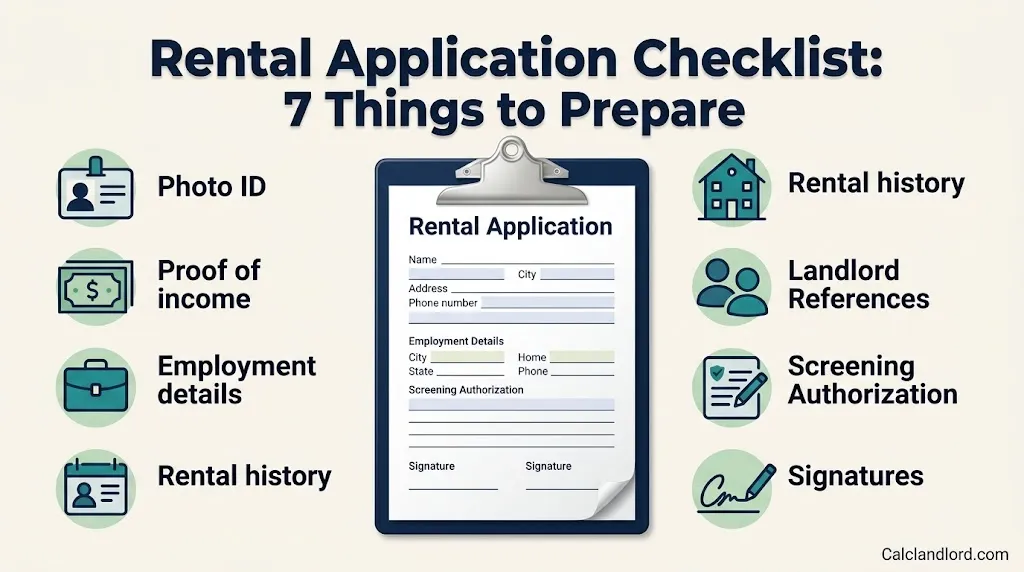
A typical rental application includes:
- Full legal name and contact information.
- Current and previous addresses.
- Employment and income details.
- Rental history and landlord references.
- Information about intended occupants and pets, where appropriate.
- Authorization or disclosures for permitted screening checks.
- Applicant declarations and signature.
A rental application is generally different from a lease agreement. The application helps the landlord decide whom to rent to; the lease establishes the terms of the tenancy.
Application requirements, permissible screening practices, fees, and deadlines vary by state and locality.
2. What Is a Rental Application and How Does It Work?
A rental application is the starting point of the tenant selection process. It helps a landlord gather comparable information from prospective tenants before making a rental decision.
For example, suppose a landlord advertises a single-family home for $2,000 per month. Three people apply. One provides complete income documentation, another leaves several fields blank, and the third provides references that the landlord cannot initially verify.
Rather than making an informal decision based on appearance or personal impressions, the landlord can review each completed application against the same written screening standards.
A typical application process follows these steps:
- Find a rental property. The prospective tenant reviews the listing, rent, lease terms, and basic requirements.
- Complete the application. The applicant provides the requested personal, employment, income, and rental history information.
- Pay any lawful application fee. The applicant should understand the amount, purpose, and applicable refund rules before paying.
- Authorize or complete permitted screening procedures. The landlord may verify information and obtain appropriate consumer reports.
- Review the application. The landlord compares the available information with established criteria.
- Receive a decision. The landlord approves the application, denies it, or requests additional information.
- Sign the lease if approved. The parties finalize the rental agreement and complete the required move-in procedures.
The exact sequence can differ. For instance, some landlords use online application platforms that collect information and coordinate screening in one place.
The important point is that submitting an application does not automatically guarantee approval or reserve a property.
3. Rental Application vs. Lease Agreement
Although people sometimes use these terms interchangeably, a rental application and a lease agreement serve different purposes.
| Feature | Rental application | Lease agreement |
| Main purpose | Evaluate a prospective tenant | Establish the rental relationship |
| Typical timing | Before approval | Usually after approval |
| Main information | Identity, income, references, rental history | Rent, term, deposits, responsibilities, rules |
| Screening | Supports the landlord’s evaluation | Establishes obligations after agreement |
| Automatically guarantees a home? | No | Depends on the executed agreement and applicable law |
| Legal effect | May create specific obligations through its terms, authorizations, or fee arrangements | Generally establishes enforceable tenancy obligations |
A rental application should clearly explain that it is not itself a lease unless the document and applicable law provide otherwise.
This distinction matters when an applicant submits an application fee or a landlord accepts money to hold a unit. Those payments may have separate legal consequences, even when the parties have not signed a lease.
Before collecting or paying money beyond an application fee, both parties should understand the written terms and any state or local requirements.
4. What Should a Rental Application Include?
A professional rental application should collect enough information to evaluate the applicant fairly without asking for unnecessary or intrusive details.
Property and application information
Identify the property and the application being submitted.
Include the rental address, unit number, advertised monthly rent, proposed move-in date, application date, and landlord or property manager’s contact information.
This information is especially important when an owner manages several properties or receives multiple applications for the same unit.
Applicant identity and contact details
The application can request the applicant’s full legal name, phone number, email address, current address, and other identification information reasonably necessary for verification.
If a Social Security number or date of birth is required for screening, explain why the information is being collected and use a secure method to handle it. Avoid sending sensitive identity details through unsecured email or unverified links.
Employment and income
Landlords commonly request information that helps establish whether the applicant can reasonably afford the rent.
Relevant details may include:
- Employer and job title.
- Length of employment.
- Gross monthly income.
- Other lawful and verifiable income sources.
- Contact information for employment verification, when appropriate.
- Supporting income documents.
Do not assume that every suitable tenant has a traditional salaried job. Self-employed applicants, retirees, students with lawful financial support, and people receiving benefits may have different ways of demonstrating their ability to pay.
Use documented criteria that comply with applicable source-of-income protections.
Rental history and references
Ask for current and previous rental addresses, tenancy dates, rent amounts, and landlord or property manager contact information.
A landlord reference may help establish whether rent was generally paid as agreed, whether lease obligations were followed, and whether the previous tenancy ended with unresolved issues.
A previous landlord’s negative statement should not automatically determine the result. Verify material claims where practical, and consider the surrounding facts rather than treating an unverified allegation as established truth.
Household and property-related information
An application may request the number of intended occupants, vehicle details when relevant, and information about pets under the property’s lawful policies.
Questions about assistance animals require particular care. Under applicable fair-housing requirements, an assistance animal is not simply a pet, and a reasonable accommodation may be required. See HUD’s guidance on assistance animals.
Screening disclosures and authorization
If a landlord intends to conduct credit, background, rental history, or other screening, the application should explain the process and include appropriate disclosures and authorization where required.
The landlord should use a screening provider and procedures that comply with applicable federal, state, and local laws.
5. What Documents Do You Need for a Rental Application?
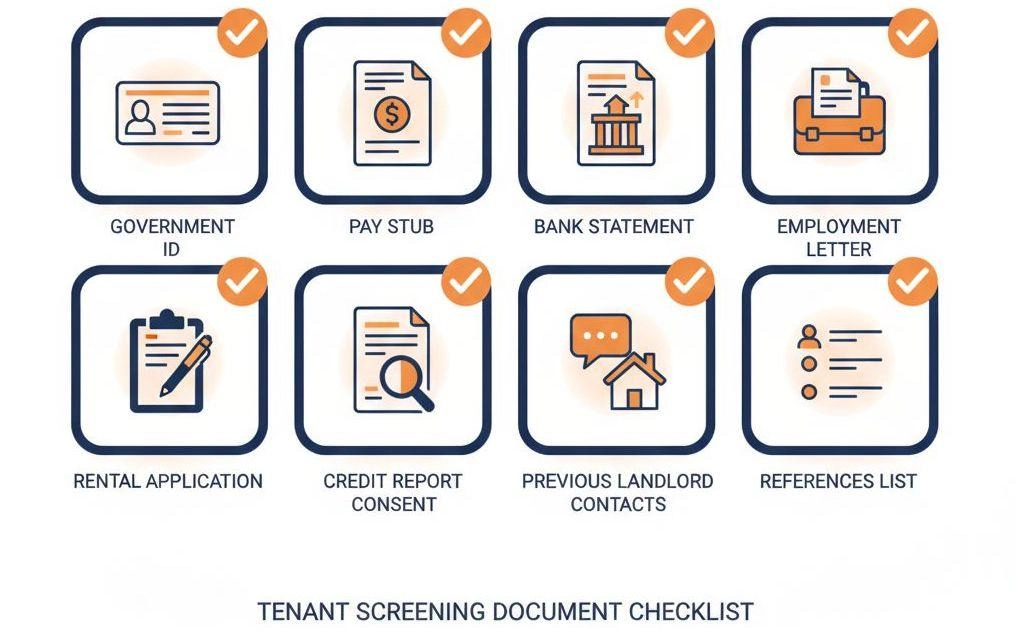
Preparing supporting documents before applying can make the process smoother. The exact requirements depend on the property and the landlord’s published screening criteria.
| Document | Why it may be needed | Common examples |
| Government-issued identification | Verify identity | Driver’s license, state ID, passport |
| Proof of income | Evaluate ability to pay rent | Recent pay statements, benefit statements |
| Employment verification | Confirm employment details | Employer contact, verification letter |
| Self-employment records | Document variable income | Tax returns, profit-and-loss statements |
| Rental history | Verify previous tenancies | Previous addresses and landlord contacts |
| Credit or screening authorization | Support permitted background checks | Completed disclosure and authorization |
| Additional financial documentation | Evaluate other lawful sources of funds | Appropriate account statements or award letters |
Applicants should ask which documents are actually necessary before paying a fee. Not every landlord will need every item.
For example, a self-employed applicant may not have traditional pay stubs. Recent tax returns and business financial records could provide a more useful picture of income.
Applicants should also redact unrelated sensitive information from supporting documents when appropriate and permitted, and should never provide financial credentials or passwords to a prospective landlord.
6. Free Rental Application Checklist
Use the following checklist to prepare for an application or standardize a landlord’s application workflow.
For tenants
- Confirm the advertised rent and expected move-in date.
- Review the landlord’s written screening criteria.
- Prepare accurate identity and contact information.
- Gather appropriate proof of income.
- Compile current and previous rental history.
- Check that landlord reference details are correct.
- Identify all intended occupants as requested.
- Review any relevant pet policies and accommodation procedures.
- Read screening disclosures and application fee terms.
- Complete every required field.
- Submit documents through the landlord’s verified process.
- Save a copy of the application and payment receipts.
For landlords
- Prepare a consistent rental application form.
- Establish lawful, written screening criteria.
- Disclose the screening process and applicable fees.
- Collect only information relevant to the rental decision.
- Handle personal and financial information securely.
- Verify income and rental references consistently.
- Follow applicable consumer-reporting requirements.
- Document the decision against the written criteria.
- Send the appropriate response and required notices.
- Keep records according to applicable privacy and retention rules.
A standardized checklist reduces avoidable omissions and makes it easier to explain what remains outstanding.

7. Free Rental Application Template: Copy-Ready Structure
The following is an educational template structure for a U.S. residential rental application. It is a starting point, not a substitute for a state-specific form reviewed for compliance.
Landlords should adapt the template to the property, their lawful screening policy, and applicable local requirements.
Section A: Property details
Rental property address: ______________________________
Unit number: _________________________________________
Advertised monthly rent: $_____________________________
Requested move-in date: _______________________________
Requested lease term: _________________________________
Application date: _____________________________________
Landlord or property manager: __________________________
Section B: Applicant information
Full legal name: ______________________________________
Phone number: _________________________________________
Email address: ________________________________________
Current address: ______________________________________
Length of current residence: ___________________________
Preferred contact method: _____________________________
Identification details should be collected only as needed and handled securely.
Section C: Employment and income
Employment status: ____________________________________
Employer or business name: ____________________________
Job title or occupation: _______________________________
Length of employment or business operation: ____________
Gross monthly income: $________________________________
Other income the applicant wishes to disclose for eligibility: ______________________________
Supporting documents provided: ________________________
Section D: Rental history
Current or most recent rental address: _________________
Tenancy start date: ____________________________________
Tenancy end date, if applicable: _______________________
Monthly rent: $________________________________________
Landlord or property manager contact: _________________
Reason for moving: ____________________________________
Previous rental address and reference: ________________
Applicants should provide truthful information and explain relevant circumstances where necessary. Landlords should verify material information consistently.
Section E: Household and property details
Number of intended occupants: _________________________
Additional adult applicants: ___________________________
Vehicles, if relevant to the property: _________________
Pets, if applicable under the property’s policies: _____
Requested disability-related accommodation, if any: May be discussed separately through the appropriate accommodation process.
Do not use this section to solicit unnecessary medical information or to screen unlawfully based on familial status or disability.
Section F: Screening disclosure
The landlord should explain which checks may be used, the purpose of screening, applicable fees, the handling of consumer reports, and how the applicant can contact the landlord with questions.
Any required consent or authorization should be presented clearly and separately where appropriate.
Section G: Applicant declaration
I certify that the information I have provided is true and complete to the best of my knowledge. So I understand that the landlord or property manager may verify relevant information and may obtain consumer reports or conduct other screening permitted by applicable law, subject to any required notices and authorizations. I understand that submitting this application does not guarantee approval or establish a tenancy. Any additional terms, fees, authorizations, or agreements are subject to their stated terms and applicable law.
Applicant signature: _________________________________
Date: ________________________________________________
Landlord or property manager notes: ___________________
This sample is not a complete universal legal form. Before using it commercially, check the required state-specific disclosures, applicable screening rules, and any local requirements regarding application fees or selection procedures.
8. What Questions Should a Rental Application Ask?
The best rental application questions are specific, relevant to the tenancy, and applied consistently.
Appropriate questions for applicants
Depending on the property and applicable law, a landlord may ask:
- What is your full legal name and preferred contact information?
- What is your current address?
- When would you like to move in?
- What is your employment status and verifiable income?
- Can you provide appropriate proof of income?
- Where have you rented previously?
- May we contact the listed rental references?
- How many people are expected to occupy the unit?
- Do you have vehicles or pets relevant to the property’s written policies?
- Do you understand the screening process and applicable disclosures?
Additional questions about rental history or background records should be limited to information that is relevant and lawful to consider.
Questions landlords should avoid
Landlords should not ask questions that discriminate based on federally protected characteristics or additional characteristics protected by state or local law.
For example, do not ask applicants to disclose their religion, disability diagnosis, pregnancy plans, or other sensitive personal details unrelated to a lawful rental decision.
A landlord may need to discuss occupancy limits, reasonable accommodations, or assistance animals, but these subjects should be handled in the appropriate, legally compliant manner.
9. How Landlords Should Review Rental Applications
A consistent review process is more reliable than making a decision based on intuition or whichever applicant seems most appealing.
Step 1: Check completeness
Confirm that the application is signed where required and contains the information necessary to proceed. If details are missing, ask the applicant for clarification rather than immediately treating every omission as evidence of dishonesty.
Step 2: Verify income and affordability
Review income documents and other appropriate evidence using the same methodology for comparable applicants.
Some landlords use a guideline such as gross monthly income equal to 2.5 or 3 times monthly rent. These are policy choices, not universal federal legal requirements.
For example, consider a property renting for $1,800 per month.
| Measure | Calculation | Result |
| Monthly rent | Advertised rent | $1,800 |
| Annual rent | $1,800 × 12 | $21,600 |
| Monthly income at a 3× guideline | $1,800 × 3 | $5,400 |
| Annual income at that guideline | $5,400 × 12 | $64,800 |
Under this illustrative guideline, the target gross monthly income is $5,400.
That does not automatically mean an applicant earning less must be rejected, or that an applicant earning more is certain to afford the property. Income stability, recurring obligations, applicable source-of-income rules, and the landlord’s written criteria may also matter.
Step 3: Contact references
Contact the listed landlord or property manager using independently verified contact information when possible. Confirm the relevant tenancy dates and ask neutral, factual questions.
Do not assume that a person is a previous landlord simply because an applicant listed them as one.
Step 4: Conduct permitted screening checks
If using a consumer reporting agency, follow the Fair Credit Reporting Act and relevant state and local requirements. Review reports for identity mismatches, incomplete records, outdated information, and other potential errors.
A screening report is an input to a decision, not a guarantee of future tenant behavior.
Step 5: Compare applicants using written criteria
Apply the same lawful standards to each applicant. Document the information reviewed and how it relates to the criteria.
For example, if the written policy requires verified income, use the same verification approach for all comparable applicants. Do not impose extra requirements on one applicant because of a protected characteristic.
Step 6: Communicate the decision
Notify the applicant of approval, denial, or the need for additional information. If a negative decision is based wholly or partly on a consumer report, comply with applicable adverse-action notice requirements.
Keep records of the decision and relevant communications, subject to applicable privacy and record-retention rules.
- More to Explore: https://calclandlord.com/how-long-will-my-money-last-calculator/
10. Rental Application Red Flags: What Should Landlords Check?
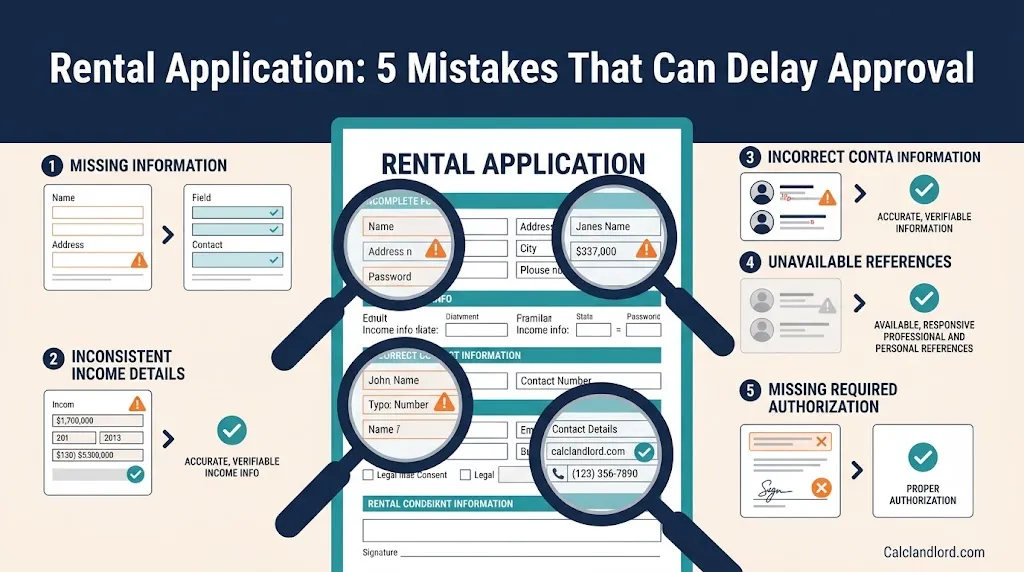
A red flag is a reason to verify information or request clarification. It is not automatically proof of fraud or a legally sufficient reason to deny an applicant.
| Potential concern | Why it matters | Appropriate next step |
| Missing information | Important details cannot be assessed | Request the missing information |
| Conflicting income figures | Affordability information may be unreliable | Ask for clarification and supporting documents |
| Unverifiable employment | Employment details remain uncertain | Use a reasonable alternative verification method |
| Unreachable landlord reference | Rental history cannot yet be confirmed | Request another contact or supporting documentation |
| Inconsistent dates or addresses | Records may be incomplete or inaccurate | Ask the applicant to clarify the timeline |
| Disputed screening information | A report may contain errors | Review the information and applicable dispute process |
| Reluctance to provide required documentation | The application may remain incomplete | Explain what is required and why |
Some apparent problems have innocent explanations.
A previous eviction filing may not have resulted in an eviction judgment. An employment gap may reflect caregiving, education, illness, or a job transition. A landlord reference may be difficult to reach because the property manager changed.
A sound screening process distinguishes verified facts from assumptions and gives applicants a reasonable opportunity to clarify material discrepancies.
11. How Tenants Can Improve Their Rental Application
Applicants cannot control every part of the landlord’s decision, but they can make their applications easier to review.
Prepare documents before applying. Gather identity information, income documentation, and previous landlord contact details. Ask which documents are necessary rather than sending sensitive records indiscriminately.
Be accurate and consistent. Make sure names, employment dates, addresses, and income figures match the supporting documents. If a figure changes because income varies, explain the difference rather than leaving the landlord to guess.
Explain unusual circumstances honestly. If you recently changed jobs, are self-employed, have a limited credit history, or have a previous housing record that needs context, prepare a concise explanation and appropriate supporting evidence.
Respond promptly. Answer reasonable follow-up questions and ask when the landlord expects to finish reviewing the application.
Understand the property’s criteria. Before paying a fee, ask about written income requirements, screening procedures, acceptable documentation, and whether any application fees are refundable.
Protect your personal information. Confirm that the property listing, landlord, and application platform are legitimate before providing identification or financial documents.
A complete, well-supported application does not guarantee approval, but it can reduce delays caused by missing information or avoidable errors.
12. Rental Application Fees, Screening Costs, and Holding Deposits
A landlord may charge a rental application or screening fee when permitted by applicable law. The fee may help cover costs associated with credit reports, background checks, or verification procedures.
However, Application Fees and holding deposits are not the same thing, and their legal treatment varies by location.
Application fees
Before submitting a fee, applicants should ask:
- How much is the fee?
- What screening does it cover?
- When will the application be considered?
- Is any part refundable?
- What happens if the unit is rented to someone else before the application is reviewed?
Landlords should provide required disclosures, avoid unlawful charges, and follow local fee limits and refund procedures.
California provides one example of why local verification matters: the California Department of Real Estate’s current tenant guide describes specific requirements for application screening fees, including requirements applying from January 1, 2025. These rules should not be assumed to apply nationwide. See the California Department of Real Estate’s rental guide.
Holding deposits
A holding deposit may be used to reserve a property while the parties move toward a rental agreement. Its treatment depends on the written terms and applicable law.
Before paying, applicants should understand whether the payment is refundable, what happens if the landlord declines the application, and what happens if the applicant decides not to proceed.
Landlords should put the relevant terms in writing before accepting money.
13. Fair Housing and Legal Compliance for Rental Applications
Rental applications must comply with federal fair-housing protections and any additional state or local requirements.
The federal Fair Housing Act prohibits discrimination in housing based on:
- Race.
- Color.
- National origin.
- Religion.
- Sex.
- Familial status.
- Disability.
Additional protections may apply under state and local laws. The precise coverage and any legal exceptions depend on the circumstances and jurisdiction.
The U.S. Department of Housing and Urban Development’s fair-housing guidance provides an overview of federal protections.
Apply screening criteria consistently
Landlords should establish written, lawful criteria and apply them consistently. Avoid changing the standards for individual applicants without a legitimate, legally permissible reason.
Handle disability-related requests appropriately
A request for a reasonable accommodation should be considered under applicable law. For example, a qualifying request involving an assistance animal may require an exception to a property’s standard pet policy. Assistance animals should not automatically be treated as pets for fee and policy purposes.
Be careful with criminal and eviction records
The existence of a record does not necessarily establish what happened or whether it is relevant to the current application. Landlords should ensure that screening is lawful, accurate, and based on appropriate criteria rather than relying on unverified or overly broad assumptions.
Protect consumer information
Screening reports and identity documents contain sensitive information. Collect only what is needed, use secure handling practices, restrict unnecessary access, and follow applicable data-protection requirements.
Check state and local laws
Application fees, reusable screening reports, credit-check procedures, criminal-record screening, income-source protections, occupancy rules, and required disclosures may vary considerably by jurisdiction.
This article provides general U.S. Educational information, not individualized legal advice. Landlords and tenants should consult the rules applicable to the property’s location when a specific legal issue arises.
14. What Happens If a Rental Application Is Denied?
A rental application may be denied because the applicant does not meet lawful, consistently applied screening criteria, the application remains incomplete, or material information cannot be verified.
However, a denial must not be based on unlawful discrimination, and consumer-reporting laws may impose additional obligations.
Understand adverse-action notices
Under the federal Fair Credit Reporting Act, a landlord who takes an adverse action based wholly or partly on a consumer report generally must provide an adverse-action notice.
Depending on the circumstances, an adverse action may include:
- Rejecting a rental application.
- Requiring a co-signer because of consumer-report information.
- Charging higher rent because of that information.
- Requiring a larger security deposit because of that information.
The notice must identify the consumer reporting agency that supplied the report and provide information about the applicant’s rights, including the right to request a free copy of the report within 60 days and to dispute inaccurate or incomplete information.
The applicant can review the report, identify potential errors, and raise a dispute with the reporting company. The Federal Trade Commission’s guide to tenant background checks explains these rights.
What tenants should do after a report-based denial
If a rental application is denied based on a screening report:
- Ask for the adverse-action notice and identify the reporting agency.
- Request a free copy of the report within the applicable 60-day period.
- Check for incorrect identities, duplicate records, outdated information, or incomplete case outcomes.
- Dispute errors with the reporting company and provide supporting documents.
- Ask the landlord whether corrected information can be reviewed, while understanding that the landlord may have other lawful reasons for its decision.
An applicant who believes a denial involved unlawful housing discrimination may also contact HUD or an appropriate state or local fair-housing agency. Reporting an error or challenging a denial does not itself guarantee that the property will be offered.
15. People Also Ask About Rental Applications
There is no universal approval timeline. Some applications can be reviewed within a day or two, while others take longer because income verification, reference checks, or screening records require additional attention. Ask the landlord for an expected timeline before submitting the application.
Some landlords use a gross monthly income guideline of 2.5 to 3 times the monthly rent. This is a common screening approach, not a universal legal requirement. Income-source protections and the landlord’s written criteria may affect which evidence can be considered.
Many landlords require each adult applicant to complete a separate application. This allows the landlord to review each adult using the same lawful screening criteria. Requirements can vary depending on the property, relationship between occupants, housing program, and local law.
The answer depends on the circumstances and applicable law. Federal and state fair-housing laws prohibit specified forms of discrimination, and a denial based on a consumer report generally triggers federal adverse-action notice requirements. Other state or local rules may require additional disclosures.
A rental application is generally different from a lease, but that does not mean every provision is legally meaningless. Screening authorizations, fee arrangements, declarations, or holding-deposit agreements may have legal consequences. The effect depends on the wording and applicable law.
Often, yes, depending on the landlord’s lawful criteria and the property’s requirements. An applicant may be able to demonstrate financial reliability through income documentation, rental references, or other appropriate evidence. Ask the landlord what alternatives are accepted before paying a screening fee.
In some circumstances, yes. The amount, permitted purpose, disclosure requirements, and refund rules vary by state and locality. Applicants should verify the applicable rules and ask what the fee covers before paying.
What should I do if my tenant screening report contains an error?
Request a copy of the report if you are eligible, identify the inaccurate or incomplete information, and dispute it with the reporting company. Keep copies of supporting documents and relevant communications. The FTC explains the process in its tenant background check guide.
A well-designed rental application helps both sides make better decisions. Tenants benefit from knowing what information to prepare and how their screening data may be used. Landlords benefit from a consistent process that verifies relevant information, protects sensitive records, and supports fair, well-documented decisions.
Before using an application form, check the rules that apply to the property’s location, explain the screening process clearly, and evaluate each applicant against the same lawful criteria. A complete application is only the beginning; careful verification and responsible decision-making are what make the process useful.
Conclusion
A strong rental application helps Landlords choose tenants fairly and helps applicants prepare for approval. Complete the form accurately, verify essential information, and follow applicable fair housing and screening laws. A consistent, transparent process can reduce delays and help both parties start the rental relationship with confidence.

Pingback: Rent Ledger: 7 Costly Mistakes Every Landlord Must Avoid
Pingback: BRRRR Strategy: 5 Proven Steps to Escape the Rent Race
Pingback: Move-In & Move-Out Inspection Checklist for Landlords: 15 Essential Steps