
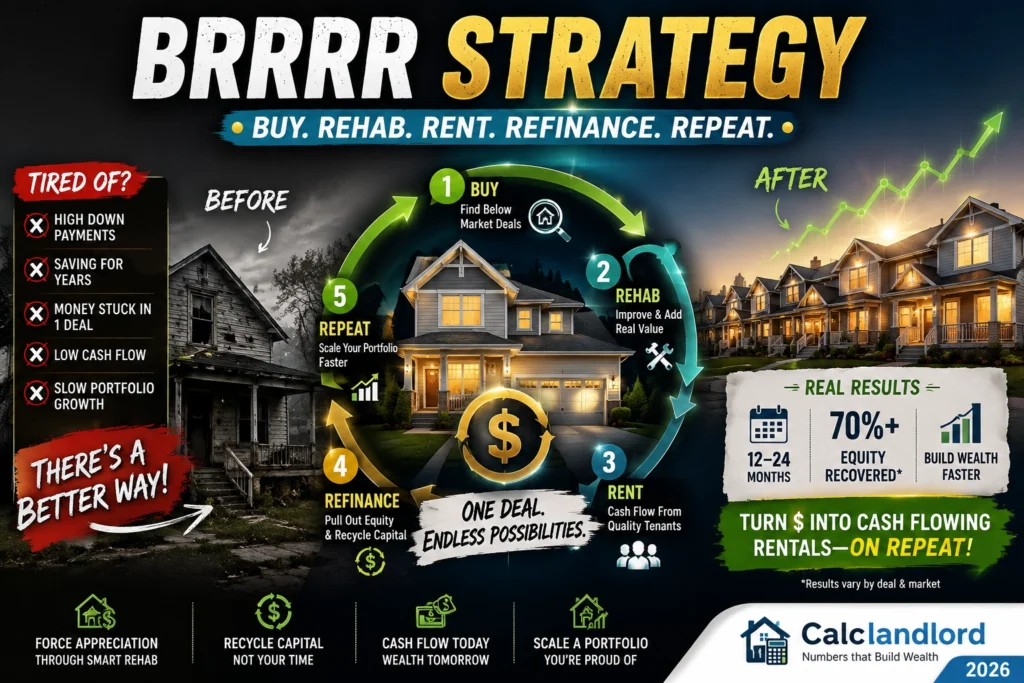
The BRRRR Strategy Explained: A Landlord’s Guide to Buying, Rehabbing, Renting, Refinancing, and Repeating
Most BRRRR guides still quote 2020 numbers — 100% capital recycled, 75-80% refinance LTVs, rates near 3%. That’s not the market you’re buying in today.
Here’s the honest version: at current rates, you’ll likely leave $5,000-$20,000 in each deal, not walk away with everything back. The good news? The strategy still works — you’re just playing a slightly different game than the one everyone’s still writing about.
This guide walks through the real 2026 math, the single biggest reason BRRRR deals stall (it’s not the rehab), and exactly how to protect yourself against it before you make an offer.
If you’ve spent any time in landlord or real estate investing circles, you’ve heard the acronym thrown around like everyone already knows what it means: BRRRR. Buy, Rehab, Rent, Refinance, Repeat.
It’s one of the few strategies that lets you build a real rental portfolio without saving a full 20-25% down payment for every single property. Instead, you recover most of your capital from each deal and roll it into the next one. On paper, it sounds like a money machine. In practice, it’s a method — and like any method, it only works if you understand the mechanics well enough to avoid the mistakes that quietly kill deals.
This guide walks through exactly how BRRRR works in today’s market, where the strategy tends to break, and how to run the numbers before you ever put in an offer. Wherever it’s useful, we’ll point you to the and related tools on CalcLandlord so you can plug in your own property numbers instead of just reading about someone else’s.
Quick Answer: What Is BRRRR?
BRRRR is a real estate investing method where you buy a property below market value (usually distressed or dated), renovate it to increase its value, rent it to a tenant, then refinance it based on the new, higher appraised value. The cash-out refinance returns most of your original investment, which you then use to buy the next property. Repeat the cycle, and you can scale a rental portfolio with far less new capital per deal than traditional buy-and-hold investing requires.
The strategy works because you’re forcing appreciation through renovation rather than waiting years for the market to do it for you. That’s also exactly where it can go wrong — if the rehab doesn’t add enough value, or the appraisal doesn’t reflect it, the “refinance” part of the cycle stalls out.
Why BRRRR Still Works With Higher Rates
A common question landlords ask right now: does BRRRR even make sense with mortgage rates well above where they were a few years ago? The honest answer is yes, but the expectations have to change.
With average conventional rates sitting in the high-6% to mid-7% range and refinance LTVs more commonly capped at 70-75% (down from the 75-80% many investors got used to), the “recycle 100% of your capital” outcome that BRRRR is famous for is no longer the norm. It still happens on great deals. On most deals, you should plan to leave some cash in the property — more on the real math below.
What hasn’t changed is the core mechanic: you’re creating equity through work (the rehab), not hoping for it through market timing. That’s still one of the few ways to build a rental portfolio faster than your savings account allows, rate environment aside.
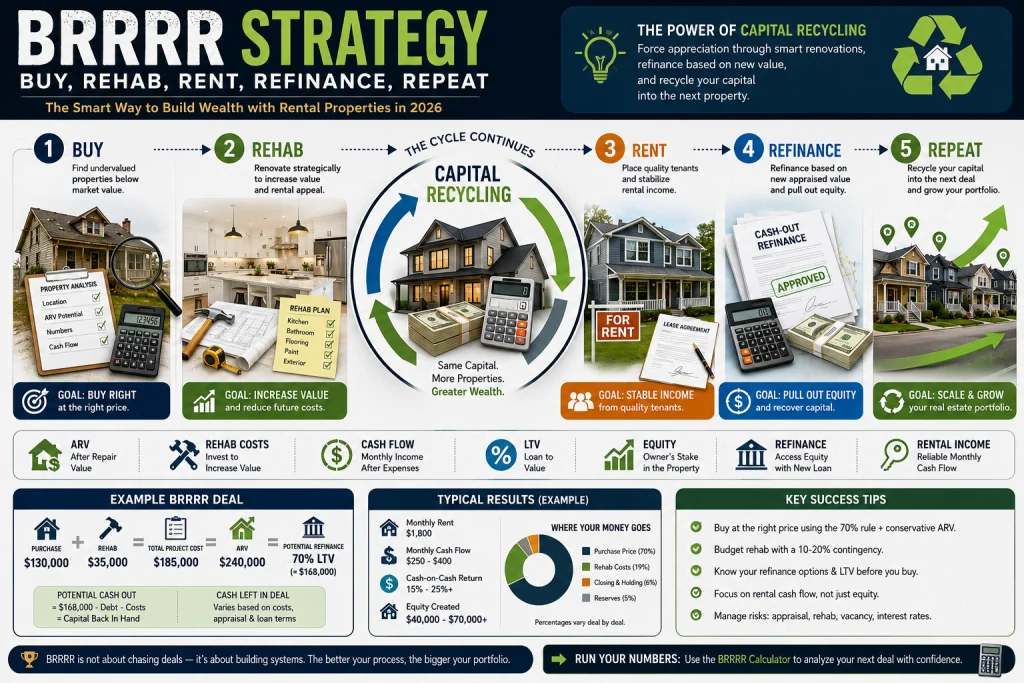
Buy below market value, rehab to force appreciation, rent to a qualified tenant, refinance to pull most of your capital back out, then repeat — see the full breakdown (with 2026 refinance numbers) below.
How the BRRRR Cycle Works, Step by Step
Step 1: Buy — Finding a Deal With Enough Margin
Everything about BRRRR depends on buying right. If you overpay at the front end, no amount of good rehab or property management fixes it later.
The classic guideline is the 70% rule: don’t pay more than 70% of the after-repair value (ARV), minus rehab costs. In today’s market, that percentage should flex based on where you’re buying:
| Market Type | Target Buy Price (% of ARV) | Why |
| Cash flow markets (Midwest, Southeast) | 70-75% | Higher rent-to-price ratios give you more room |
| Balanced markets (parts of Texas, the Carolinas) | 65-70% | Moderate rents mean you need a tighter entry |
| Appreciation-driven markets (Sun Belt metros) | 60-65% | Lower rental yields require a bigger equity cushion |
| High-cost coastal metros | 55-60% and below | BRRRR is genuinely difficult here — the spread rarely exists |
The formula:
Maximum Purchase Price = (ARV × Target %) − Rehab Costs
Example: ARV of $250,000, estimated rehab of $35,000, targeting 70% of ARV.
Max Price = ($250,000 × 0.70) − $35,000 = $140,000
Run this formula against your own numbers in the before you ever write an offer — it takes the guesswork out of “is this deal even worth pursuing.”
Where deals actually come from: wholesalers, off-market direct-to-seller outreach, MLS listings (especially estate sales and bank-owned properties), and local auctions. Off-market and wholesale deals tend to have more room below ARV, but they also move fast — you often need to decide within 24-48 hours.
Buy-stage checklist:
- Purchase price at or below your target % of ARV
- Rehab estimate confirmed by an actual contractor walkthrough, not a guess
- Projected rent supports positive (or at least breakeven) cash flow at current rates
- Neighborhood has genuine rental demand and low vacancy
- Comparable rentals nearby confirm your rent estimate
- No structural surprises that would tank your target ARV at appraisal
Step 2: Rehab — Renovate for Appraisal Value and Durability, Not Curb Appeal Alone
BRRRR rehab has a different goal than a flip rehab. A flipper is optimizing for a buyer’s emotional reaction during a showing. You’re optimizing for two things: what an appraiser will value, and what will survive years of tenant turnover without draining your cash flow in maintenance calls.
| BRRRR Rehab | Flip Rehab | |
| Primary goal | Appraised value + rental durability | Resale appeal |
| Materials | Tenant-proof, low-maintenance | High-end finish for a fast sale |
| Typical timeline | 4-6 weeks | 8-12 weeks |
| Budget focus | 15-20% of ARV on value-add work | Often 20-30% of purchase price |
A reasonable rehab budget breakdown:
| Category | % of Rehab Budget | Focus |
| Kitchen | 25-30% | Durable counters, updated appliances, refreshed cabinets |
| Bathrooms | 15-20% | New vanity, tile, fixtures — nothing precious |
| Flooring | 15-20% | Luxury vinyl plank throughout — waterproof and scratch-resistant |
| Paint | 10-15% | Neutral colors, a finish that survives cleaning |
| Systems (HVAC, plumbing, electrical) | 10-20% | Fix or replace as needed; this is what prevents 2 a.m. maintenance calls |
| Exterior / curb appeal | 5-10% | First impression for both the appraiser and future tenants |
Materials worth spending on:
| Area | Skip | Use Instead | Why |
| Flooring | Carpet, real hardwood | Luxury vinyl plank (LVP) | Waterproof, scratch-resistant, cheap to spot-replace |
| Counters | Laminate | Quartz or a solid surface | Durable, stain-resistant, and appraisers notice |
| Fixtures | Builder-grade chrome | Brushed nickel or matte black | Hides water spots, reads as updated |
| Paint finish | Flat | Eggshell or satin | Wipeable, hides scuffs between tenants |
Budget for the unexpected. Renovation projects go over budget more often than they come in on time — that’s not pessimism, it’s the norm. Build in a 15-20% contingency for the things you can’t see until walls are open: old wiring, foundation issues, permit delays. If your rehab estimate doesn’t have a contingency line, it’s not a real estimate yet.
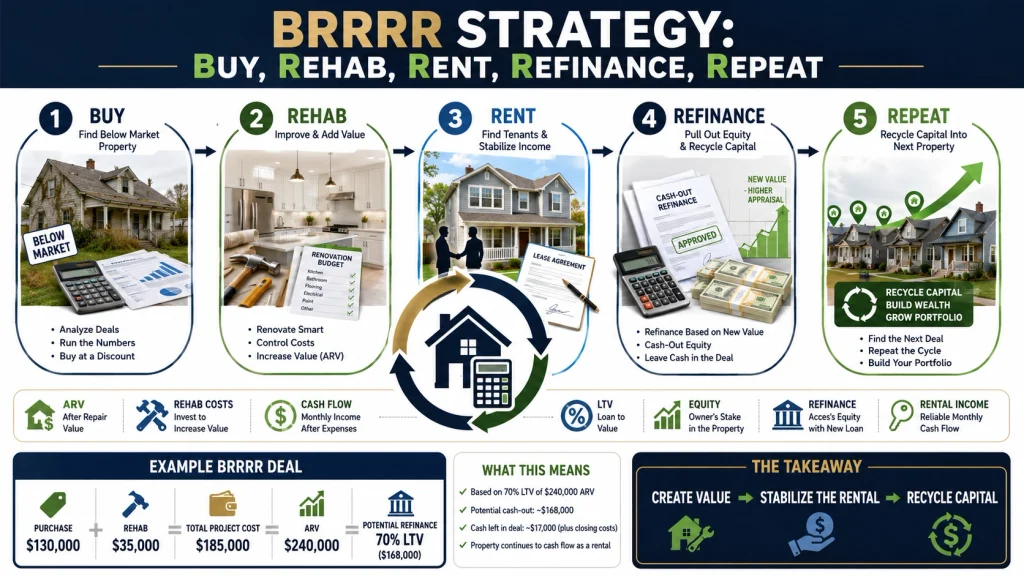
Buy below market value, rehab to force appreciation, rent to a qualified tenant, refinance to pull most of your capital back out, then repeat — see the full breakdown (with 2026 refinance numbers) below.
Step 3: Rent — Getting a Tenant in Place Without Bleeding Holding Costs
Every month a property sits vacant, you’re paying the mortgage, insurance, and utilities out of pocket with no rent coming in. At today’s rates, that holding cost adds up fast. Vacancy, not a slightly-below-market rent, is usually the bigger threat to your returns.
| Pricing Strategy | Typical Result |
| 10% above market rent | Longer vacancy (30-60+ days), thinner applicant pool |
| At market rent | Normal vacancy (roughly 2-4 weeks), solid applicant pool |
| 5% below market rent | Fast placement (1-2 weeks), strong applicant pool |
Pricing slightly under market to fill the unit faster often nets more annual income than holding out an extra month for a marginally higher rent — the math on lost holding costs usually wins.
Tenant screening baseline (adjust for your local laws and fair housing requirements):
| Criteria | Reasonable Minimum |
| Income | 3x monthly rent |
| Credit score | Mid-600s, with flexibility for strong income and rental history |
| Rental history | 2+ years, no evictions |
| Employment | Verified and stable |
| Background check | Screened per your state and local fair housing rules |
For the legal side of screening — what you can and can’t ask, and how criteria has to be applied consistently — see our requirements vary by state and locality, so don’t treat any single criteria table as legal guidance.
Lease basics that matter for BRRRR specifically: a 12-month minimum term (longer helps with refinance seasoning requirements), a clear rent-increase clause, and clarity on who handles minor repairs. Lenders generally want to see a signed lease before approving a cash-out refinance on a rental property — the rent amount is what feeds into the debt service coverage ratio (DSCR) calculation many refinance lenders use, typically requiring a ratio of 1.25 or higher.
Step 4: Refinance — The Step Where BRRRR Actually Delivers (or Doesn’t)
This is the step that makes BRRRR different from just buying and holding, and it’s also where the strategy most often disappoints first-timers who expected to walk away with all their cash back.
Typical refinance parameters today:
| Loan Type | Rate Range | LTV | Seasoning | Best For |
| Conventional | Mid-6% to mid-7% | 70-75% | 6-12 months | Best rates, stricter qualification |
| DSCR loan | High-6% to mid-8% | 70-75% | 3-6 months | No personal income verification, faster process |
| Portfolio lender | 7-9% | 65-75% | 0-6 months | More flexible terms, relationship-based |
| Local credit union | Mid-6% to low-7% | Up to 80% | 6-12 months | Often the best LTV, but local-only |
The refinance math, worked through an example:
| Line Item | Amount |
| Purchase price | $120,000 |
| Rehab cost | $30,000 |
| Total invested | $150,000 |
| After-repair value (ARV) | $200,000 |
| Refinance at 75% LTV | $150,000 |
| Cash back | $0 — you break even on cash, but now own the property free of “extra” capital |
| Refinance at 70% LTV instead | $140,000 |
| Cash left in the deal | $10,000 |
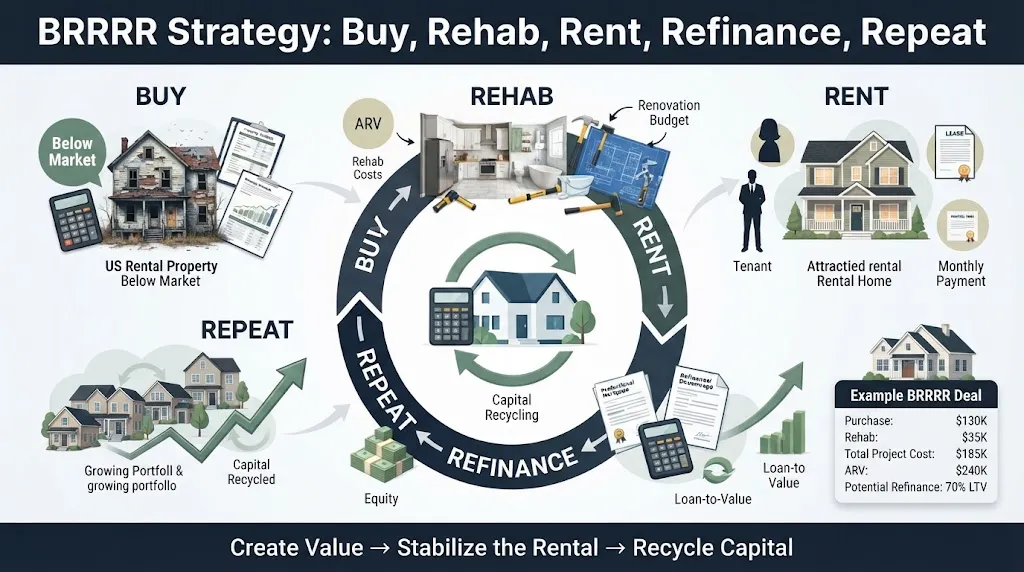
Buy below market value, rehab to force appreciation, rent to a qualified tenant, refinance to pull most of your capital back out, then repeat — see the full breakdown (with 2026 refinance numbers) below.
The realistic expectation for 2026: getting 100% of your capital back is the exception, not the rule. Plan to leave somewhere between $5,000 and $20,000 in each deal, depending on your market and how conservatively you bought. That’s not a failure of the strategy — the property is still cash-flowing and building equity. It just means “recycling 100% of your capital” shouldn’t be the bar you’re measuring success against.
How to protect your appraisal (the single biggest failure point in BRRRR): a low appraisal is the most common way a BRRRR deal falls short of plan, because it directly determines how much cash you get back.
- Complete all rehab work before ordering the appraisal — an appraiser can’t value work that isn’t finished
- Give the appraiser a scope-of-work summary and before/after photos
- Provide 3-5 comparable sales that support your target ARV
- Make sure the property is clean and reasonably staged when the appraiser walks through
- Have the signed lease in hand — it demonstrates the property is income-producing and stabilized
If the appraisal still comes in low, you generally have a few options: ask the lender to review it with additional comps, wait several months and try again once more comparable sales have closed, bring in outside capital to cover the shortfall on your next deal, or simply accept a longer timeline before you can move to the next property.
Step 5: Repeat — Scaling Without Starting From Zero Every Time
Once the refinance closes, whatever capital you got back goes toward the down payment and rehab reserve on the next property. Over several deals, the amount of new money you need per deal typically shrinks, even though the amount left in each individual deal doesn’t hit zero.
| Deal # | Capital In | Capital Recovered | Net Capital Deployed | Properties Owned |
| 1 | $150,000 | $140,000 | $10,000 | 1 |
| 2 | $140,000 | $130,000 | $20,000 | 2 |
| 3 | $130,000 | $125,000 | $25,000 | 3 |
| 4 | $125,000 | $120,000 | $30,000 | 4 |
After four deals in this example, you own four cash-flowing properties on $30,000 of total net capital deployed. If each one nets around $200/month, that’s roughly $9,600 a year of cash flow on that $30,000 — a return that would take most other strategies far longer to reach. Run your own numbers through the once you have a couple of properties under your belt to see where you actually stand.
What actually makes repeating sustainable:
- Build a repeatable checklist for each stage instead of relearning the process every time
- Assemble a team you trust — contractor, property manager, lender, and agent — rather than sourcing each one from scratch per deal
- Diversify across a few submarkets instead of concentrating every property in one zip code
- Reinvest a portion of rental cash flow to help cover the gap capital on the next deal
More Explore: https://calclandlord.com/property-investment-returns/
Best Markets for BRRRR Investing
The single best predictor of whether BRRRR will work in a given market is the price-to-rent ratio — median home price divided by annual rent. Generally, a ratio under 150 is favorable for BRRRR; above 200, the spread between purchase price and achievable rent gets too thin to make the math work.
| Market | Median Price | Avg. Rent (3BR) | Price-to-Rent | BRRRR Fit |
| Memphis, TN | ~$160,000 | ~$1,200 | ~133 | Strong |
| Indianapolis, IN | ~$190,000 | ~$1,350 | ~141 | Strong |
| Cleveland, OH | ~$130,000 | ~$1,100 | ~118 | Strong |
| Birmingham, AL | ~$150,000 | ~$1,150 | ~130 | Strong |
| Kansas City, MO | ~$185,000 | ~$1,400 | ~132 | Strong |
| Columbus, OH | ~$210,000 | ~$1,450 | ~145 | Good |
| Jacksonville, FL | ~$270,000 | ~$1,600 | ~169 | Moderate |
| San Antonio, TX | ~$250,000 | ~$1,500 | ~167 | Moderate |
Treat these as directional, not gospel — local price and rent data shifts, so confirm current numbers for any market you’re seriously considering with a local agent and property manager before committing capital. Use the Market Comparison tool to compare price-to-rent across the specific markets you’re weighing.
The Risks That Actually Sink BRRRR Deals
BRRRR isn’t riskier than other rental strategies by nature — it’s just riskier if you skip the parts that require discipline. Here’s where deals actually go wrong, and how experienced investors guard against each one.
| Risk | What Happens | How to Guard Against It |
| Overpaying at purchase | Refinance can’t return enough capital | Stick to your target % of ARV; get 3 contractor bids before closing; be willing to walk away |
| Rehab cost overruns | Budget blown mid-project, cash reserves strained | Build in a 15-20% contingency from day one; get a professional inspection before buying |
| Low appraisal | Refinance returns less cash than planned | Prepare a comp package; complete rehab before appraisal; meet the appraiser on-site |
| Extended vacancy | Holding costs eat into or eliminate cash flow | Start marketing before rehab wraps up; price slightly under market to fill fast |
| Rising rates between purchase and refinance | Refinance payment is higher than underwritten | Underwrite every deal at current rates plus a 1% buffer |
| Market softening during your hold | ARV comes in lower than projected at purchase | Buy with real margin (the 70% rule); favor cash-flow markets over speculative ones |
BRRRR vs. Other Rental Investing Strategies
| Strategy | Capital Required | Time to Cash Flow | Scalability | Best Fit |
| BRRRR | High upfront, mostly recycled | 4-8 months | Strong | Building a portfolio with limited starting capital |
| House Hacking | Low (owner-occupant financing) | 1-2 months | Limited to about one per year | First-time investors |
| Turnkey Rental | High (20-25% down) | Immediate | Limited by available capital | Passive, out-of-state investors |
| Wholesaling | Very low | No cash flow — fee income only | Scales with deal volume | Investors wanting income without holding property |
| Traditional Buy-and-Hold | High per property | 1-2 months | Limited by available capital | Long-term appreciation, stable markets |
How Much Capital Do You Actually Need to Start?
A reasonable starting range for a first BRRRR deal in a secondary, cash-flow-friendly market is $30,000 to $50,000. That covers:
- The down payment on a hard money or DSCR loan (typically 20-30% of purchase price)
- Closing costs
- Rehab costs (15-20% of ARV)
- A reserve fund of $15,000-$25,000 beyond the deal itself — don’t skip this
In higher-cost markets, that range can climb to $50,000-$100,000. The refinance step is designed to return most of that capital, but budget for leaving $5,000-$20,000 behind, as covered above.
Can you do BRRRR with no money down? Technically, yes, but it’s the exception rather than the plan. It generally requires a joint-venture partner who funds the deal while you manage it, private money at 100% financing, or a deal priced so far below ARV that hard money alone covers the full purchase and rehab. Most investors run BRRRR with 20-30% down plus rehab reserves — plan for that reality rather than the outlier.
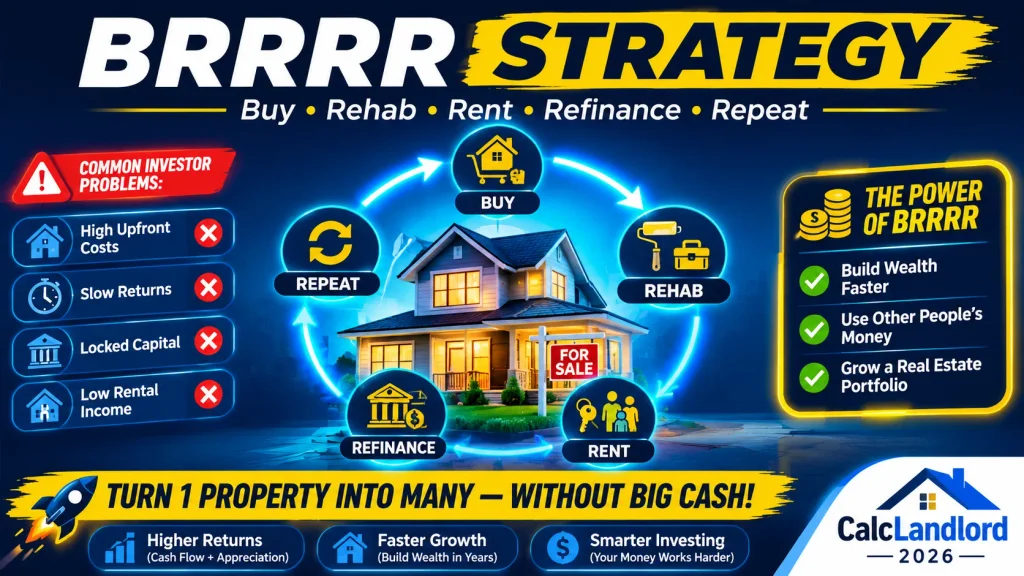
Buy below market value, rehab to force appreciation, rent to a qualified tenant, refinance to pull most of your capital back out, then repeat — see the full breakdown (with 2026 refinance numbers) below.
How Long Does a Full BRRRR Cycle Take?
| Phase | Typical Duration |
| Finding and closing on the property | 2-4 weeks |
| Rehab | 4-8 weeks |
| Tenant placement | 2-4 weeks |
| Seasoning period before refinance | 3-6 months (lender-dependent) |
| Refinance closing | 30-45 days |
Total: roughly 6-10 months per cycle. Some DSCR and portfolio lenders allow refinancing with 0-3 months of seasoning, which can shorten the full cycle to 4-6 months — worth asking about upfront if speed matters to your plan.
People Also Ask
Yes, but with adjusted expectations. Higher rates mean hard money costs more and refinance payments are higher, which pressures monthly cash flow. What still makes it work is that you’re forcing appreciation through renovation rather than waiting on the market, and higher rates often mean less buyer competition and lower purchase prices. Be conservative with your numbers, and judge success on total return — cash flow plus equity plus principal paydown — not monthly cash flow alone.
Most investors need $30,000-$50,000 for a first deal in an affordable market, covering down payment, closing costs, rehab, and reserves. Expensive markets can require $50,000-$100,000.
Not sticking to the target percentage of ARV when buying. It’s easy to get emotionally invested in a deal and stretch the purchase price, but that’s exactly what breaks the refinance math later. Underestimating rehab costs and skipping the contingency buffer is the second most common mistake.
Yes — many investors use conventional financing for the refinance step once the property is renovated and rented, since it typically offers the best long-term rate. The purchase and rehab stages more often use hard money, private money, or a DSCR loan because of the speed and flexibility they offer on a distressed property.
A flip is designed to be sold — the rehab optimizes for buyer appeal and a quick sale. BRRRR is designed to be held as a rental — the rehab optimizes for appraised value and durability against tenant wear, and the property stays in your portfolio generating cash flow after the refinance.
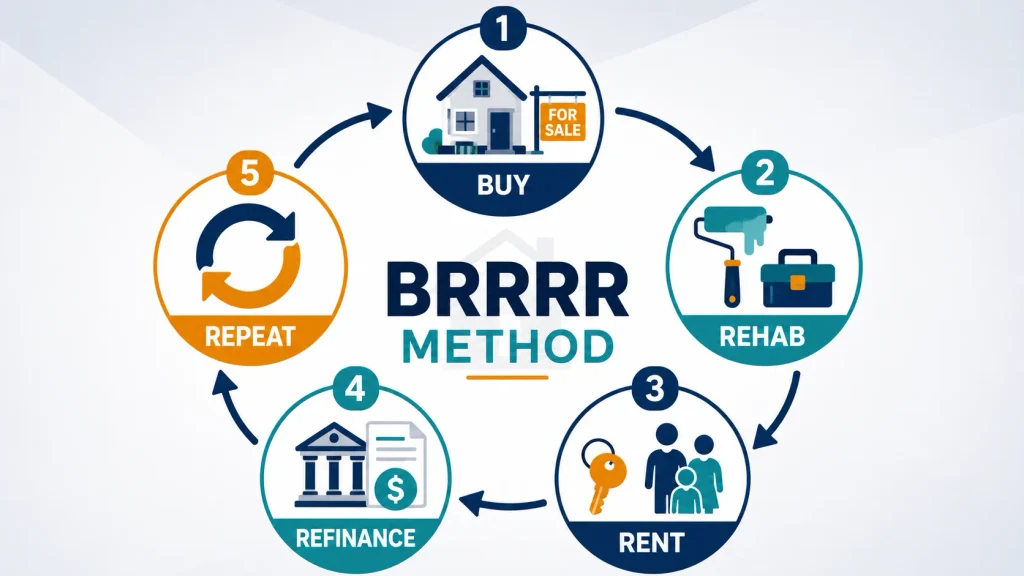
Buy below market value, rehab to force appreciation, rent to a qualified tenant, refinance to pull most of your capital back out, then repeat — see the full breakdown (with 2026 refinance numbers) below.
The Bottom Line
BRRRR works well if you have access to meaningful upfront capital, the patience for a 6-10 Month Cycle, and the willingness to manage (or closely oversee) a rehab. It’s not a fit for someone who wants fully passive income from day one or can’t absorb an unexpected repair bill without it derailing the deal.
Done consistently over several years, BRRRR is one of the more realistic paths to a double-digit-property portfolio without needing a large amount of new capital for every single purchase. The step that separates the investors who scale from the ones who stall out after one deal is almost always discipline at the buy stage and realistic expectations at the refinance stage.
Before you make an offer on your next property, run the numbers through the — it’ll tell you, before you’re financially committed, whether the deal actually has enough margin to work.
Tax treatment of rehab costs, depreciation, and refinance proceeds varies by situation — see our for the basics, and consult a tax professional for advice specific to your situation. Lending requirements referenced above vary by lender and change over time; confirm current terms directly with your lender before underwriting a deal around them.
Use The Calculator
Pingback: The Real Cost of Evicting a Tenant (It's Not $250)