

403(b) Calculator: Estimate Your Retirement Savings, Employer Match, and Growth
What could your 403(b) be worth when you retire? The answer depends on more than how much you contribute. Your current savings, employer match, investment returns, fees, and years until retirement can all influence your final balance. Whether you’re a teacher, nurse, or nonprofit employee, a 403(b) calculator helps you explore different retirement scenarios before making decisions. See how increasing your contributions or capturing your full employer match could affect your projected savings. You can also compare assumptions to understand the potential impact of market returns and costs. Start with your numbers and build a clearer retirement savings plan.
A 403(b) calculator helps you estimate how much money you could accumulate in your retirement account based on your current savings, salary, contributions, employer match, investment returns, and years until retirement.
Whether you’re a teacher, nurse, university employee, nonprofit professional, or eligible religious organization employee, understanding how your 403(b) grows can help you make better retirement decisions.
For example, imagine you’re 30 years old, earn $75,000 annually, and contribute 6% of your salary to a 403(b). If your employer matches 50% of your contributions up to 6% of your salary, that match can add thousands of dollars to your retirement savings over time. Investment growth can increase the total even further.
The key is to understand not just how much you save, but also how employer contributions, investment fees, and time affect your eventual balance.
Important: This calculator provides an educational estimate, not a guarantee of future results or personalized investment, tax, or legal advice. Actual balances depend on investment performance, plan rules, fees, contributions, and withdrawals.
403(b) Calculator
Use the calculator to estimate your future retirement balance. For the most useful result, include your current account balance, planned contributions, employer match, expected return after fees, and retirement age.
Calculator inputs explained
| Input | What to enter | Why it matters |
| Current age | Your age today | Helps determine how long your money can grow |
| Retirement age | Your planned retirement age | Establishes your investment time horizon |
| Annual salary | Your gross yearly salary | Helps calculate contributions and matching funds |
| Current 403(b) balance | Your existing account balance | Establishes your starting savings |
| Employee contribution | Percentage of salary or monthly amount | Determines how much you save from your pay |
| Employer match | The matching percentage offered by your employer | Estimates additional employer contributions |
| Match cap | The maximum percentage of salary eligible for matching | Determines the maximum available match |
| Expected annual return | Your assumed investment return | Estimates potential investment growth |
| Annual fees | Plan administration and investment costs | Helps estimate growth after expenses |
| Annual salary increase | Your expected yearly pay increase | Projects future contributions when saving a percentage of salary |
| Inflation rate | Your assumed annual inflation rate | Helps estimate future purchasing power |
For more realistic projections, use monthly payroll contributions, apply the employer match according to your actual plan, account for fees, and increase contributions when your salary rises.
A calculator that models these details will generally be more useful than one that only compounds your existing balance.
What Is a 403(b) Plan?
A 403(b) is a tax-advantaged retirement savings plan offered by eligible public educational institutions, certain tax-exempt organizations, and eligible religious organizations.
It allows eligible employees to contribute part of their compensation toward retirement, usually through payroll deductions.
Depending on the plan, employers may also contribute matching funds.
Common eligible employee groups include:
- Public school teachers and school employees.
- College and university staff.
- Employees of eligible nonprofit organizations.
- Nurses and other healthcare workers employed by qualifying organizations.
- Certain employees of religious organizations.
A 403(b) plan is sometimes called a tax-sheltered annuity plan. Depending on the employer’s arrangement, its investment options may include mutual funds and annuity contracts.
Why a 403(b) matters for retirement planning
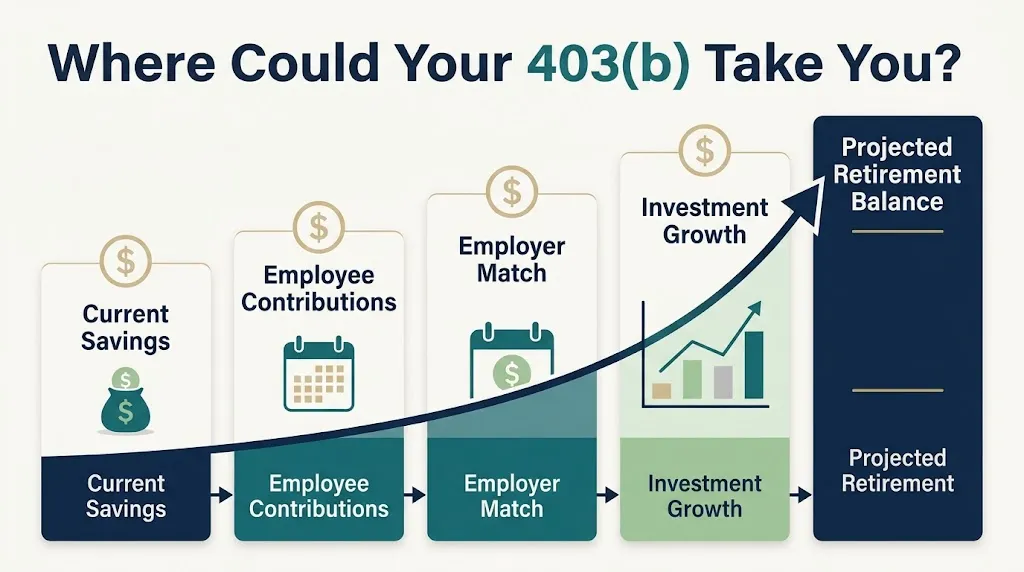
A 403(b) can help you build retirement savings through three main sources:
- Your own payroll contributions.
- Employer matching or other employer contributions, when available.
- Investment returns earned over time.
The combination can be powerful because your account may continue growing while you make regular contributions throughout your career.
However, investment returns are not guaranteed, and fees, poor market performance, and withdrawals can reduce the balance.
For official plan rules and contribution limits, consult the IRS guide to 403(b) contribution limits.
How Does a 403(b) Calculator Work?
A 403(b) calculator estimates your future account balance by combining your existing savings with future contributions, employer matching funds, and investment growth.
The result depends on the assumptions you enter.
The 403(b) growth formula
A simplified future-value formula for an account with a starting balance and equal annual contributions is:
FV=P(1+r)n+C(1+r)n-1r
Where:
- FV = projected future account balance.
- P = current account balance.
- r = assumed annual net investment return, expressed as a decimal.
- n = number of years until retirement.
- C = annual contribution, including employer matching contributions.
This version assumes equal contributions at the end of each year and a constant annual return. A more advanced calculator can use monthly contributions, salary increases, changing contribution rates, and annual fees.
Formula for employer matching contributions
A simplified employer-match calculation is:
\[ \text{Employer Match}= \min(\text{Employee Contribution},\text{Eligible Salary Amount}) \times\text{Match Rate} \]
The eligible salary amount depends on your employer’s matching formula.
For example, suppose your employer matches 50% of your contributions up to 6% of your salary.
If your salary is $75,000:
- Your contribution at 6% is $4,500 per year.
- The maximum salary amount eligible for matching is $4,500.
- Your employer contributes 50% of that amount, or $2,250 per year.
Your combined annual contribution is therefore $6,750.
The exact calculation should follow your plan documents, including any payroll-period requirements, matching limits, and true-up provisions.
Example: What Could Your 403(b) Be Worth at Retirement?
Consider a teacher who begins retirement planning at age 30 and intends to retire at age 65.
The following example shows how personal contributions, employer matching funds, and investment growth can work together.
Assumptions
| Variable | Assumption |
| Current age | 30 |
| Retirement age | 65 |
| Years invested | 35 |
| Annual salary | $75,000 |
| Current 403(b) balance | $10,000 |
| Employee contribution rate | 6% of salary |
| Employer match | 50% of contributions up to 6% of salary |
| Annual salary increase | 3% |
| Assumed annual return after fees | 6% |
Assume contributions are made monthly, the employer match is received in full, salary increases by 3% annually, and investment returns remain constant for illustration.
Estimated retirement balance
Illustrative projection using monthly contributions and annual salary increases.
| Growth source | Approximate amount |
| Your contributions | $272,000 |
| Employer contributions | $136,000 |
| Existing balance | $10,000 |
| Investment growth | $785,000 |
| Projected retirement balance | $1,203,000 |
Under these assumptions, the account could grow to approximately $1.2 million by age 65.
The employee contributes about $272,000 over the period, while the employer adds approximately $136,000. The remaining growth comes primarily from investment returns compounding over time.
These figures are estimates, not promised results. Actual returns fluctuate, salary increases may differ, employer benefits may change, and fees can reduce long-term growth.
What does this example teach us?
Three lessons stand out.
First, regular contributions build the foundation of your account. Second, an employer match can meaningfully increase your savings without requiring an equal increase in your personal contribution. Third, giving investments decades to grow can make a substantial difference.
Change the assumptions in the calculator to see how the results change when you save 4%, 8%, or 10%, retire earlier, or earn a lower investment return.
How Much Should You Contribute to Your 403(b)?
There is no single contribution rate that works for everyone. Your ideal amount depends on your income, expenses, debt, emergency savings, pension, other retirement accounts, and expected retirement lifestyle.
Still, a practical approach can help you establish a starting point.
1. Contribute enough to receive the full employer match
If your employer offers matching contributions, identify the contribution rate required to receive the maximum match.
For example, if the employer matches 50% of your contributions up to 6% of your salary, contributing 6% generally secures the full match under that formula.
Contributing less may mean missing out on some available employer contributions.
Review the plan’s rules before making assumptions about eligibility or timing.
2. Increase your contribution rate gradually
If you cannot afford a large contribution today, consider increasing your rate by one percentage point after a salary raise or when your budget improves.
For someone earning $75,000 annually, a one-percentage-point increase represents $750 in additional annual contributions before considering salary changes.
Your actual reduction in take-home pay depends on whether you use traditional or Roth contributions and on your tax situation.
3. Establish a realistic savings target
Some retirement planning approaches use 10% to 15% of gross pay as a long-term savings target, including employer contributions. This is a guideline, not a universal requirement.
Someone starting at age 25 with a pension may need a different contribution rate from someone beginning at age 45 without other retirement savings.
Use your projected 403(b) balance alongside your other retirement resources to determine whether you are on track.
4. Consider catch-up contributions when eligible
Employees approaching retirement may have access to additional contribution limits based on age and, for qualifying 403(b) participants, years of service.
These provisions can help eligible savers contribute more than the standard annual limit.
5. Review your plan fees and investments
Check the expense ratios of your investment options, administrative charges, and any annuity-related costs.
A plan’s available investments and fees can materially affect long-term results. A higher projected return is not necessarily the right choice if it requires taking risk you cannot comfortably tolerate.
How Does a 403(b) Employer Match Work?
An employer match is an additional contribution made by your employer when you save through the plan.
The match can increase your total retirement savings, but matching formulas vary.
Common employer-match formulas
| Matching formula | Your contribution required for full match | Employer contribution |
| 100% up to 3% of salary | 3% of salary | 3% of salary |
| 50% up to 6% of salary | 6% of salary | 3% of salary |
| 100% up to 4% of salary | 4% of salary | 4% of salary |
| 25% up to 8% of salary | 8% of salary | 2% of salary |
The percentages in this table illustrate common ways matching formulas work; they are not a statement about what every employer offers.
Example: How much could you receive in employer matching funds?
Suppose you earn $100,000 per year and your employer matches 50% of contributions up to 6% of salary.
| Your contribution rate | Your annual contribution | Employer match |
| 3% | $3,000 | $1,500 |
| 4% | $4,000 | $2,000 |
| 6% | $6,000 | $3,000 |
| 8% | $8,000 | $3,000 |
Under this formula, contributions above 6% of salary do not increase the employer match.
Contributing 8% may still improve your retirement outlook because the extra $2,000 remains invested, but it does not generate additional matching funds under the stated cap.
Check your vesting schedule
Some employer contributions are subject to a vesting schedule. Vesting determines when you gain a nonforfeitable right to employer-contributed funds.
If you may change employers before retirement, confirm whether your employer contributions are immediately vested or subject to service requirements.
Also check how the employer calculates matching contributions. Some plans match each payroll contribution, and plan provisions may affect whether you receive the full annual match if your contributions vary throughout the year.
What Are the 2026 403(b) Contribution Limits?
The IRS sets annual limits for employee salary deferrals and total contributions. The applicable limits depend on your age, eligibility for catch-up contributions, compensation, and plan rules.
According to the IRS’s 403(b) contribution limits guidance, the key 2026 figures are as follows.
Employee contribution limits for 2026
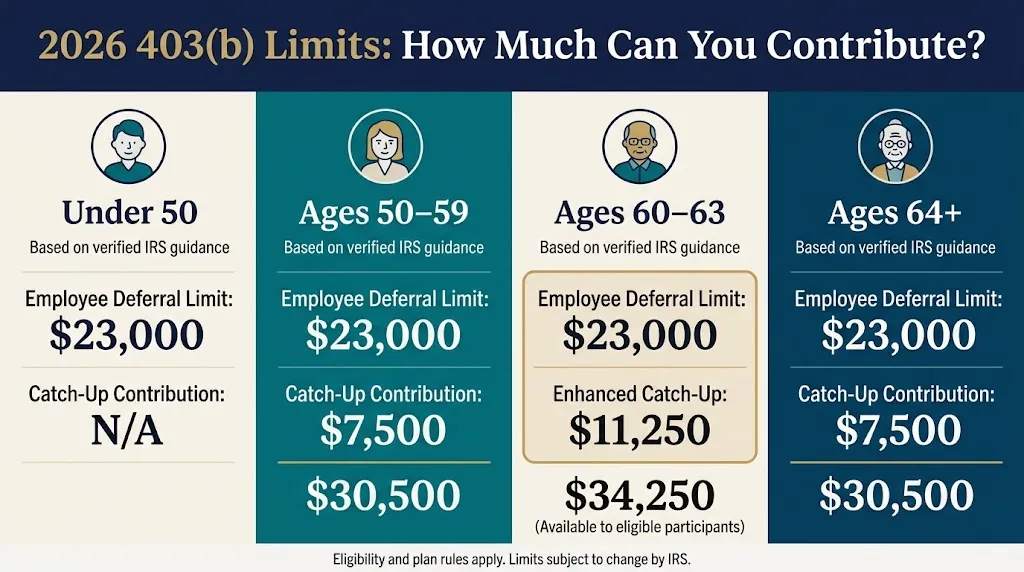
| Your age at the end of 2026 | Standard employee deferral limit | Potential age-based catch-up | Maximum with age-based catch-up |
| Under 50 | $24,500 | Not applicable | $24,500 |
| 50–59 | $24,500 | $8,000 | $32,500 |
| 60–63 | $24,500 | $11,250 | $35,750 |
| 64 and older | $24,500 | $8,000 | $32,500 |
The higher catch-up limit applies to eligible participants who attain age 60, 61, 62, or 63 during the calendar year. Catch-up contributions depend on plan provisions and applicable IRS rules.
The figures above cover the standard employee deferral limit plus the applicable age-based catch-up. They do not automatically include a separate 15-year-service catch-up.
Total annual contribution limit
For 2026, the general limit on annual additions to a 403(b) account is the lesser of:
- $72,000, or
- 100% of your includible compensation for your most recent year of service.
This limit generally combines employee elective deferrals and employer contributions. Separate rules apply to catch-up contributions, and your plan may impose additional restrictions.
Special 15-year-service catch-up
Some 403(b) plans permit qualifying employees with at least 15 years of service with the same eligible employer to contribute additional amounts.
The potential additional limit depends on prior contributions and years of service. Under the IRS formula, the maximum additional amount is determined by the least of specified calculations, including a $3,000 annual amount and a $15,000 lifetime maximum.
Not every employer offers this provision, and meeting the service requirement alone does not guarantee eligibility.
See IRS Publication 571 or speak with your plan administrator before relying on this catch-up.
Roth catch-up rules for certain higher-paid employees
Beginning in 2026, eligible catch-up contributions generally must be designated Roth contributions when the participant’s wages from the relevant employer exceeded $150,000 in the preceding year, subject to the applicable rules.
This requirement can affect the tax treatment of additional contributions for eligible higher-paid employees. Review the IRS catch-up contribution guidance for details.
Because these limits and eligibility rules can be complicated, confirm your permitted contribution amount with HR or your plan administrator before changing payroll deductions.
Traditional vs. Roth 403(b): Which Should You Calculate?
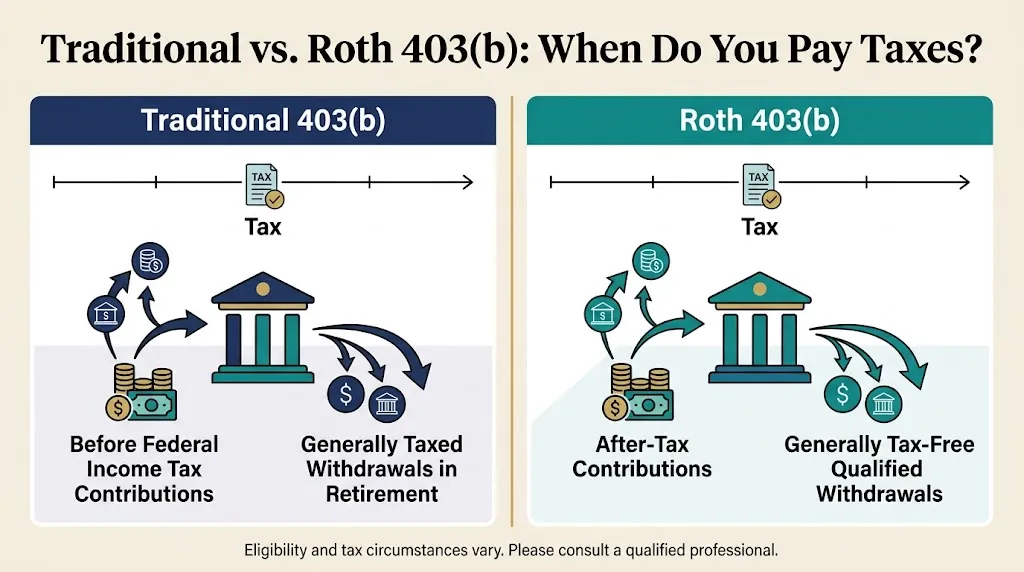
Many 403(b) plans offer traditional contributions, Roth contributions, or both. The main difference is when you pay income tax.
| Feature | Traditional 403(b) | Roth 403(b) |
| Contribution treatment | Generally made before federal income tax | Made after income tax |
| Immediate federal income-tax deduction | Generally reduces current taxable income | No current deduction |
| Investment growth | Tax-deferred | Potentially tax-free withdrawals if qualified |
| Retirement withdrawals | Generally taxable as ordinary income | Qualified withdrawals are generally tax-free |
| Potential advantage | Tax benefit today | Tax benefits on qualified withdrawals later |
Traditional 403(b) contributions generally remain subject to Social Security and Medicare taxes, even when excluded from current federal income-tax wages.
Roth contributions do not provide the same immediate federal income-tax benefit, but qualified withdrawals can be tax-free if the applicable requirements are met.
When might a traditional 403(b) make sense?
A traditional account may appeal to someone who values a reduction in current taxable income and expects their tax rate to be lower in retirement.
When might a Roth 403(b) make sense?
A Roth account may appeal to someone who expects their tax rate to be higher later or prefers the potential benefit of qualified tax-free withdrawals.
Neither option is automatically better. Your current tax bracket, expected retirement income, other accounts, and state tax treatment all matter.
A standard 403(b) calculator estimates the account balance, not necessarily the amount you will keep after taxes. A more complete retirement comparison should model both account growth and potential after-tax spending.
403(b) vs. 401(k): What Is the Difference?
Both plans allow eligible workers to save for retirement through payroll deductions and may offer employer matching contributions.
Their differences generally reflect the type of employer sponsoring the plan and the plan’s available benefits and investments.
| Feature | 403(b) | 401(k) |
| Common employer | Schools, eligible nonprofits, hospitals, and certain religious organizations | Private-sector companies and other eligible employers |
| Employee contributions | Salary deferrals | Salary deferrals |
| Employer match | Depends on the plan | Depends on the plan |
| Investment options | May include mutual funds and annuity contracts | Depends on the investment menu |
| Special 15-year-service catch-up | Potentially available to eligible participants | No equivalent general 15-year-service provision |
| Annual employee deferral limit in 2026 | $24,500 | $24,500 |
The standard employee deferral limits are generally shared across certain employer-sponsored plans when applying the applicable IRS rules. If you contribute to more than one eligible plan, check the combined limit rather than assuming each plan automatically permits a separate full deferral.
If your employer also offers a governmental 457(b) plan, ask whether participation in both plans is permitted and how the applicable contribution limits interact.
The best plan is not necessarily the one with the more familiar name. Compare your employer match, vesting, investment choices, administrative costs, and tax treatment.
What Affects Your 403(b) Growth?
The account balance shown by a calculator depends on multiple variables. Understanding them helps you make more realistic projections.
Contribution amount
Your contribution rate directly affects how much money enters the account.
Increasing the rate can increase your projected balance through both additional deposits and the potential investment growth earned on those deposits.
However, your contribution rate should fit your financial circumstances. Avoid sacrificing necessary living expenses or emergency savings simply to achieve an arbitrary target.
Time until retirement
Time gives investments more opportunities to compound.
Someone who starts saving earlier may have more years of investment growth than someone who starts later. The earlier saver does not necessarily need to contribute the same amount every year to achieve a higher final balance.
A calculator can help compare different starting ages and retirement dates without assuming that any particular contribution strategy guarantees success.
Investment returns
The annual return assumption has a significant effect on projected savings.
A higher assumed return will usually produce a higher projected balance, but actual market performance can be negative as well as positive.
It is better to compare several plausible scenarios than to choose a highly optimistic return simply because it produces a desirable result.
Investment and plan fees
Fees reduce the portion of investment growth that remains in your account.
Check fund expense ratios, recordkeeping or administration charges, and any additional costs associated with annuity contracts or advisory services.
Use an after-fee return in the calculator, or enter an expected return and fee assumption separately if the tool supports both.
Avoid subtracting fees twice.
Salary increases
When you contribute a percentage of salary, a higher salary generally increases the dollar value of your contributions.
For example, 6% of a $75,000 salary is $4,500 annually, while 6% of an $85,000 salary is $5,100 annually.
If you expect salary increases, include them in the projection when possible. Real salary growth may differ from your assumption.
Inflation
Inflation reduces purchasing power over time.
A future account balance of $1 million will not buy the same amount of goods and services in 30 years as it does today if prices increase during that period.
Use an inflation-adjusted projection when the calculator supports one. This helps you evaluate your expected retirement lifestyle rather than looking at a large future dollar amount in isolation.
Withdrawals and loans
Money removed from a retirement account can no longer generate potential returns inside that account.
Withdrawals may also have tax consequences and, depending on your circumstances, an additional early-distribution tax. Exceptions may apply. Review IRS retirement-plan distribution guidance before making a withdrawal decision.
If your plan permits loans, understand the repayment requirements and possible consequences of leaving your employer with an outstanding loan.
Who Can Use a 403(b)?
A 403(b) calculator is useful for employees who qualify for an eligible employer’s plan and want to understand their potential retirement savings.
Examples include public school teachers, higher-education employees, qualifying nonprofit staff, and eligible hospital employees.
Teachers and school employees
A teacher may have access to a 403(b), a pension, or both, depending on the employer and retirement system.
The calculator can help estimate the 403(b) balance, but the teacher should consider the pension and any other retirement resources separately before evaluating total retirement readiness.
Nurses and healthcare employees
Employees of eligible healthcare organizations may use a 403(b) to supplement other retirement benefits.
Their planning should account for employer matching, investment costs, contribution limits, and the possibility of changing employers during their careers.
Nonprofit employees
Eligible nonprofit employees may benefit from regular contributions and employer matching where offered.
Plan eligibility, investment options, and vesting should be verified with the employer rather than assumed from the organization’s nonprofit status alone.
Ministers and religious organization employees
Certain religious organizations and ministers may qualify for 403(b) arrangements, but eligibility and tax circumstances depend on the specific plan and applicable rules.
Consult the employer or a qualified tax professional when specialized religious-employment tax rules may apply.
How to Interpret Your 403(b) Calculator Results
A projected balance is a planning estimate, not a guarantee that the account will reach that amount.
After calculating your expected balance, use the result to answer several practical questions.
1. Will the projected balance support your retirement income?
Consider how much annual income you may need from savings after accounting for pensions, Social Security, and other sources of income.
For example, a simple 4% calculation applied to a projected $1.2 million balance is:
\[ \$1{,}200{,}000 \times 0.04=\$48{,}000 \]
That equals $48,000 in initial annual withdrawals before taxes.
This is only an illustrative planning yardstick, not a guarantee of sustainable income. The suitability of a withdrawal rate depends on market returns, inflation, the length of retirement, fees, taxes, and other factors.
2. Are you receiving the full employer match?
Compare your contribution rate with the matching formula in your plan.
If you’re contributing less than the rate required to receive the full match, determine whether increasing your payroll deductions is affordable.
3. What happens if you contribute more?
Calculate several scenarios, such as 4%, 6%, 8%, and 10% of your salary.
Compare the balances, your own contributions, and the employer match. This helps distinguish the effects of saving more from the effects of investment growth.
4. What if you retire earlier or later?
Try changing your retirement age. Retiring later could provide more time for contributions and investment growth, while retiring earlier may mean fewer contributions and a longer period during which savings must support you.
5. Could lower fees improve the outlook?
Compare the expenses of available investments in your plan and test how different net-return assumptions affect your projected balance.
A calculator can illustrate the potential impact of fees, but it cannot determine whether an investment is suitable for your personal financial circumstances.
Common 403(b) Calculator Mistakes to Avoid
A useful calculator is only as reliable as its assumptions.
Ignoring the employer match. Leaving out matching contributions can understate the amount entering your account. Enter the correct formula and any applicable cap.
Using an unrealistic investment return. A very high assumption can make a weak savings plan appear sufficient. Test several scenarios and remember that actual returns fluctuate.
Forgetting fees. Fees reduce investment growth. Avoid entering a return that ignores costs when you intend to model your net return.
Confusing future dollars with today’s purchasing power. Inflation can reduce what your projected balance will buy. Use an inflation-adjusted estimate when available.
Assuming salary will stay constant. If your contributions are a percentage of pay, salary increases can change your future deposits.
Overlooking contribution limits. Your plan may restrict contributions, and annual IRS limits can change. Verify the applicable limit for the year.
Treating the projected balance as guaranteed. A calculator uses assumptions; it does not predict market performance with certainty.
Forgetting other retirement income. A 403(b) is only one piece of your retirement plan. Consider pensions, Social Security, other accounts, and expected spending when evaluating the result.
More Explore: https://calclandlord.com/how-to-rent-your-house/
People Also Ask
Your future balance depends on your current account balance, contribution rate, salary, employer match, investment returns, fees, and years until retirement. Enter these values into a 403(b) calculator to estimate the amount under different scenarios.
A practical starting point is often to contribute enough to receive the full employer match, if available and affordable. After that, increase your savings as your budget permits and assess your broader retirement income needs. There is no universal monthly amount suitable for every employee.
The standard employee salary-deferral limit is $24,500 in 2026. Eligible employees age 50 or older may qualify for an additional $8,000 catch-up, while eligible participants who attain age 60 through 63 during the year may qualify for an $11,250 catch-up. Special rules and plan provisions apply. See the IRS contribution-limit guidance.
Your employer contributes additional money based on a specified formula. For example, a 50% match on contributions up to 6% of salary means the maximum employer contribution under that formula equals 3% of salary when you contribute at least 6%.
Neither is automatically better. Compare the employer match, fees, investment options, vesting rules, tax treatment, and the features of your specific plan.
Some employees can participate in both plans through an eligible employer. The tax rules and contribution limits differ by plan type, and special combined-limit rules may apply. Check your plan documents and the IRS guidance on 457(b) plans.
Not necessarily. The Rule of 72 provides a rough estimate of doubling time by dividing 72 by the assumed annual return percentage. At a hypothetical 7% annual return, the estimate is about 10 years. Actual returns vary, and ongoing contributions affect how an account grows.
Final Thoughts
A 403(b) calculator is a useful starting point for understanding how Retirement savings could grow over time. By combining your current balance, regular contributions, employer matching funds, investment returns, and retirement timeline, you can see how different decisions may influence your financial future.
Start with realistic assumptions, confirm your plan’s employer-match formula, check the current IRS contribution limits, and account for investment fees and inflation.
Most importantly, run multiple scenarios rather than relying on a single projected balance. Comparing different contribution rates and retirement ages can help you identify a savings approach that fits your budget and long-term goals.
Your result is an estimate, not a promise. Use it to ask better questions, review your plan regularly, and make informed decisions about your retirement savings.
