

Split Rent Calculator: Divide Rent Fairly With Roommates
Splitting rent sounds easy—until one roommate gets the larger bedroom, another has a private bathroom, or a couple shares a room with a third person. An equal split may be simple, but it does not always feel fair. A split rent calculator helps you compare practical ways to divide the monthly cost, including equal shares, bedroom size, income, and shared spaces. You’ll see the formulas, worked examples for two, three, and four roommates, and ways to handle utilities separately. Use these calculations as a starting point, discuss the results openly, and agree on a split everyone understands before move-in.
Splitting rent with roommates sounds simple until one person gets the master bedroom, another has a tiny room, and someone else has a private bathroom. Dividing the total rent equally may be convenient, but it does not always reflect the space, privacy, or shared facilities each person receives.
A split rent calculator helps roommates determine how much each person should pay every month. Depending on your situation, you can divide rent equally, base each share on bedroom size, adjust for room features, or calculate payments according to income. You can also work out how to divide utilities, internet, and other shared expenses.
Whether you are sharing a two-bedroom apartment, living with three roommates, or splitting a house with a couple, the goal is the same: find a Transparent Arrangement that everyone understands and accepts.
This guide explains the main rent-splitting formulas, shows practical examples for two, three, and four people, and helps you choose a method that balances fairness with simplicity.
Quick Answer: How Do You Calculate a Fair Rent Split?
To calculate a fair rent split, divide the total monthly rent according to the method everyone agrees to use. For equal shares, divide rent by the number of people. For room-size-based shares, divide each bedroom’s square footage by the total bedroom area and multiply that percentage by the rent. Split utilities separately when appropriate.
For example, if three roommates pay $2,400 per month and agree to split rent equally, each pays $800. If one person has a substantially larger bedroom, a room-size or hybrid calculation may be more appropriate.
What Is a Split Rent Calculator?
A split rent calculator is a tool that estimates each roommate’s share of monthly housing costs.
Instead of relying on guesswork or negotiating a random amount, roommates can enter their rental figures and compare different ways of allocating the costs.
Depending on the calculation method, the tool can help account for:
- Total monthly rent.
- Number of roommates and occupants.
- Bedroom size and relative privacy.
- Private bathrooms, balconies, closets, and other room features.
- Differences in income, when everyone agrees to an income-based arrangement.
- Electricity, water, gas, internet, and other shared bills.
The result is a proposed monthly payment for each roommate. It is an estimate of a fair household arrangement, not a universally established rent amount or a legal determination of what each tenant owes the landlord.
Which Rent-Splitting Method Should You Choose?
The best method depends on the differences between the rooms, the number of people living in the property, and how your household wants to share costs.
| Situation | Suggested method | Why it may work |
|---|---|---|
| Bedrooms and facilities are similar | Equal split | Simple and easy to maintain |
| Bedrooms have different dimensions | Room-size split | Recognizes differences in private space |
| One room has a private bathroom or balcony | Feature-adjusted split | Accounts for additional privacy or amenities |
| Roommates have significantly different incomes | Income-based split | Allocates rent according to earning capacity |
| A couple shares one bedroom | Hybrid split | Accounts for both private-room use and shared spaces |
| Utilities differ according to usage | Separate utility split | Keeps variable bills distinct from rent |
There is no single method that is automatically fair in every household.
For most apartments with noticeably different bedrooms, a hybrid method that allocates part of the rent equally and part according to room size is a useful starting point. However, roommates should compare the results and agree on the final arrangement.
1. Calculate Rent With an Equal Split
An equal rent split is the easiest method. Every roommate contributes the same amount, regardless of bedroom size or income.
Equal rent split formula
\[ \text{Rent per person}= \frac{\text{Total monthly rent}}{\text{Number of people}} \]
Example: Two roommates
Suppose two people share an apartment with monthly rent of $2,000.
\[ \$2,000\div 2=\$1,000 \]
Each roommate pays $1,000 per month.
Example: Three roommates
Suppose three friends rent a house for $3,000 per month.
\[ \$3,000\div 3=\$1,000 \]
Each person pays $1,000.
When is an equal split fair?
An equal split works well when everyone has comparable bedrooms, similar access to bathrooms, and equivalent use of the property.
It is also convenient when roommates value simplicity more than precise room-by-room adjustments.
However, charging identical amounts may cause frustration when one person receives a much larger room or significantly better amenities. In that case, consider the room-size or hybrid methods below.
2. How to Split Rent by Room Size
Splitting rent by bedroom size assigns a larger share to the roommate using more private bedroom space.
This method is relatively straightforward because bedroom dimensions can be measured in square feet.
Room-size rent split formula
\[ \text{Room’s rent share}= \frac{\text{Bedroom area}}{\text{Total bedroom area}} \times\text{Total rent} \]
Bedroom area is calculated by multiplying the room’s length by its width.
For example, a bedroom measuring 12 feet by 15 feet has an area of:
\[ 12\times15=180\text{ sq ft} \]
Example: Three roommates with different bedrooms
Imagine three roommates share a property with monthly rent of $3,000.
| Roommate | Bedroom size | Share of bedroom area | Rent using the room-size method |
|---|---|---|---|
| Roommate A | 150 sq ft | 37.5% | $1,125 |
| Roommate B | 150 sq ft | 37.5% | $1,125 |
| Roommate C | 100 sq ft | 25% | $750 |
| Total | 400 sq ft | 100% | $3,000 |
Roommate A pays:
\[ \frac{150}{400}\times\$3,000=\$1,125 \]
Roommate C pays:
\[ \frac{100}{400}\times\$3,000=\$750 \]
The smaller bedroom receives a lower rent allocation because it occupies a smaller proportion of the total bedroom area.
Important limitation: This simple formula allocates all rent according to bedroom size. It does not separately recognize the kitchen, living room, hallways, and other shared spaces. That is why some households prefer the hybrid method.
3. Use a Hybrid Rent Split Calculator
A hybrid rent split divides housing costs into two parts:
- A shared-space portion that is divided equally among the people living in the property.
- A private-bedroom portion that is allocated according to bedroom size.
This recognizes that everyone uses common areas, even when their private bedrooms differ considerably.
The shared-space percentage is a choice the roommates make together. There is no universally correct percentage for every property.
Hybrid rent split formula
Let \(c\) represent the agreed percentage of rent allocated to shared spaces.
\[ \text{Shared pool}=\text{Total rent}\times c \]
\[ \text{Bedroom pool}=\text{Total rent}\times(1-c) \]
For a person occupying a bedroom alone:
\[ \begin{aligned} \text{Rent share}={}&\frac{\text{Shared pool}}{\text{People}}\\ &+\frac{\text{Bedroom area}}{\text{Total bedroom area}}\\ &\times\text{Bedroom pool} \end{aligned} \]
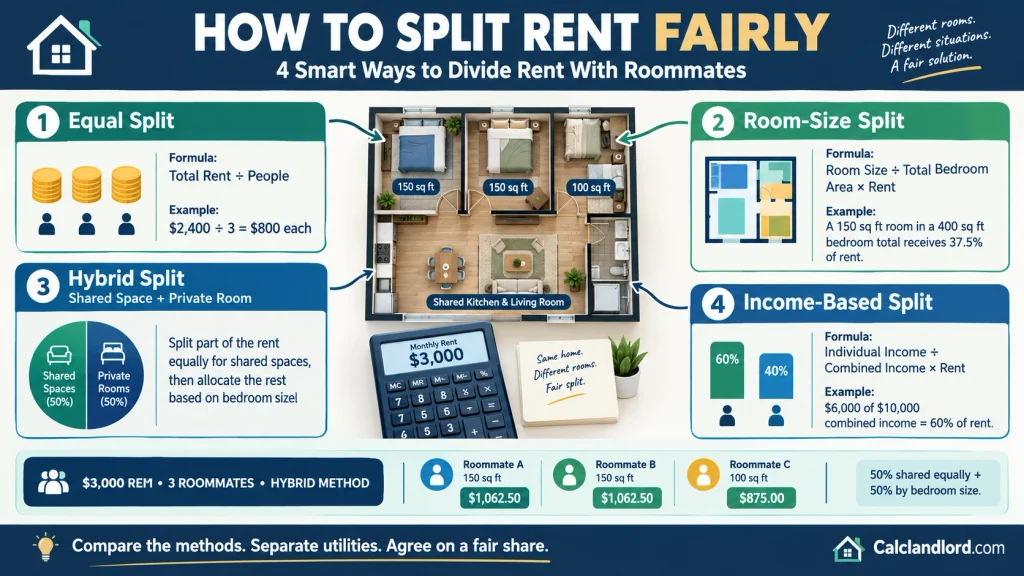
Example: Three roommates using a 50/50 split
Suppose three roommates pay $3,000 in monthly rent. Their bedrooms measure 150, 150, and 100 square feet.
They agree to allocate 50% of the rent to shared spaces and 50% to bedrooms.
Step 1: Calculate the shared-space pool.
\[ \$3,000\times50\%=\$1,500 \]
Each roommate’s share of common space is:
\[ \$1,500\div3=\$500 \]
Step 2: Calculate the bedroom pool.
\[ \$3,000\times50\%=\$1,500 \]
Step 3: Calculate each roommate’s total rent.
| Roommate | Shared-space share | Bedroom share | Total monthly rent |
|---|---|---|---|
| A — 150 sq ft | $500 | $562.50 | $1,062.50 |
| B — 150 sq ft | $500 | $562.50 | $1,062.50 |
| C — 100 sq ft | $500 | $375.00 | $875.00 |
| Total | $1,500 | $1,500 | $3,000 |
This arrangement recognizes equal use of common spaces while still charging more for larger bedrooms.
The 50/50 allocation is illustrative, not a recommended standard for every home. Roommates could choose a different shared-space percentage if it better reflects their property’s layout and their agreement.
4. Adjust Rent for Private Bathrooms and Other Amenities
Bedroom square footage does not tell the whole story.
Two rooms of identical size may offer different levels of privacy, convenience, or comfort. A room with an en-suite bathroom may be more desirable than one requiring the occupant to share a bathroom with everyone else.
Other features that may affect the agreed rent split include:
- Private bathrooms or exclusive bathroom access.
- Walk-in closets and additional storage.
- Balconies or private outdoor space.
- Dedicated parking.
- Natural light, noise, and privacy.
- Access to laundry facilities or other amenities.
There is no fixed percentage that every private bathroom or balcony should add to rent. Its value depends on the property and what the roommates consider reasonable.
A simple room-weighting method
Instead of applying arbitrary dollar increases, roommates can agree on relative room weights.
For example, three rooms might receive the following weights:
| Room | Agreed weight |
|---|---|
| Room A — largest, with en-suite bathroom | 1.2 |
| Room B — standard bedroom | 1.0 |
| Room C — smaller bedroom | 0.8 |
| Total weight | 3.0 |
For $3,000 in rent, using these weights to allocate the entire rent would produce:
| Room | Calculation | Monthly rent |
|---|---|---|
| A | $3,000 × 1.2 ÷ 3.0 | $1,200 |
| B | $3,000 × 1.0 ÷ 3.0 | $1,000 |
| C | $3,000 × 0.8 ÷ 3.0 | $800 |
| Total | $3,000 |
These weights are illustrative values chosen for this example, not standardized market premiums.
When a hybrid method is used, apply the weights only to the bedroom portion, then add each person’s shared-space contribution.
The advantage of weighting is that the final amounts still add up to the total rent. Simply adding a bathroom premium to one person’s original share without reallocating the remaining rent can make the total exceed the actual rent.
5. Split Rent Based on Income
An income-based rent split allocates rent according to each roommate’s share of combined household income.
This can be useful for couples or close friends who agree to make housing costs proportional to what each person earns.
It is not necessarily appropriate for every group of unrelated roommates, particularly when everyone expects to pay for the room they occupy.
Income-based rent split formula
\[ \text{Rent share}= \frac{\text{Individual income}}{\text{Combined income}} \times\text{Total rent} \]
Roommates should agree beforehand on whether they will use monthly gross income or take-home pay after deductions. Both methods are mathematically possible, but they can produce different results.
Example: Two roommates with different incomes
Suppose two roommates pay $2,000 per month in rent.
Roommate A earns $6,000 per month, and Roommate B earns $4,000 per month in the income measure they agreed to use.
Combined income is:
\[ \$6,000+\$4,000=\$10,000 \]
Roommate A’s income represents 60% of the total, while Roommate B’s represents 40%.
| Roommate | Monthly income | Income share | Monthly rent |
|---|---|---|---|
| A | $6,000 | 60% | $1,200 |
| B | $4,000 | 40% | $800 |
| Total | $10,000 | 100% | $2,000 |
Roommate A pays $1,200, and Roommate B pays $800.
Before choosing this method, consider whether income differences should affect housing contributions at all. A transparent agreement is more important than choosing a formula that one roommate considers unfair.
6. How to Split Rent When a Couple Shares One Bedroom
When a couple lives with another roommate, dividing rent simply by the number of bedrooms may overlook how many people use the property’s common spaces.
The couple shares one private bedroom, but both people use the kitchen, living room, bathroom facilities, and utilities.
One practical approach is to split the shared-space portion per person and the bedroom portion according to the area of each room.
Example: A couple and one single roommate
Assume:
- Total rent: $3,000 per month.
- Couple’s bedroom: 250 sq ft.
- Single roommate’s bedroom: 150 sq ft.
- Shared-space allocation: 50% of rent.
- Total occupants: Three people.
Step 1: Calculate the common-space contribution.
\[ \$3,000\times50\%=\$1,500 \]
Dividing this amount among three people gives $500 per person.
The couple contributes $1,000 in total for shared spaces, and the single roommate contributes $500.
Step 2: Calculate the bedroom contributions.
The private-bedroom pool is $1,500.
The couple’s room accounts for:
\[ \frac{250}{250+150}=62.5\% \]
Its bedroom allocation is:
\[ \$1,500\times62.5\%=\$937.50 \]
The single roommate’s bedroom allocation is $562.50.
| Person or household | Shared-space contribution | Bedroom contribution | Total |
|---|---|---|---|
| Couple, together | $1,000.00 | $937.50 | $1,937.50 |
| Single roommate | $500.00 | $562.50 | $1,062.50 |
| Total | $1,500.00 | $1,500.00 | $3,000.00 |
If the couple splits its total equally, each partner pays $968.75 per month.
This method does not automatically make the couple pay twice as much as a single roommate. Instead, it considers the household’s bedroom space and each individual’s share of common areas.
Roommates can adjust the shared-space percentage if their circumstances justify a different arrangement.
7. Split Rent and Utilities Separately
Rent and utilities are related expenses, but they do not always need the same allocation method.
Rent primarily reflects the cost of occupying the property. Utility bills may depend on the number of occupants, how much energy or water they use, and whether a service has a fixed monthly charge.
Common shared expenses include electricity, gas, water, internet, trash service, and agreed cleaning costs.
| Expense | Possible splitting method | What to consider |
|---|---|---|
| Rent | Equal, room-size, hybrid, or income-based | Property layout and roommate agreement |
| Electricity | Equal or usage-adjusted | Air-conditioning use and work-from-home arrangements |
| Water | Equal or usage-adjusted | Number of occupants and available billing information |
| Internet | Equal per person or another agreed split | Whether everyone shares access |
| Cleaning service | Equal split | Who benefits from the service |
| Parking | Assigned to the person using the space | Whether parking is included in rent |
The appropriate approach depends on the household. For example, a fixed internet bill may be divided equally, while a separately metered utility may be allocated according to actual usage where that information is available.
Example: Three roommates splitting rent and bills
Suppose three roommates have the following monthly expenses:
| Expense | Total |
|---|---|
| Rent | $2,400 |
| Electricity | $200 |
| Internet | $60 |
| Cleaning | $40 |
| Total housing costs | $2,700 |
They agree to split rent equally because their bedrooms are similar and share the remaining bills equally.
Each person’s rent share is:
\[ \$2,400\div3=\$800 \]
Each person’s shared bills are:
\[ (\$200+\$60+\$40)\div3=\$100 \]
Therefore:
\[ \$800+\$100=\boxed{\$900} \]
Each roommate pays $900 per month.
Practical tip: When rent is split unequally, calculate each person’s rent first, then add their agreed share of utilities. This keeps rent adjustments from accidentally changing how household bills are divided.
8. Split Rent Between Four People
A split rent calculator can also help when four roommates share a house or apartment.
When the bedrooms are similar, an equal split may be sufficient. When room sizes differ, roommates can compare a proportional calculation.
Example: Four roommates with different bedroom sizes
Suppose four roommates pay $4,000 per month. Their bedrooms measure 200, 180, 160, and 140 square feet.
The combined bedroom area is:
\[ 200+180+160+140=680\text{ sq ft} \]
Using the simple room-size formula:
| Room | Bedroom size | Calculated rent | Rounded monthly payment |
|---|---|---|---|
| A | 200 sq ft | $1,176.47 | $1,176 |
| B | 180 sq ft | $1,058.82 | $1,059 |
| C | 160 sq ft | $941.18 | $941 |
| D | 140 sq ft | $823.53 | $824 |
| Total | 680 sq ft | $4,000.00 | $4,000 |
Rounding is necessary because roommates generally pay to the nearest cent or dollar. Always adjust rounding so the final payments equal the agreed rent.
This example allocates rent purely according to bedroom size. A hybrid calculation could produce different amounts by allocating part of the rent equally among all four occupants.
9. How to Use a Split Rent Calculator Step by Step
Use the following process to calculate a proposed rent split before asking everyone to commit to a monthly amount.
Step 1: Enter the total monthly rent
Start with the rent for the entire property. Do not include security deposits, one-time moving costs, or utility bills in this figure unless your calculator specifically handles them as separate inputs.
Step 2: Identify each roommate and bedroom
Record how many people live in the property, which bedroom each person occupies, and whether any room is shared.
For a bedroom-based calculation, measure each bedroom consistently using square feet.
Step 3: Choose a splitting method
Select the approach that fits your household:
- Equal split for comparable rooms.
- Room-size split for unequal bedrooms.
- Hybrid split for private bedrooms and common areas.
- Income-based split when everyone agrees to it.
- Feature-adjusted split for meaningful differences in room amenities.
Step 4: Account for room features
Discuss private bathrooms, outdoor spaces, closets, parking, and other features before deciding whether they should affect anyone’s share.
Agree on any weights or adjustments before finalizing the calculation.
Step 5: Calculate utilities separately
Enter electricity, water, internet, and other shared expenses into a separate calculation. Choose an allocation method for each bill rather than assuming all expenses should follow the rent split.
Step 6: Check the totals
Add all roommates’ rent shares together and confirm that they equal the property’s total monthly rent.
Then calculate shared bills and check that those allocations equal the total bills. Investigate any discrepancy caused by rounding or incorrect inputs.
Step 7: Record the agreement
Share the calculations with everyone. Record the agreed amounts, payment dates, utility arrangements, and procedure for changes in writing.
The calculator provides the figures; the agreement clarifies how the household will use them.
10. What Makes a Rent Split Fair?
A fair rent split should be understandable, consistent, and acceptable to the people paying it.
The amount each person pays should reflect the arrangement they have agreed to, whether that is based on equal contributions, private space, room features, income, or a combination.
Before finalizing the split, discuss the following questions:
- Does every roommate understand how their monthly payment was calculated?
- Are the bedrooms meaningfully different in size or quality?
- Does a private bathroom or dedicated parking space justify a different contribution?
- Are shared spaces and utilities accounted for consistently?
- Does the method treat couples and single occupants in a way everyone considers reasonable?
- Will the agreement be reviewed if someone moves out, a new occupant arrives, or the room assignments change?
Avoid assuming that one method will satisfy everyone in every situation. Two households with identical rent and bedroom sizes may still prefer different arrangements because they value simplicity, privacy, or income-based affordability differently.
The best outcome is one where the calculation is transparent and no roommate discovers an unexpected charge after moving in.
11. Common Split Rent Calculator Mistakes
Even a simple calculator can produce an unhelpful result if the inputs or assumptions are wrong.
Dividing rent by bedrooms instead of people
A three-bedroom property with four occupants does not necessarily have three equal household contributions. A couple may share a bedroom, so the arrangement needs to account for both the private room and the number of people using common spaces.
Ignoring shared living areas
Allocating 100% of rent according to bedroom square footage is easy, but it can overlook the value everyone receives from the kitchen, living room, hallways, and other common areas.
A hybrid split makes this assumption explicit.
Giving a private bathroom an arbitrary premium
There is no universal bathroom premium that applies to every rental. Roommates should agree on a reasonable adjustment based on the property’s features and their preferences.
Mixing rent and utilities into one calculation
When bills change from month to month, combining them with rent can make it harder to explain why someone’s payment increased.
Calculate rent and utilities separately unless everyone intentionally chooses another arrangement.
Using income-based rent without agreement
Income-based splitting can shift a substantial amount of rent between roommates. It should not be introduced as though it were automatically the fairest approach.
Forgetting to verify the final total
A calculation that assigns feature premiums without normalizing the shares can overallocate rent. Rounding can also create small differences.
Check that all rent allocations add up to the amount actually charged for the property.
Failing to document the arrangement
A calculator does not explain what happens when a roommate leaves, a room changes hands, or a utility bill increases.
Write down the agreed method, payment amounts, and procedure for revisiting the arrangement.
12. Create a Written Roommate Rent-Splitting Agreement
A written agreement can reduce disagreements by recording exactly how the household plans to divide its expenses.
A simple agreement should cover:
Property and lease details: Property address, lease dates, total rent, and the people occupying the property.
Room assignments: Who occupies each bedroom, whether a room is shared, and any features that affect the split.
Rent allocation: The chosen method, calculated monthly share for every roommate, and payment due date.
Shared expenses: How electricity, water, internet, cleaning, parking, and other household costs will be allocated.
Payments: Who pays the landlord or utility providers, how roommates reimburse that person, and how payment records are maintained.
Changes to the arrangement: What happens when someone moves out, another person joins the household, or a room assignment changes.
Agreement and signatures: Each roommate’s name, signature, and the date the agreement is made.
Keep a copy that everyone can access. Review the terms when the household changes rather than relying on informal conversations or old calculations.
A roommate agreement does not automatically amend the landlord’s lease or override applicable law. Make sure the arrangement is consistent with the existing lease and relevant state or local requirements.
For U.S. renters who need help understanding their rights or a landlord dispute, USAGov’s tenant-rights guidance recommends reviewing the lease and identifying the appropriate state agency or other housing resource.
People Also Ask About Split Rent Calculators
Calculate utilities separately and confirm that the total amounts add up to the actual costs.
The fairest method is the one the roommates understand and accept. Equal splitting is simple for comparable rooms, while a hybrid method can be useful when bedrooms and shared spaces differ in value.
Roommates who prioritize affordability may agree to split by income instead.
For three people sharing comparable rooms, divide the monthly rent by three. If their bedrooms differ, you can allocate rent according to room size or use a hybrid calculation.
For example, $3,000 divided equally between three people is $1,000 each.
For four roommates, divide rent by four if everyone agrees to equal shares. For $4,000 in monthly rent, each person would pay $1,000.
If the bedrooms differ, a room-size or hybrid formula can produce a different allocation.
A practical approach is to divide the shared-space portion among all occupants and allocate the private-bedroom portion according to bedroom size. The couple can then decide how to share its household contribution internally.
This recognizes that the couple uses one private bedroom but includes two people in the shared spaces.
An equal split works best when bedrooms and amenities are comparable. Room-size splitting is more responsive to differences in private space, but it may ignore shared living areas if it allocates the entire rent according to bedrooms.
A hybrid method can help balance those two considerations.
Divide each roommate’s agreed income measure by the combined income, then multiply the result by the total monthly rent.
For example, if two roommates earn $6,000 and $4,000 per month and pay $2,000 in rent, a proportional split would be $1,200 and $800.
Conclusion: Find a Rent Split Everyone Can Understand
A split rent calculator can make shared housing expenses easier to manage by replacing guesswork with clear calculations. Equal splitting works for similar rooms, room-size splitting recognizes differences in private space, and income-based arrangements can help roommates who agree to share costs according to earnings.
For homes with unequal bedrooms and shared living areas, a hybrid method offers another practical option. Whatever method you choose, handle utilities transparently, check that the totals reconcile, and document the agreement.
Use the split rent calculator to compare possible monthly contributions, discuss the results with your roommates, and settle on an arrangement that is fair, understandable, and practical for your household.
