

Commercial Real Estate Due Diligence Checklist Template: The Complete Buyer’s Guide
Buying or investing in commercial real estate can look straightforward—until one missed detail becomes an expensive problem. Due diligence helps investors uncover hidden liabilities, verify income, assess leases, inspect physical conditions, review zoning and permits, and understand financing and legal risks before closing. This commercial real estate due diligence checklist puts the key steps into one framework, so you can evaluate a property with clarity and fewer surprises. Whether you’re reviewing an office, retail, industrial, or multifamily asset, use this checklist to organize your research, ask questions, spot red flags, and make a more informed decision before committing capital.
Buying commercial real estate is rarely just a matter of inspecting the building and confirming that the rent roll looks attractive.
You are also buying contractual rights, tenant obligations, operating expenses, physical systems, title rights, environmental exposure, future capital requirements, insurance risk, financing constraints, and the property’s ability to support your investment thesis.
That is why a strong commercial real estate due diligence checklist template should do more than tell you which documents to collect.
It should help you answer four questions:
- What should I request?
- What should I verify?
- What could go wrong?
- What should I do if I find a problem?
The framework below turns diligence into an active decision-making process: request the evidence, assign responsibility, reconcile the information, quantify the impact, and resolve each material issue before your contractual deadline.
What Is Commercial Real Estate Due Diligence?
Commercial real estate due diligence is the buyer’s investigation of a property and transaction before closing.
The objective is to determine whether the property is actually what the seller represented, whether its income and expenses are sustainable, whether the intended use is legally supportable, what physical and environmental risks exist, and whether the economics still make sense after those risks are included.
For an income-producing property, due diligence commonly covers:
| Due Diligence Area | Main Question | Typical Materials |
| Transaction & legal | Can the seller deliver what the PSA promises? | PSA, legal description, entity documents, disclosures |
| Title & survey | What rights, exceptions, easements, or encroachments affect the property? | Title commitment, survey, recorded documents |
| Zoning & regulatory | Can the property legally operate as intended? | Zoning records, permits, certificates of occupancy |
| Financial | Is the reported income and expense base reliable? | Rent roll, T-12, bank records, tax bills, invoices |
| Lease & tenant | Are the contractual income streams durable? | Leases, amendments, estoppels, guaranties |
| Physical | What repairs and capital expenditures are coming? | PCA, inspection reports, roof/HVAC records |
| Environmental | Could contamination or hazardous materials create liability? | Phase I/II ESA, remediation records |
| Insurance | Can the property be insured at acceptable cost and coverage? | Policies, loss runs, quotes |
| Market | Does the investment thesis hold in the actual market? | Rent comps, sales comps, supply data |
| Financing | Will the property support the proposed debt? | Term sheet, appraisal, lender requirements |
| Tax & closing | Are taxes and settlement obligations understood? | Tax records, closing statement, certifications |
The most important mindset is this:
Due diligence is not a document-collection exercise. It is the process of converting uncertainty into a price adjustment, contractual protection, reserve requirement, financing change, or decision not to close.
That distinction can materially change the quality of an acquisition.
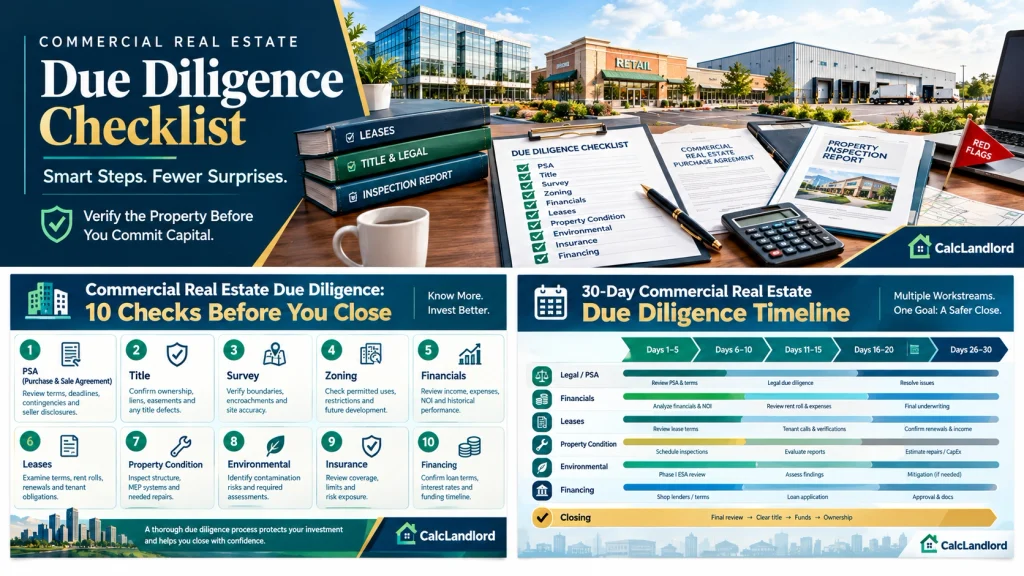
Commercial Real Estate Due Diligence Checklist Template
The easiest way to use this template is to put it into Excel, Google Sheets, Notion, Airtable, or your transaction-management system.
For every item, track:
| Column | What to Record |
| Category | Title, financial, lease, physical, environmental, etc. |
| Checklist Item | Exact document or review task |
| Requested | Date requested |
| Received | Date received |
| Reviewer | Attorney, CPA, engineer, lender, buyer, etc. |
| Status | Not requested, requested, received, under review, complete, exception |
| Finding | What the review actually discovered |
| Risk | Low, medium, high, deal-breaking |
| Financial Impact | Cost, income impact, reserve, or valuation effect |
| Action | Cure, renegotiate, test, insure, reserve, extend, etc. |
| Deadline | Date the issue must be resolved |
| Final Decision | Accept, accept with condition, renegotiate, terminate |
This turns a static checklist into a transaction-control system. Track documents, responsibility, deadlines, findings, risk, financial impact, and final decisions instead of simply marking documents as received.
Master CRE due diligence checklist
Transaction and legal
- Confirm buyer and seller legal entity names.
- Verify property address.
- Verify parcel identification numbers.
- Reconcile legal description with the purchase agreement.
- Confirm exactly what real and personal property is included.
- Confirm purchase price.
- Confirm earnest-money amount.
- Confirm financing and other contingencies.
- Confirm due diligence expiration date.
- Confirm termination notice requirements.
- Confirm earnest-money refund rights.
- Review seller representations and warranties.
- Review disclosure schedules.
- Review indemnification provisions.
- Confirm property-inspection rights.
- Confirm environmental-testing rights.
- Confirm survey access.
- Review assignment rights.
- Review casualty provisions.
- Review condemnation provisions.
- Review default remedies.
- Review closing conditions.
- Review required prorations.
Title and survey
- Obtain title commitment or preliminary title report.
- Confirm seller vesting.
- Reconcile title legal description with PSA.
- Identify mortgages and deeds of trust.
- Identify judgment liens.
- Identify tax liens.
- Review UCC filings where relevant.
- Review easements.
- Review access rights.
- Review utility easements.
- Review drainage and stormwater easements.
- Review reciprocal easement agreements.
- Review restrictive covenants.
- Review CC&Rs.
- Identify rights of first refusal and purchase options.
- Identify memoranda of lease.
- Identify title exceptions requiring removal or modification.
- Order or update the appropriate title survey.
- Identify encroachments.
- Confirm legal access to public roads.
- Map parking and loading areas.
- Compare improvements with title and survey documents.
For surveys commenced under the current standard, note that the 2026 ALTA/NSPS Land Title Survey standards became effective February 23, 2026, replacing the prior version. The survey scope and any optional Table A items should be agreed upon with the surveyor, title company, lender, and other relevant parties rather than assumed.
Zoning and regulatory
- Confirm zoning classification.
- Confirm current permitted use.
- Confirm intended future use.
- Determine whether the use is by right, conditional, nonconforming, or otherwise restricted.
- Obtain zoning verification or compliance documentation when appropriate.
- Review variances.
- Review special-use approvals.
- Review conditional-use approvals.
- Confirm parking requirements.
- Confirm actual parking supply.
- Review setbacks.
- Review lot coverage.
- Review height restrictions.
- Review density restrictions.
- Review floor-area-ratio requirements.
- Review signage restrictions.
- Review loading requirements.
- Review outdoor-storage restrictions.
- Verify certificate of occupancy.
- Review open permits.
- Review unresolved code violations.
- Review fire and life-safety compliance.
- Review ADA-related issues.
- Review elevator or specialized-use requirements where applicable.
- Investigate proposed rezoning or nearby public projects.
Financial
- Obtain current rent roll.
- Obtain historical rent rolls.
- Obtain trailing-12-month operating statement.
- Obtain year-to-date financials.
- Obtain historical operating statements.
- Obtain general ledger.
- Review bank statements or equivalent collection evidence where appropriate.
- Obtain accounts receivable aging.
- Review delinquency.
- Review bad-debt history.
- Review CAM reconciliations.
- Review property-tax bills.
- Review special assessments.
- Review tax appeals.
- Review utility bills.
- Review insurance invoices.
- Review management fees.
- Review vendor contracts.
- Review maintenance invoices.
- Review capital-expenditure history.
- Review current operating budget.
- Review capital budget.
- Normalize unusual income and expenses.
- Recalculate NOI.
- Stress-test the investment model.
Leases and tenants
- Obtain all executed leases.
- Obtain amendments.
- Obtain extensions and renewals.
- Obtain side letters.
- Obtain guaranties.
- Obtain assignments and assumptions.
- Prepare lease abstracts.
- Confirm base rent.
- Confirm rent escalations.
- Confirm free-rent periods.
- Confirm concessions.
- Confirm reimbursements.
- Confirm CAM terms.
- Confirm tax and insurance recoveries.
- Confirm maintenance obligations.
- Identify tenant-improvement obligations.
- Review renewal options.
- Review termination rights.
- Review kick-out clauses.
- Review co-tenancy provisions.
- Review exclusives.
- Review expansion rights.
- Review assignment provisions.
- Review sublease rights.
- Review security deposits.
- Review letters of credit.
- Obtain tenant estoppels.
- Obtain lender-required SNDAs.
- Review tenant payment history.
- Review material tenant disputes.
- Analyze tenant concentration.
Physical condition
- Inspect structure and foundation.
- Inspect roof.
- Review roof age and warranty.
- Inspect façade and building envelope.
- Inspect windows and doors.
- Review drainage and waterproofing.
- Inspect HVAC equipment.
- Review equipment age and service history.
- Inspect electrical systems.
- Review generators and backup systems.
- Inspect plumbing.
- Inspect sewer and stormwater systems.
- Inspect fire-suppression systems.
- Inspect elevators where applicable.
- Inspect loading docks.
- Inspect parking areas.
- Inspect sidewalks and curbs.
- Inspect lighting.
- Review accessibility.
- Review deferred maintenance.
- Identify near-term capital projects.
- Estimate remaining useful lives of major systems.
- Confirm warranties transfer to buyer.
Environmental
- Order Phase I ESA when appropriate.
- Review historical property uses.
- Review neighboring property uses.
- Identify recognized environmental conditions.
- Review controlled or historical environmental findings.
- Review prior Phase I reports.
- Review prior Phase II reports.
- Review underground-storage-tank records.
- Review tank closure documentation.
- Review soil or groundwater testing.
- Review hazardous-material records.
- Investigate asbestos, lead-based paint, mold, radon, PCBs, or other concerns as applicable.
- Review environmental notices.
- Review remediation obligations.
- Review environmental liens.
- Determine whether additional testing is warranted.
- Review environmental indemnities.
- Review available environmental insurance.
Insurance
- Obtain current property policy.
- Obtain declarations.
- Obtain endorsements.
- Obtain loss runs.
- Review claims history.
- Review deductibles.
- Review exclusions.
- Review sublimits.
- Obtain buyer-specific insurance quotes.
- Review replacement-cost assumptions.
- Review flood exposure.
- Review wind exposure.
- Review wildfire exposure.
- Review earthquake exposure where applicable.
- Review business-interruption coverage.
- Confirm lender insurance requirements.
- Model insurance cost in the operating forecast.
Financing and closing
- Review lender term sheet.
- Confirm LTV.
- Confirm DSCR requirement.
- Confirm interest-rate structure.
- Confirm amortization.
- Confirm maturity.
- Review recourse.
- Review prepayment terms.
- Review reserve requirements.
- Review appraisal requirements.
- Review lender third-party reports.
- Confirm borrower entity requirements.
- Confirm guarantor requirements.
- Review rate-lock requirements.
- Review refinancing risk.
- Review property-tax consequences.
- Review transfer taxes where applicable.
- Consult a tax adviser about depreciation and potential cost-segregation or exchange issues.
- Confirm closing statement.
- Reconcile rents and CAM.
- Reconcile deposits and prepaid amounts.
- Confirm service-contract assignments or terminations.
- Confirm warranty transfers.
- Confirm lien releases.
- Confirm payoff letters.
- Confirm deed and bill of sale.
- Confirm assignment and assumption documents.
- Confirm closing affidavits and certifications.
- Confirm insurance activation.
- Confirm utilities and management transition.
How to Use the Checklist
A checklist becomes valuable when every item has an owner and a consequence.
Do not create a spreadsheet where the only status options are “yes” and “no.” A document can be received and still contain a serious problem.
A better status system is:
Not Requested → Requested → Received → Under Review → Complete → Exception Found → Resolved
For each exception, answer five questions:
What did we find?
State the actual issue in plain English.
What evidence supports it?
Record the document, report, lease clause, invoice, inspection observation, or other evidence.
What does it cost?
Estimate repair costs, income impact, reserves, insurance increases, financing effects, or valuation changes.
Who owns the resolution?
Assign the buyer, seller, attorney, lender, engineer, property manager, or another responsible party.
What happens if it remains unresolved?
Determine whether to accept, cure, renegotiate, extend diligence, obtain additional protection, or terminate if the PSA permits it.
There are four practical responses to material diligence findings: accept the risk, require a seller cure, renegotiate economics or contract terms, or terminate where the agreement permits it.
Use a red-flag log
Your master checklist should be supported by a separate red-flag register.
| Issue | Evidence | Risk | Estimated Impact | Owner | Required Action | Deadline | Final Decision |
| Roof replacement | Roof report | High | $300,000 | Seller/Buyer | Price adjustment or reserve | Day 25 | Pending |
| Tax reassessment | Tax records | High | $70,000/year | Underwriting | Recalculate NOI | Day 20 | Pending |
| Lease rollover | Lease + tenant file | Medium/High | Variable | Leasing team | Renewal/rollover scenario | Day 25 | Pending |
The purpose is not to make every transaction risk-free. That is rarely possible.
The purpose is to make sure material risks are visible, quantified, assigned, and consciously accepted.
Purchase Agreement & Transaction Review
Before spending heavily on engineering, environmental, legal, and other third-party work, understand what the purchase and sale agreement actually allows.
The PSA controls important rights during the diligence period, including inspection access, termination rights, notice deadlines, deposits, seller obligations, representations, and closing conditions.
Purchase agreement checklist
Review:
- Buyer and seller legal names.
- Property address and parcel numbers.
- Legal description.
- Purchase price.
- Deposit requirements.
- Financing contingencies.
- Due-diligence period.
- Termination deadline.
- Termination notice procedure.
- Earnest-money refund provisions.
- Seller document-delivery requirements.
- Seller representations and warranties.
- Survival periods.
- Inspection rights.
- Environmental-testing rights.
- Access rights.
- Indemnification for inspection-related damage.
- Assignment provisions.
- Casualty provisions.
- Condemnation provisions.
- Seller-default remedies.
- Buyer-default remedies.
- Closing conditions.
- Rent and expense prorations.
PSA red flags
Pay particular attention when:
- The diligence period is short relative to the asset’s complexity.
- Essential seller documents can arrive after the diligence clock starts.
- Earnest money becomes nonrefundable before meaningful diligence is complete.
- The buyer’s termination rights are narrow.
- Environmental testing is restricted.
- Seller representations are heavily qualified.
- There is no practical mechanism for curing title defects.
- Tenant estoppels are not addressed.
- Closing conditions are vague.
One useful contractual principle is to clearly define the seller’s diligence deliverables and when the diligence period begins. The source material highlights the importance of avoiding a situation where the buyer’s review period is running while essential seller documents remain outstanding.
The exact language should be handled by transaction counsel.
Title, Survey & Legal Review
Title diligence asks a deceptively simple question:
A property can look excellent physically and financially while still having a title or access problem that affects financing, operations, expansion, or resale.
Title checklist
Review the title commitment or preliminary title materials for:
- Current vesting.
- Legal description.
- Mortgages.
- Deeds of trust.
- Judgment liens.
- Tax liens.
- Mechanic’s liens.
- UCC filings where relevant.
- Easements.
- Rights-of-way.
- Access rights.
- Utility rights.
- Drainage rights.
- Restrictive covenants.
- CC&Rs.
- Reciprocal easement agreements.
- Rights of first refusal.
- Purchase options.
- Development restrictions.
- Memoranda of lease.
- Recorded leases.
- Existing title endorsements.
- Required title cures.
Survey checklist
Compare the title documents with the appropriate current survey.
Look for:
- Boundary discrepancies.
- Encroachments.
- Building setbacks.
- Parking configuration.
- Drive aisles.
- Loading areas.
- Access points.
- Utilities.
- Easements.
- Rights-of-way.
- Building footprints.
- Fence lines.
- Improvements crossing property lines.
- Improvements located within easements.
The 2026 ALTA/NSPS standards now govern surveys performed under that version, effective February 23, 2026. ALTA states that the standards are designed to align the expectations of clients, surveyors, title insurers, and lenders around title-related survey matters.
Why this matters
Imagine buying an industrial building with excellent truck access.
During diligence, the survey reveals that a portion of the access route depends on an easement that does not provide the rights originally assumed.
That discovery could affect:
- Current operations.
- Tenant requirements.
- Financing.
- Future development.
- Property value.
- Resale.
The lesson is important:
Physical access and legally protected access are not necessarily the same thing.

Zoning, Permits & Regulatory Compliance
A property can be physically suitable for your plan but legally unsuitable for it.
Zoning diligence should therefore examine both the current use and the business plan after acquisition.
Zoning checklist
Verify:
- Zoning district.
- Current permitted use.
- Intended use.
- Conditional-use requirements.
- Nonconforming-use status.
- Variances.
- Special-use approvals.
- Parking requirements.
- Actual parking.
- Setbacks.
- Building height.
- Lot coverage.
- Density.
- Floor-area ratio.
- Signage.
- Loading.
- Truck circulation.
- Outdoor storage.
- Waste-handling requirements.
- Certificate of occupancy.
- Open building permits.
- Code violations.
- Fire/life-safety requirements.
- ADA-related obligations.
- Local development restrictions.
- Pending zoning changes.
A critical distinction: legal today vs. usable tomorrow
Suppose you are buying a warehouse and intend to add outdoor storage.
The existing warehouse may be fully legal.
That does not mean your proposed outdoor storage will automatically be permitted.
Similarly, a multifamily property may operate under an existing nonconforming status that cannot necessarily be expanded or reproduced after redevelopment.
Common zoning red flags
Watch for:
- Nonconforming uses.
- Missing certificates of occupancy.
- Deficient parking.
- Unresolved code violations.
- Unpermitted improvements.
- Required approvals with uncertain outcomes.
- Restrictions created by recorded covenants.
- Planned expansion that depends on unconfirmed entitlements.
Your diligence team should verify the local rules rather than relying on the seller’s statement that “the use has always been there.”
Financial Due Diligence & Underwriting
Financial diligence is where many attractive deals become very different deals.
The seller’s pro forma may show what the property could earn.
Your underwriting needs to determine what the property is likely to earn after realistic vacancy, expenses, capital needs, lease rollover, taxes, insurance, and other risks are considered.
Documents to request
At minimum, request and review:
- Current rent roll.
- Historical rent rolls.
- Trailing-12-month operating statement.
- Year-to-date financials.
- Historical income statements.
- General ledger.
- Bank or collection records where appropriate.
- Accounts receivable aging.
- Delinquency history.
- CAM reconciliations.
- Property-tax bills.
- Utility bills.
- Insurance invoices.
- Service contracts.
- Management agreements.
- Maintenance invoices.
- Capital-expenditure history.
- Current budget.
- Capital budget.
Reconcile rent rolls, leases, tenant collections, operating statements, tax records, utilities, CAM, insurance, and capital expenditures instead of relying on the seller’s headline NOI.
Reconcile revenue instead of accepting it.
For every meaningful tenant, compare:
Rent Roll → Executed Lease → Invoice/Billing → Collection History → Bank Deposits
You are looking for inconsistencies such as:
- Rent on the rent roll that is not supported by the lease.
- Concessions missing from the pro forma.
- Free rent that has not expired.
- Delinquent tenants counted as fully paying.
- Reimbursements that cannot actually be collected.
- Side agreements not reflected in the lease file.
- “Occupied” space generating little or no economic revenue.
Normalize NOI
A basic formula is:
NOI = Operating Revenue − Operating Expenses
But the buyer should distinguish between current in-place performance and a defensible stabilized forecast.
Stabilized NOI = Market-Supported Revenue − Normalized Operating Expenses
The important word is supported.
A stabilized forecast should have evidence behind its assumptions, such as:
- Comparable rents.
- Actual leasing activity.
- Historical occupancy.
- Known lease expirations.
- Market concessions.
- Realistic lease-up timing.
- Required capital.
- Reasonable operating costs.
Financial red flags
Be cautious when:
- Repairs are unusually low.
- Insurance is based on outdated pricing.
- Property taxes are likely to reset.
- Capital expenditures are missing.
- Expense reimbursements are aggressive.
- Collections do not reconcile.
- Vacancy is understated.
- Major leases expire soon.
- Market-rent assumptions are unsupported.
- Positive cash flow depends on ignoring replacement needs.
Example: how diligence changes value
Assume you are buying a 40,000-square-foot retail property for $8 million.
The seller reports annual NOI of $600,000.
At the asking price:
Cap Rate = $600,000 ÷ $8,000,000
= 7.50%
During diligence, you discover:
- Property taxes will increase by $70,000 annually.
- Insurance is $25,000 more expensive than the historical premium.
- The roof requires approximately $300,000 of near-term work.
- A tenant paying $90,000 annually has a lease expiring in 14 months.
Ignoring the tenant rollover temporarily, normalized NOI becomes:
$600,000 − $70,000 − $25,000
= $505,000
The normalized cap rate at the original price is:
$505,000 ÷ $8,000,000
= 6.31%
At a hypothetical 7.5% cap rate valuation:
$505,000 ÷ 0.075
= $6,733,333
That calculation does not establish the property’s exact market value.
It demonstrates something more important: diligence changed the investment case.
Depending on the transaction and the PSA, the buyer might consider a price adjustment, seller credit, repair completion, escrow holdback, additional reserves, revised financing, or a leasing strategy.
The same type of normalization exercise demonstrates how taxes, insurance, capital requirements, and lease rollover can materially change underwriting.
For acquisitions involving multiple financial assumptions, use a detailed investment or property-analysis calculator to test cap rate, NOI, cash flow, debt service, and downside scenarios rather than relying on a single spreadsheet output.
Lease & Tenant Due Diligence
In leased commercial real estate, the lease file can be as important as the building.
A buyer is purchasing an income stream supported by contracts. Those contracts determine how much revenue the property generates, who pays operating expenses, who handles repairs, what happens when tenants fail to perform, and how easily the property can be re-leased.
Lease checklist
Review every material lease for:
- Tenant name.
- Guarantor.
- Premises.
- Rentable area.
- Base rent.
- Escalations.
- Free rent.
- Abatements.
- Percentage rent where applicable.
- CAM obligations.
- Tax obligations.
- Insurance obligations.
- Utility obligations.
- Maintenance responsibilities.
- Repair responsibilities.
- Roof responsibilities.
- Structural responsibilities.
- HVAC responsibilities.
- Tenant-improvement obligations.
- Leasing commissions.
- Renewal options.
- Termination rights.
- Kick-out clauses.
- Co-tenancy provisions.
- Exclusives.
- Expansion rights.
- Rights of first refusal.
- Assignment rights.
- Sublease rights.
- Security deposits.
- Letters of credit.
- Guaranties.
- Default provisions.
Build a lease abstract.
A lease abstract lets you compare tenants consistently.
| Field | Why It Matters |
| Tenant | Identifies the contractual counterparty |
| Guarantor | Shows additional credit support |
| Suite/Area | Validates space and rent calculations |
| Base Rent | Establishes contractual revenue |
| Escalations | Shows future rent growth |
| Expiration | Measures rollover risk |
| Options | Helps forecast future occupancy |
| CAM Terms | Determines expense-recovery potential |
| Repairs | Identifies landlord capital exposure |
| Security Deposit/LOC | Measures default protection |
| Assignment/Sublease | Affects tenant flexibility |
| Co-Tenancy | Can affect income if triggered |
| Exclusives | Can restrict future leasing |
| Termination Rights | May create unexpected vacancy |
Lease abstraction, estoppels, SNDAs, guaranties, expense responsibilities, and tenant concentration are core acquisition-review items.
Tenant estoppel certificates
An estoppel certificate is a tenant-confirmed statement about material lease facts.
Depending on the form and transaction, it may address:
- Whether the lease is in effect.
- Current rent.
- Security deposits.
- Lease amendments.
- Defaults.
- Landlord defaults.
- Claims and offsets.
- Renewal options.
- Termination rights.
- Tenant improvements.
- Other material lease matters.
A clean rent roll is not proof of a clean lease file.
The strongest diligence process compares the seller’s records with the tenant’s confirmation.
Tenant concentration
A property with 20 tenants may look diversified.
But if one tenant produces 40% of revenue, it is not economically equivalent to a property with 20 similarly sized tenants.
Analyze concentration by:
- Revenue.
- Square footage.
- Industry.
- Lease expiration year.
- Credit quality.
- Geographic exposure.
A large tenant with an imminent expiration deserves different attention than a small tenant with a long remaining term.
Property Condition & Inspection
The physical inspection should answer more than “Does the building look good?”
It should help you estimate the capital required to own the asset through the planned holding period.
Inspect major building systems
Review:
- Structure and foundation.
- Roof.
- Exterior envelope.
- Façade.
- Windows and doors.
- Waterproofing.
- Drainage.
- HVAC.
- Electrical.
- Plumbing.
- Sewer.
- Fire protection.
- Elevators.
- Loading docks.
- Parking.
- Pavement.
- Sidewalks.
- Lighting.
- Landscaping.
- Accessibility.
- Security systems.
- Building automation systems.
For major equipment, record:
Age → Condition → Service History → Remaining Useful Life → Replacement Cost → Expected Timing
Don’t confuse deferred maintenance with capex
A property may report excellent NOI because the owner has delayed spending.
For example, suppose a property has:
- An old roof.
- Aging HVAC.
- Deteriorating pavement.
- Deferred exterior work.
The historical financial statements may still look strong.
But a new owner may immediately face substantial capital needs.
That means historical cash flow can overstate the economic return available to the buyer.
Property-condition red flags
Escalate findings such as:
- Roof near end of useful life.
- Major HVAC replacement.
- Elevator problems.
- Structural concerns.
- Recurring leaks.
- Water intrusion.
- Drainage problems.
- Fire/life-safety deficiencies.
- Electrical-capacity limitations.
- Significant deferred maintenance.
- Non-transferable warranties.
A property-condition assessment can help turn these observations into a more useful capital plan.
Environmental Due Diligence
Environmental diligence is designed to identify potential contamination, hazardous-material concerns, regulatory obligations, and possible liability before acquisition.
Phase I ESA
For many commercial acquisitions, a Phase I Environmental Site Assessment is an important starting point.
EPA’s All Appropriate Inquiries (AAI) framework recognizes ASTM E1527-21 as consistent with the federal AAI requirements for Phase I environmental site assessments. AAI is used in the context of evaluating environmental conditions and potential liability associated with contaminated property.
A typical Phase I review may consider:
- Historical property uses.
- Historical neighboring uses.
- Environmental databases.
- Site observations.
- Interviews.
- Existing environmental records.
- Recognized environmental conditions.
- Historical or controlled environmental findings.
- Data gaps.
When additional investigation may be needed
A Phase I may identify conditions that warrant additional investigation.
Potential next steps can include:
- Phase II investigation.
- Soil sampling.
- Groundwater testing.
- Vapor testing.
- Additional historical research.
- Regulatory consultation.
- Remediation planning.
Do not assume that ordering a Phase I automatically resolves every environmental question.
Environmental checklist
Review:
- Prior Phase I reports.
- Prior Phase II reports.
- UST records.
- Tank closures.
- Soil testing.
- Groundwater testing.
- Remediation records.
- Environmental liens.
- Government notices.
- Environmental indemnities.
- Hazardous-material records.
- Mold records where relevant.
- Asbestos information where relevant.
- Lead-related information where relevant.
- Radon information where relevant.
- Historical fueling or chemical use.
- Prior manufacturing.
- Dry-cleaning operations.
- Auto-repair activities.
- Waste-disposal activities.
Major environmental red flags
Examples include:
- Former gas-station use.
- Industrial operations.
- Dry-cleaning history.
- Underground storage tanks.
- Chemical storage.
- Prior contamination.
- Unresolved remediation.
- Adjacent contamination.
- Seller resistance to appropriate testing.
- Weak environmental indemnification.
Environmental diligence is highly fact-specific. A qualified environmental professional should determine the appropriate scope.
Insurance, Market & Investment Thesis
A property can pass title, lease, environmental, and physical review and still fail your investment model.
This is where market diligence and insurance diligence become important.
Insurance checklist
Review:
- Current policies.
- Declarations.
- Endorsements.
- Loss runs.
- Claims history.
- Deductibles.
- Exclusions.
- Sublimits.
- Replacement-cost assumptions.
- Flood coverage.
- Wind coverage.
- Earthquake coverage where relevant.
- Business-interruption coverage.
- Other location-specific risks.
- Buyer-specific quotes.
- Lender insurance requirements.
Do not simply carry forward the seller’s insurance expense.
The buyer should obtain pricing based on the buyer’s ownership, coverage requirements, asset condition, location, and intended use.
Insurance red flags
Watch for:
- Repeated water losses.
- Roof-related claims.
- Fire claims.
- Liability claims.
- Large deductibles.
- Major coverage exclusions.
- Rapidly increasing premiums.
- Coverage that does not match the property’s actual risks.
- Replacement-cost assumptions that appear inadequate.
Market diligence checklist
Study:
- Comparable sales.
- Comparable leases.
- Asking rents.
- Effective rents.
- Concessions.
- Vacancy.
- Absorption.
- New construction.
- Development pipeline.
- Tenant demand.
- Employment drivers.
- Traffic.
- Visibility.
- Access.
- Transit.
- Parking.
- Competing properties.
- Neighborhood changes.
- Infrastructure projects.
- Local zoning changes.
- Tenant-industry concentration.
Stress-test the investment thesis
Do not model only your base case.
Test downside assumptions such as:
- Lower effective rental income.
- Higher vacancy.
- Delayed renewals.
- Higher taxes.
- Higher insurance.
- Higher repairs.
- Higher replacement reserves.
- Larger capital projects.
- Higher exit cap rate.
- Higher refinancing costs.
- Lower loan proceeds.
- Loss of a major tenant.
Test scenarios such as lower rental income, higher expenses, higher taxes and insurance, larger capital requirements, a higher exit cap rate, refinancing pressure, and major-tenant loss.
The fundamental question is:
Does the property still work when reasonable assumptions become less favorable?
Financing, Tax, Entity & Closing
Financing diligence should run in parallel with property diligence.
A lender’s requirements can reveal risks that also matter to an all-cash buyer, including condition problems, environmental concerns, insurance limitations, zoning issues, appraisal gaps, and reserve requirements.
Financing checklist
Review:
- Loan-to-value.
- Debt-service coverage ratio.
- Interest rate.
- Rate type.
- Amortization.
- Maturity.
- Recourse.
- Prepayment penalties.
- Required reserves.
- Tax and insurance escrows.
- Tenant-improvement reserves.
- Leasing-commission reserves.
- Capital reserves.
- Appraisal requirements.
- Environmental requirements.
- PCA requirements.
- Survey requirements.
- Zoning requirements.
- Insurance requirements.
- Borrower entity requirements.
- Guarantor requirements.
- Rate-lock requirements.
- Refinancing risk.
Compare your underwriting with the lender’s.
If your model says the property produces strong debt coverage, but the lender’s underwriting produces a materially different result, investigate why.
Tax diligence
Review:
- Historical property-tax bills.
- Tax reassessment risk.
- Tax exemptions.
- Tax abatements.
- Appeals.
- Special assessments.
- Transfer-tax exposure.
- Personal-property tax exposure.
- Tax certifications.
- Potential exchange considerations.
Discuss depreciation, cost segregation, entity structure, and potential tax-deferred transactions with a qualified tax adviser.
FIRPTA
When the seller is a foreign person, the transaction may involve FIRPTA withholding.
The IRS states that foreign persons generally must withhold on dispositions of U.S. real property interests and that the buyer/transferee is generally the withholding agent. The general withholding rate is 15% of the amount realized, subject to applicable rules and exceptions.
Because FIRPTA is a tax matter with transaction-specific rules, do not treat a generic checklist as a substitute for professional tax and closing advice.
Closing checklist
Before closing:
- Confirm buyer entity formation.
- Confirm good standing.
- Confirm signing authority.
- Approve transaction resolutions.
- Review final title.
- Confirm title objections are resolved.
- Confirm lien releases.
- Confirm payoff letters.
- Confirm lender conditions.
- Confirm insurance.
- Confirm closing statement.
- Reconcile rent prorations.
- Reconcile CAM.
- Reconcile security deposits.
- Reconcile prepaid rent.
- Reconcile tenant credits.
- Confirm service-contract assignments.
- Confirm permit transfers where applicable.
- Confirm warranty transfers.
- Confirm keys and access credentials.
- Confirm plans and maintenance records.
- Confirm tenant notices.
- Confirm utility transfer.
- Confirm management transition.
- Confirm deed.
- Confirm bill of sale.
- Confirm assignment documents.
- Confirm estoppels.
- Confirm SNDAs where required.
- Confirm closing affidavits and certifications.
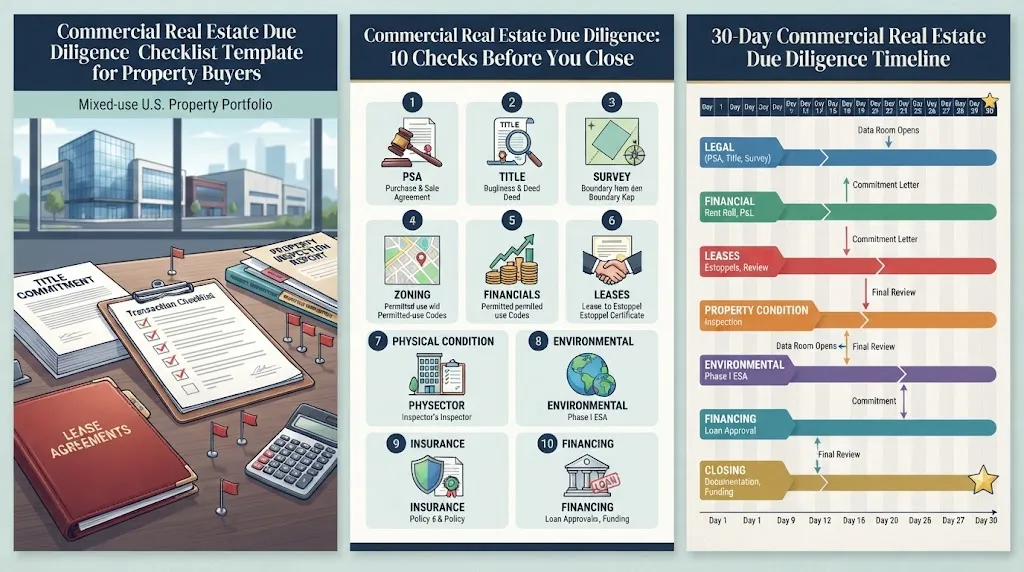
30-, 45-, and 60-Day Due Diligence Timeline
A 30-day diligence period can be workable for a relatively straightforward deal, but it may be inadequate for an older, environmentally sensitive, heavily leased, development-oriented, or otherwise complicated asset.
Run workstreams in parallel rather than waiting for one category to finish before ordering the next.
30-day timeline
| Period | Main Actions |
| Days 1–3 | Review PSA, establish data room, request documents, order title, survey, PCA, Phase I, zoning review, insurance quotes, and appraisal as needed.d |
| Days 4–7 | Review rent roll, T-12, leases, taxes, insurance, title, permits, and seller disclosures. |
| Days 8–14 | Site inspection, lease abstraction, financial reconciliation, property-manager interview, market review |
| Days 15–21 | Analyze third-party reports, quantify capex, environmental and zoning issues, update financing assumptions.ns |
| Days 22–25 | Obtain estoppels, resolve title objections, finalize underwriting and seller cure requests |
| Days 26–28 | Make proceed/renegotiate/extend/terminate decision and deliver required notices |
| Days 29–30 | Finish lender and closing requirements |
45-day timeline
A 45-day schedule provides more breathing room for:
- Complex lease abstraction.
- Multiple tenants.
- Third-party report revisions.
- Environmental follow-up.
- Municipal records.
- Lender review.
- Insurance underwriting.
- Seller responses.
- Revised financial modeling.
60-day timeline
A 60-day period can be more practical when the deal includes:
- Numerous tenants.
- Environmental concerns.
- Development or entitlement risk.
- Significant capital projects.
- Complicated title.
- Multiple properties.
- Extensive lender requirements.
- Specialized operating systems.
- Delayed seller documentation.
The PSA and transaction facts ultimately determine the correct diligence period, not a universal industry number.
CRE Due Diligence Red Flags by Asset Class
Not every property needs the same checklist.
Multifamily
Focus on:
- Unit inspections.
- Delinquency.
- Bad debt.
- Concessions.
- Renewal rates.
- Turnover costs.
- Utility billing.
- Local rent restrictions where applicable.
- Code compliance.
- Renovation assumptions.
- Deferred maintenance.
Retail
Focus on:
- Tenant sales.
- Anchor tenants.
- Co-tenancy clauses.
- Exclusives.
- CAM caps.
- Percentage rent.
- Parking.
- Visibility.
- Reciprocal easement agreements.
- Tenant concentration.
Office
Focus on:
- Lease rollover.
- Tenant-improvement allowances.
- Leasing commissions.
- Parking.
- HVAC requirements.
- Elevator systems.
- Sublease exposure.
- Flexible-work trends affecting demand.
- Large tenant concentration.
Industrial
Focus on:
- Truck access.
- Loading docks.
- Clear height.
- Power capacity.
- Outdoor storage.
- Rail access.
- Roof.
- Environmental history.
- Drainage.
- Site circulation.
Hospitality
Focus on:
- Franchise agreement.
- Brand standards.
- Management agreement.
- Occupancy.
- ADR and operating performance.
- FF&E.
- Capital reserves.
- Food and beverage operations.
- Applicable permits.
- Property-specific operating contracts.
Medical office
Focus on:
- Tenant credit.
- Specialty build-outs.
- Backup power.
- Accessibility.
- Parking.
- Licenses and regulatory requirements.
- Imaging or laboratory infrastructure.
- Specialized HVAC and electrical requirements.
Land and development
Focus on:
- Entitlements.
- Zoning.
- Utilities.
- Geotechnical conditions.
- Wetlands.
- Environmental constraints.
- Subdivision approvals.
- Construction costs.
- Impact fees.
- Infrastructure obligations.
- Development timing.
The appropriate diligence scope should follow the asset’s income model, physical characteristics, regulatory environment, and business plan rather than relying on a generic checklist.
More to Explore:https://calclandlord.com/commercial-real-estate-marketing-plan/
People Also Ask & Final Buyer Checklist
Commercial real estate due diligence is the buyer’s investigation of a property before closing. It typically includes title, legal, financial, lease, physical, environmental, zoning, insurance, market, financing, tax, and closing review.
Many transactions use a diligence period of roughly 30 to 60 days, but there is no universal period that fits every transaction. The appropriate timeline depends on asset complexity, tenant count, financing, environmental risk, third-party reports, document availability, seller cooperation, and the purchase agreement.
Typical seller materials include title documents, surveys, zoning information, leases, rent rolls, financial statements, tax records, environmental reports, permits, certificates of occupancy, insurance information, service contracts, warranties, litigation information, and other property-specific records.
For an income-producing property, one of the most useful checks is reconciling the rent roll, executed leases, collection history, bank or payment evidence, operating statements, and expense documentation. This helps determine whether reported NOI is actually recurring and sustainable.
An ALTA/NSPS Land Title Survey is a specialized land survey used in real estate transactions to document matters such as boundaries, improvements, easements, encroachments, access, and other survey-related title concerns. The current 2026 ALTA/NSPS standards became effective February 23, 2026.
Final buyer checklist before closing
Before waiving contingencies or closing, confirm that you have:
- Verified title, survey, legal access, and easements.
- Confirmed zoning and intended use.
- Reviewed permits and certificates of occupancy.
- Investigated code and regulatory issues.
- Reconciled rent roll and leases.
- Reviewed tenant collections and delinquency.
- Normalized revenue and expenses.
- Underwrote taxes and insurance realistically.
- Identified deferred maintenance.
- Priced major capital expenditures.
- Completed appropriate property-condition review.
- Completed appropriate environmental review.
- Reviewed insurance claims and coverage.
- Stress-tested occupancy and revenue.
- Stress-tested expenses.
- Stress-tested exit assumptions.
- Reviewed tenant rollover.
- Obtained required estoppels.
- Obtained required SNDAs.
- Confirmed lender conditions.
- Reviewed appraisal.
- Resolved material title issues.
- Confirmed tax and closing obligations.
- Resolved or consciously accepted every high-risk item.
- Made the final transaction decision before the applicable contractual deadline.
The end state is the same: material diligence findings should be resolved, documented, or incorporated into the transaction decision before contingencies expire.
Conclusion
A commercial real estate due diligence checklist template is most useful when it helps you connect documents to decisions.
A title exception should lead to a title decision.
A roof problem should lead to a capital estimate.
A weak lease should lead to a rollover scenario.
A tax reassessment should flow into NOI.
An insurance increase should flow into operating expenses.
An environmental concern should trigger the appropriate professional review.
A lender condition should flow into the financing model.
That is the real purpose of commercial real estate due diligence.
You are not trying to prove that a property has zero risk.
You are trying to determine which risks exist, what they are worth, who is responsible for resolving them, and whether the final deal still makes sense after the facts are known.
The strongest buyers therefore treat due diligence as an operating system for the acquisition—not as a pile of documents waiting for someone to check a box.

Pingback: Lender Due Diligence Checklist for Commercial Real Estate
Pingback: Industrial Property Due Diligence Checklist: 12 Key Checks
Pingback: Office Property Due Diligence Checklist: 25 Key Checks